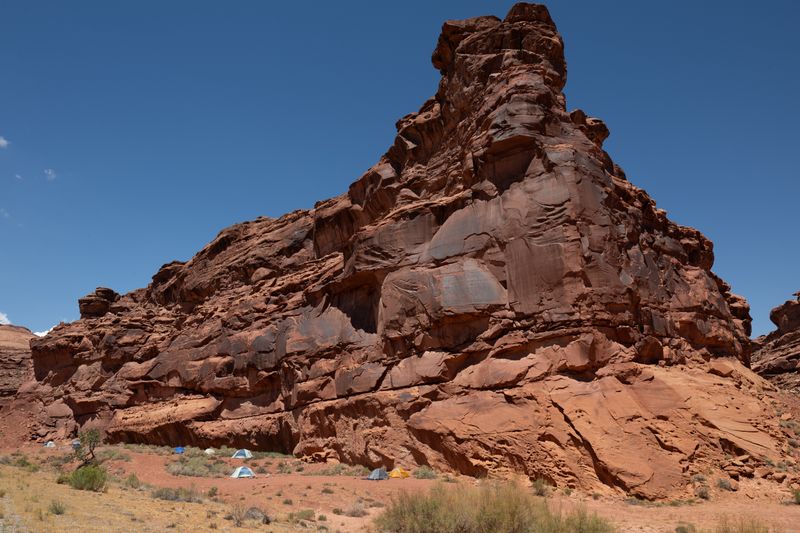
Can you camp anywhere on BLM land in Utah? Mostly yes. BLM Utah's own fact sheet allows free dispersed camping across its 22.8 million acres except where posted — no fee, no permit, no pass. The limits are the 14-day stay, previously disturbed ground off a designated route, 200 feet from water, and the posted exceptions, which cluster around Moab, where the popular corridors are campground-only. The Forest Service and Utah's trust-land agency (SITLA) each write their own version, and this page keeps the three apart.
Every rule number on this page is traced to an agency source in the Field Sources block at the bottom. Where the agencies disagree with each other, or with the folk version, we say so.
Can you camp anywhere on BLM land?
The short answer holds across 22.8 million acres, and the rest of this section is what it leaves out. The BLM's own dispersed-camping fact sheet puts it plainly: free dispersed camping is allowed throughout BLM Utah lands except where posted, with no fees, permits or passes. Camping is the default — allowed unless an area is closed or designated otherwise — which is the reverse of how Park Service land works.
The limits below are what "anywhere" means in practice. The biggest one is geographic: the closer you are to Moab, the more likely the ground you are looking at is campground-only.
BLM dispersed camping rules
Stay limit. BLM Utah's fact sheet sets a 14-day camping limit at any campsite. BLM's national guidance frames the same rule as 14 days within any 28-day period, after which you relocate — "often at least 25 to 30 miles." The Moab Field Office makes its version explicit: 14 days at a single location, then a new site at least 30 miles from the last one. Popular areas can post shorter limits, and the posted sign always wins. The rule exists to stop informal homesteading on public land.
Setbacks. Camp at least 200 feet (roughly 70 paces) from lakes, rivers, streams, springs and potholes — that is BLM's national guidance, and the Forest Service uses the same figure. BLM Utah adds a setback most people have never heard of: at least 300 feet from range improvements — corrals, gates, livestock water and pens. Interfering with a lawful range operation is a citable offense under 43 CFR 4140.1(b)(7). Don't camp in the vicinity of developed sites either — picnic areas, campgrounds and trailheads.
Roads and tracks. Travel only on designated routes. Then camp close to the route on ground that has already been camped on: BLM's guidance is to stay within about 150 feet of the designated route and never to create a new track. You will still see "200 feet from the road" repeated online. It is not in BLM Utah's fact sheet or in BLM's national camping guidance, and the guidance that does exist runs the other way — stay near the road, on disturbed ground, rather than pushing out into untouched desert.
Camping surface. Previously disturbed sites only. Do not trench, dig or level your site, and do not cut tree limbs to fit a tent or trailer. Stay off biological soil crust — the dark, lumpy ground cover that a single footprint kills (more under Leave No Trace below).
Fires. Check the current restriction order at utahfireinfo.gov before you go. Use an existing fire ring or a fire pan. Collect only dead and down wood statewide — and in the Moab Field Office, don't collect at all: no firewood gathering or cutting is allowed there, so buy it in town. Never leave a fire unattended, and drown and stir it before bed and before you leave.
Waste. Pack out all trash. For human waste BLM prefers a portable toilet or pack-out; where catholes are allowed, dig 6 to 8 inches deep at least 200 feet from water and trails. Around Moab the preference is a requirement: Grand County requires carry-out of solid human waste for all dispersed camping — a wag bag or a groover. Permitted river corridors carry their own toilet rules in the permit stipulations.
Fees and permits. None for dispersed camping on BLM Utah land, except where posted. The posted exceptions that matter: Grand Staircase-Escalante National Monument, where a free permit is required for every overnight stay; permitted river corridors; and developed campgrounds — $20 a night per vehicle at Sand Flats, $15 a night at Buckhorn Draw and Temple Mountain Townsite.
What's not allowed on BLM land
Public land isn't a free-for-all. The bigger violations to know:
- Cutting live vegetation — including limbs for firewood, shade, or to fit a trailer. Dead and down only, and none at all in the Moab Field Office.
- Disturbing archaeological sites — rock art, ruins, artifact scatters. A federal crime under ARPA, the Archaeological Resources Protection Act.
- Driving off designated routes, including cutting a new spur to a campsite. One tire pass across soil crust leaves a scar that outlasts you.
- Trenching, digging or leveling a site.
- Dumping gray water, sewage or trash — anywhere, including in catholes or fire rings.
Designated wilderness and wilderness study areas add their own rules — no motorized or mechanical travel in wilderness, camping limits in some units. Read the unit's page before you plan on it.
Where you cannot camp
Areas with active closures. The BLM closes ground temporarily for fire, seasonal wildlife protection, and rehabilitation. Closures are posted on field-office pages and sometimes at trailheads.
The Moab corridors. Because of visitation, the Moab Field Office has closed the popular ground near town to dispersed camping. Camp only in campgrounds along Highway 128, Highway 279 (Potash Road), Highway 313 and Kane Creek Road — Kane Creek alone has Kings Bottom, Moonflower, Hunter Canyon and the Ledge campgrounds. Camp only in designated backcountry sites — marked by a tent symbol on a brown post — around Gemini Bridges, Mill Canyon and Courthouse Rock, Black Ridge and Pack Creek. Sand Flats Recreation Area is 140 designated first-come sites plus six group sites at $20 a night per vehicle, run jointly by Grand County and the BLM. These are exceptions, not the rule — but they are the rule precisely where demand is highest.
Grand Staircase-Escalante. Free permits are required for all overnight stays in the monument, from a visitor center or a developed trailhead. That includes every pull-off along Hole-in-the-Rock Road and Cottonwood Canyon Road.
The rim at the Wedge. Camping along the rim of the San Rafael's Little Grand Canyon is not authorized; the designated sites sit before the rim.
Private land and state trust sections inside BLM areas. Utah ownership is a patchwork and signage is rare. Camping on private land without permission is trespass; state trust land has its own rules, covered below.
BLM vs NPS: why the rules feel so different
The difference matters when you're planning a trip that crosses jurisdictions.
BLM manages for multiple use. Dispersed camping is allowed anywhere on BLM land unless specifically prohibited, there are no designated sites on most of it, permits aren't required for most overnight stays, and fees are rare outside developed recreation areas.
NPS manages for resource protection. Camping on Park Service land is almost always at designated sites with an advance permit, group sizes are capped, and the regulations are more detailed and more strictly enforced.
Canyonlands and the surrounding BLM land illustrate the contrast. Inside the park boundary, backcountry camping requires a permit at a designated site. A mile outside the park on BLM land, you choose your own spot within the standard rules — except where Moab's corridor closures apply.
How to find BLM land in Utah
Land ownership in Utah is patchwork. Verify before you camp.
- Gaia GPS or onX — both apps carry land-ownership layers with high accuracy. Toggle the public-land layer and BLM shows as yellow. This is the practical field tool.
- BLM travel maps and OHV route designations — the official source for land status and route designations (open / closed / limited), published by field office. "Motor Vehicle Use Map" is the Forest Service's term for the same thing, not the BLM's.
- BLM's own map viewer — blm.gov/maps hosts the National Data map viewer and georeferenced PDF maps you can load into a phone app. More detailed than the consumer apps, less friendly in the field.
Field offices and who to ask
BLM Utah runs a state office and five districts, and the field offices inside them manage their ground semi-independently — rules for Moab differ from Price or Monticello. Each office publishes its own travel plan, permit requirements and current restrictions; Recreation.gov handles the reservations where a permit or campground booking exists.
- Canyon Country District (Moab) — the Moab Field Office (1.8 million acres: the Colorado Riverway from Dewey Bridge to Canyonlands, Kane Creek, Sand Flats) and the Monticello Field Office (about 1.8 million acres: the San Juan River, Cedar Mesa, Indian Creek).
- Green River District (Vernal) — the Price Field Office (the San Rafael Swell, the Green River through Desolation and Gray canyons, Nine Mile Canyon) and the Vernal Field Office.
- Paria River District (Kanab) — the Kanab Field Office (Paria Canyon, Coral Pink Sand Dunes). Grand Staircase-Escalante National Monument sits in the same country but is managed by its own monument staff with its own permit rules.
- Color Country District (Cedar City) and West Desert District (Salt Lake City) cover the southwest and the Great Basin side.
For remote or thinly documented ground, call the field office. Rangers can tell you exactly what applies.
USFS dispersed camping rules
Utah's national forests — Ashley, Uinta-Wasatch-Cache, Manti-La Sal, Fishlake and Dixie — hold the mountains and high plateaus around the canyon country. The Forest Service's Intermountain Region sets a baseline: campsites at least 200 feet from any stream or water source, catholes 6 to 8 inches deep and at least 200 feet from water, camp and trails, pack it in and pack it out, fires unless a restriction is in effect. Then it hands the stay limit to each forest — and the forests do not agree with each other, or with the BLM.
| Forest | Stay limit | After the limit | Setbacks and extras |
|---|---|---|---|
| Uinta-Wasatch-Cache | 14 days in any 30 consecutive days (Order 04-19-22-533, in force through August 2032) | Move to another area | Developed sites are 7 consecutive days on most districts |
| Manti-La Sal (the La Sals above Moab, the Abajos, Wasatch Plateau) | 14 days within any 28 consecutive days (Order 04-010-013) | Move at least 10 miles in a straight line; don't reuse the site for 14 days | Nothing left unattended more than 72 hours; vehicles no more than 150 feet off the road |
| Fishlake | 16 days, and no more than 16 in any 30-day period at one area | Move at least 5 road miles | 200 feet from water; camp within 150 feet of the road; at least 1 mile from developed campgrounds |
| Dixie | 16 days | Move at least 10 miles | 300 feet from water; 300 feet from livestock corrals May 1 – Nov 15; at least 1 mile from developed campgrounds; vehicles no more than 150 feet off designated routes |
| Ashley | Set by the forest — check the current order |
Wilderness areas inside the forests add their own rules — some restrict camping near lakes, some ask for a free trailhead registration. Read the forest's wilderness page for the unit you're entering.
Campfires: Forest Service restrictions follow the same order-by-order system as the BLM; current orders are posted at forest offices, trailheads and utahfireinfo.gov.
State trust land (SITLA) camping rules
SITLA manages about 3.3 million acres of surface estate in Utah — much of it scattered in one-square-mile sections through BLM country, the classic checkerboard. It is not federal public land; it is held in trust to earn money for schools. But SITLA's own recreation page is clearer than the folklore suggests.
Camping is allowed on most trust lands for up to 15 consecutive days. Anything longer requires a right-of-entry permit, and so does commercial use.
The rules: limit camping to existing campsites; pick a durable, non-vegetated surface at least 100 feet from water — note that is 100, not the BLM's 200; stay out of wet areas and fragile meadows; leave nothing unattended more than 72 hours; pack it in and pack it out, and bury human waste at least 8 inches deep and 200 feet from camp and water. If you must have a fire, use an existing ring with clean cord wood or charcoal and a way to put it out. Fireworks are always prohibited on trust lands.
Accurate land-status maps still matter here — a trust section looks exactly like the BLM ground on either side of it, and the rules just changed under your tires.
Fire Restrictions by Season
Fire restrictions are the most variable and most important rules to check before any Utah camping trip.
Summer (July–September): This is fire restriction season across most of Utah. The BLM and USFS typically have Stage 1 restrictions in place by early July and maintain them through September. Some years see Stage 2 restrictions during extreme conditions.
Stage 1 restrictions: The lighter tier. Most Stage 1 orders prohibit campfires, charcoal, and coal fires outside developed sites with agency-provided fire rings, allow gas and propane stoves, and confine smoking to vehicles, buildings, or a cleared area whose size the order sets. The exemptions are what vary — some river-corridor orders still allow a fire in an approved fire pan at designated camps. The order text is the definition, not this paragraph.
Stage 2 restrictions: The heavier tier. Stage 2 orders prohibit open fires outdoors and typically restrict other ignition sources; whether gas stoves stay legal depends on the order's exact language. Read the specific order for the unit you are camping in.
Spring and fall: Restrictions usually lift by October and are usually not in place before late spring, though a dry year can bring the first orders before June. Spring rains reduce fire risk significantly. This is when campfires are most reliably allowed.
Check: utahfireinfo.gov is the official source; its restrictions map links the signed order for each area. Check it within 48 hours of your trip — restrictions can change after a week of dry wind.
LNT in the Utah Desert
Leave No Trace principles apply everywhere, but the desert requires specific interpretations.
Desert soil is fragile and slow to recover. Biological soil crust (cryptobiotic soil) is a living skin of cyanobacteria, lichen and moss, and a single footprint can kill the crust beneath it. The Park Service's Southeast Utah biologists put recovery this way: under the best circumstances a thin veneer may return in five to seven years, mature crust can take 50 years to strengthen, lichens and mosses may take hundreds of years, and impacted areas may never fully recover. Camp on bare rock, sand, or already-disturbed surfaces. Never cross undisturbed crust.
Water sources are wildlife-critical. In canyon country, a pothole or spring may be the only water source for miles. Camp far from water sources not just because the rules say so, but because animals depend on access to that water during night hours.
Sound and light travel far in the desert. Generators, loud music, and bright lights are more intrusive in open desert than in forest. The desert amplifies everything.
"Pack it in, pack it out" means everything. Orange peels, apple cores, and food scraps do not decompose quickly in arid conditions. Bury nothing, leave nothing.
Popular Dispersed Camping Areas in Utah
Near Moab (BLM Moab Field Office): the close-in corridors are managed camping now. Highway 128, Potash Road (Highway 279), Highway 313 and Kane Creek Road are campground-only; Gemini Bridges, Mill Canyon and Black Ridge are designated-site only; Sand Flats is designated fee sites. For open dispersed ground, drive out: the BLM flats along Highway 191 south toward Monticello stay open under the standard rules, and Canyon Rims has the Hatch Point campground on the Needles Overlook road. Whatever you choose, Grand County requires a portable toilet or waste bag for all dispersed camping.
Near Green River / San Rafael Swell (BLM Price Field Office): the Swell has real dispersed camping on disturbed sites under the standard rules, no permit and no fee — but its landmarks are managed. Camping along the rim at the Wedge is not authorized; use the designated sites before the rim. Buckhorn Draw is a fee campground — 26 numbered sites at $15 a night plus group sites — spread along nine miles of road under the petroglyph panels. Temple Mountain Townsite is a $15 campground at the junction of Temple Mountain and Behind-the-Reef roads, the base for the old uranium roads beyond.
Near Escalante and Kanab (Grand Staircase-Escalante National Monument): free permits are required for all overnight stays in the monument, from the Escalante Interagency Visitor Center or a developed trailhead. With the permit in hand, Hole-in-the-Rock Road runs 62 miles one way from Escalante to the Hole itself, the last five or so inside Glen Canyon National Recreation Area, and Cottonwood Canyon Road is the same story on the monument's west side.
For Forest Service or state trust ground in any of these areas, the USFS and SITLA sections above apply. For permit-only corridors — the rivers, White Rim, Canyonlands — start with Backcountry Permits in Utah.