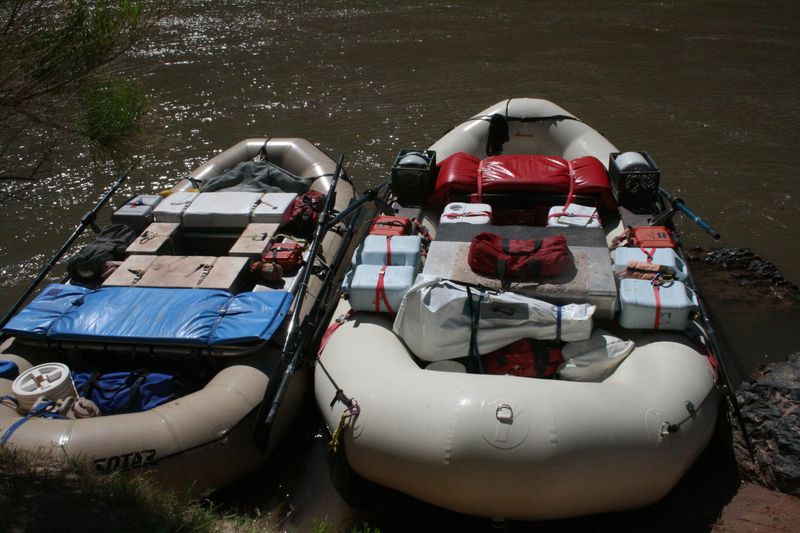
There's a version of your raft that rows effortlessly, carries everything you need, and doesn't lose a single item when you flip in a Class IV hole at mile 34. Building that version takes deliberate rigging. This is the complete guide — from frame setup to shade system — for a fully-rigged multi-day expedition oar raft.
Start with the Frame
Every rigging decision flows from the frame. Before you attach a single cam strap to a dry bag, the frame needs to be mounted, aligned, and tested.
Mount the frame on fully inflated tubes. Position the oar towers slightly aft of the raft's center point so the bow is slightly lighter than the stern — this makes the boat more maneuverable in eddies and less likely to bury the nose in a wave. Align the frame perpendicular to the centerline (measure from the bow to each oar mount; they should be identical). Strap every frame foot to raft D-rings using 2-inch cam straps. Push the frame hard in all four directions — it should not move.
Standard oar setup: 10-foot oars on a 14-foot raft, 10.5-foot on a 16-foot raft. Oar blades should feather slightly down. Set the oar gates so the oars release under severe load rather than using a death grip on a locked system — you want oars to pop free if a blade gets pinned underwater.
Rigging the Heavy Items First
Once the frame is solid, place your heaviest items before anything else. You cannot adjust weight distribution after the boat is loaded — plan first.
Cooler: Goes at the stern on the raft floor or on a cooler platform just behind the rower's seat. Two 2-inch cam straps in an X-pattern across the body, one strap across the lid. Attach all straps to raft D-rings, not the frame.
Kitchen box: Typically an ammo can or metal box. Sits on the frame deck, strapped with two 2-inch straps to tube D-rings. Position it on the side of the boat that balances the cooler weight. If the cooler is centered, put the kitchen box slightly off-center toward your lighter side.
Dry boxes: Pelican cases and similar rigid dry boxes for valuables, electronics, and maps go on the frame deck beside the kitchen box. Two straps each, attached to D-rings. Never stack heavy items — they shift and fall.
Stacking and Strapping Dry Bags
Large dry bags (65–115L) fill the frame deck around and on top of the rigid items. This is where most groups go wrong — bags piled randomly, inadequately strapped, or stacked too high.
The correct approach: fill your dry bags before you're at the river. A half-full dry bag is harder to strap securely and wastes space. Roll the top correctly — three tight rolls minimum, buckle closed. Then stack:
- First layer: large dry bags on the frame deck, lying flat, not standing up
- Second layer: medium bags (35–65L) on top of the first layer
- Small bags: fill gaps and go on top
Every bag gets at least one cam strap. Bags over 40 lbs get two. Route straps over the tops of bags, not through handles or around sides (handles aren't load-rated, sides let straps slip off). Connect straps to raft D-rings only.
Before stacking the second layer, sit in the rowing seat and check your sightline downstream. The top of your gear stack should be below your line of sight in the seated position. If you can't see the next 100 yards of river over your load, it's too high.
Safety Gear Placement
Safety gear has one rule: it must be reachable in 5 seconds without unstrapping anything.
Throw bag: Clip to the stern frame rail with a carabiner or strap it to the tube with a single strap. It should hang free, ready to grab and throw without unwrapping anything. Test it: close your eyes, reach back, grab the bag. If you can't do it immediately, move the bag.
First aid kit: On top of the gear stack in a marked dry bag, or in a dedicated frame pouch. Not under anything.
Flip line: A 20-foot section of 1-inch webbing, coiled, attached to the upstream side of the frame. Used to right a flipped raft.
River knife: On your PFD, not in a dry bag.
Rescue PFDs: One per person, worn — not stacked on the frame.
The Shade System
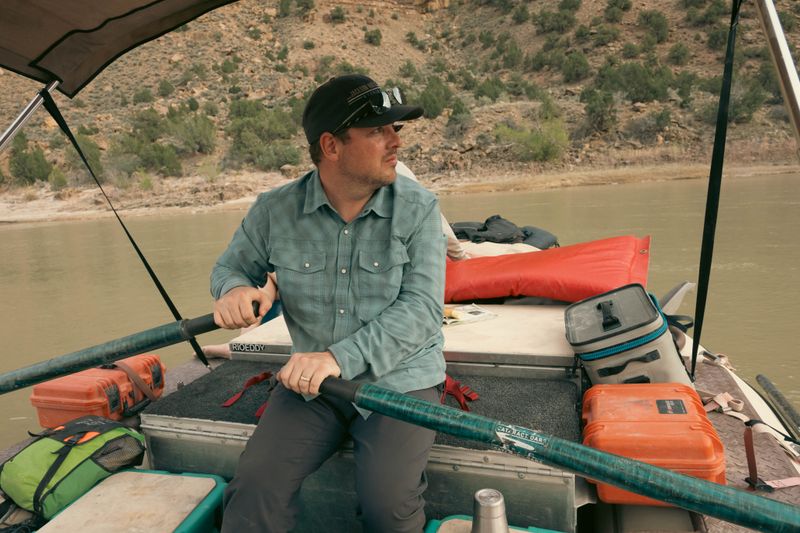
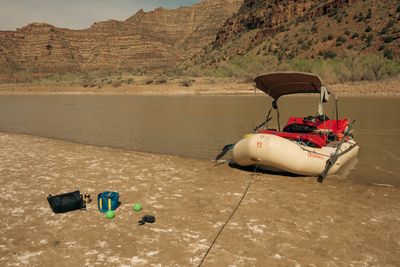
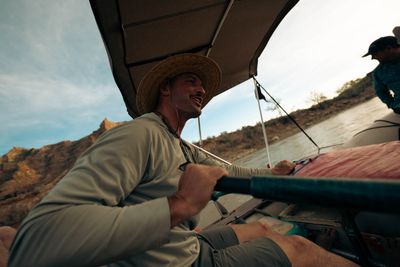
A shade tarp is not luxury — on Utah desert river trips in June through August, direct sun for 8 hours can produce heat exhaustion in paddlers who aren't actively moving. A shade system protects the rower and passengers.
The simplest system that works: a 5×7-foot silnylon tarp mounted on two poles that attach to the oar tower uprights. Angle the tarp toward the stern at about 30 degrees so the leading edge is forward and higher — this gives the rower sightlines downstream while shading passengers in back. Guy the tarp with two lines forward and two aft to raft D-rings.
More elaborate systems use a fabric frame cover that spans the entire raft. These are fantastic in camp but create windage problems on moving water and require unrigging for technical rapids. The simple tarp-and-pole system can stay up through Class III water without issue.
The Shade System
A shade tarp is not luxury — on Utah desert river trips in June through August, direct sun for 8 hours can produce heat exhaustion in paddlers who aren't actively moving. A shade system protects the rower and passengers.
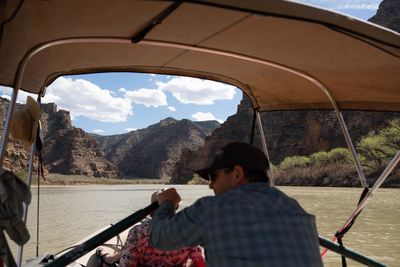
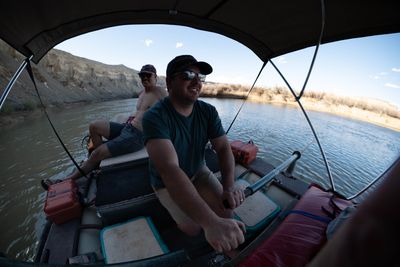
More elaborate systems use a fabric frame cover that spans the entire raft. These are fantastic in camp but create windage problems on moving water and require unrigging for technical rapids. The simple tarp-and-pole system can stay up through Class III water without issue.
Prioritizing Access vs. Security
These two goals are in permanent tension. Tighter rigging is more secure. More accessible rigging is easier to live with. The resolution is a tiered system.
Top tier (daily access): Lunch, snacks, sunscreen, water filter, camera. These live in a small dry bag strapped on top of the load with a single easy-release strap, or in a mesh bag clipped to the frame. You should be able to grab them without stopping the boat.
Middle tier (camp access): Tent, sleeping bag, pad, camp clothing. These come off the boat at every camp. They can be strapped more securely — two straps, nested under other bags — because you have time to unload deliberately.
Bottom tier (trip access): Spare parts, emergency gear, backup food, camp stove fuel. These can be buried under everything else and accessed infrequently. Wrap them tight, label the bags, and accept that access takes 10 minutes.
Do a full gear inventory before your first launch and assign every item to a tier. Loading at the put-in goes fast when you know exactly where everything lives.