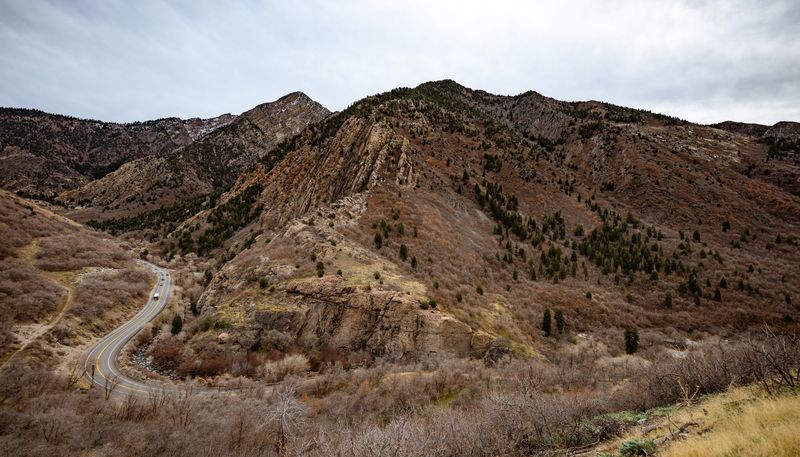
Big Cottonwood Canyon
Fifteen miles of Wasatch canyon — V-shaped below, glacier-carved above — exposing billion-year-old quartzite and a Snowball Earth tillite, with Brighton and Solitude skiing at its head and a no-dogs watershed throughout.
Also known as: BCC, Big Cottonwood
Salt Lake Valley · Central Wasatch
- Length
- 15 mi
- Relief
- 3,550 ft
- Elevation
- 5,200 → 8,750 ft
- Gradient
- 250 ft/mi
- Valley
- mixed (V-shaped lower, U-shaped above Reynolds Flat at mile 9)
- Drainage
- Big Cottonwood Creek
Overview
Big Cottonwood Canyon is a roughly fifteen-mile canyon cut into the west slope of the central Wasatch Range, about twelve miles southeast of downtown Salt Lake City between Mill Creek and Little Cottonwood. It is a textbook study in canyon-cutting: stream-carved and V-shaped in its lower reach, then abruptly broad and U-shaped above Reynolds Flat (mile 9), where the Pleistocene valley glacier reached its terminus. Its walls expose one of the oldest and most complete rock columns on the Wasatch Front — the roughly one-billion-year-old Big Cottonwood Formation quartzite, ripple-marked with some of the world's oldest documented tidal rhythmites, capped by the Mineral Fork Tillite, a Cryogenian 'Snowball Earth' glacial deposit named for one of the canyon's own forks. Two resorts sit at its head — Brighton, Utah's first ski area (1936), and Solitude (1957) — above a chain of glacial-cirque lakes and the marquee Lake Blanche, Donut Falls, and Brighton Lakes hikes. The entire canyon is Salt Lake City's protected drinking-water watershed, which makes the defining rule simple and strict: no dogs anywhere, and no swimming or wading.
Tributaries & side-drainages
| Name | Side | Notes |
|---|---|---|
| Mill A Basin (Mill A Gulch) | north | North-side drainage in the lower-middle canyon; its upper reaches connect toward Mount Olympus and the Mill B North trail. Lettered for one of the 1850s pioneer sawmills. |
| Mill B South Fork (Lake Blanche Fork) | south | South-side glacial drainage holding Lakes Blanche, Florence, and Lillian beneath Sundial Peak. Glacial striations and polished bedrock are preserved near Lake Blanche. Trailhead at the S-curve, ~4.4 mi up canyon. The companion Mill B North Fork climbs the north wall toward Mount Raymond. |
| Mineral Fork | south | South-side mining basin, ~6.1 mi up canyon, behind a usually-locked gate. Type locality of the Mineral Fork Tillite. Old Wasatch Mine workings; now the Mineral Fork Trail (9.9 mi RT, ~3,480 ft gain). |
| Mill D South Fork (Cardiff Fork) | south | South-side drainage carrying the Donut Falls and Cardiff Fork trails. Its tributary glacier left a terminal moraine at Reynolds Flat (mile 9), the V-to-U pivot. Cardiff Mine was the district's largest ore body. A USFS fee trailhead since December 2024. |
| Mill D North Fork | north | North-side ridge drainage, ~9.6 mi up canyon opposite Cardiff Fork. The long route to Desolation Lake and the Big Cottonwood 'Dog Lake' on the divide with Mill Creek Canyon; also the descent leg of the Wasatch Crest mountain-bike shuttle. A USFS fee trailhead (Doughnut Falls / Mill D). |
| Butler Fork | north | North-side trail drainage climbing to the BCC Dog Lake and the Mount Raymond / Gobblers Knob ridge. |
| Days Fork | south | South-side drainage up-canyon from Cardiff Fork, accessed from the Spruces area. Classic but avalanche-prone ski touring; a notable terrain-trap gully below Days Draw avalanches frequently. |
| Silver Fork | south | South-side high basin near the head of the canyon, historically the Silver Fork mining community and a tent city of as many as ~2,500 at its 19th-century peak. Moderate ski-touring terrain laced with old mine workings. |
Named lakes & reservoirs
-
Lake Blanche
Elevation: 8,920 ft
Type: tarn
Drainage: Mill B South Fork
Glacial tarn below Sundial Peak; the canyon's premier hike. Glacial striations and polished bedrock preserved nearby. Watershed rules — no swimming, no dogs.
-
Lake Florence
Elevation: 8,900 ft
Type: tarn
Drainage: Mill B South Fork
Paired with Blanche and Lillian, just below Lake Blanche. Elevation approximate.
-
Lake Lillian
Elevation: 8,900 ft
Type: tarn
Drainage: Mill B South Fork
Lowest of the Blanche/Florence/Lillian trio. Elevation approximate.
-
Lake Mary
Elevation: 9,050 ft
Type: reservoir
Drainage: Brighton basin
Dammed glacial tarn on the Brighton Lakes trail (2.3 mi RT, ~780 ft gain). Elevation approximate within the route's 8,764–9,548 ft range.
-
Lake Martha
Elevation: 9,300 ft
Type: tarn
Drainage: Brighton basin
Above Lake Mary on the Brighton Lakes chain. Elevation approximate.
-
Lake Catherine
Elevation: 9,950 ft
Type: tarn
Drainage: Brighton basin
Highest of the Brighton chain, below Catherine Pass / Sunset Peak; named for Catherine Brighton. Elevation approximate.
-
Twin Lakes (Reservoir)
Elevation: 9,450 ft
Type: reservoir
Drainage: Brighton basin
Dammed glacial basin above Brighton, ~2.5 mi RT (~700 ft gain). Managed for Bonneville cutthroat. Elevation approximate.
-
Silver Lake
Elevation: 8,740 ft
Type: tarn
Drainage: Brighton / Solitude basin
Valley-floor lake at the canyon head with a boardwalk interpretive loop (Silver Lake Interpretive Center). Top moose-viewing and shore-fishing spot. Originally called Dog Lake; renamed by Catherine Brighton.
-
Lake Solitude
Elevation: 8,700 ft
Type: tarn
Drainage: Solitude base area
Small lake at the Solitude resort base. Elevation approximate.
-
Dog Lake (Big Cottonwood)
Elevation: 8,725 ft
Type: tarn
Drainage: Mill D North / Butler Fork divide
Forested tarn on the divide with Mill Creek Canyon. Despite the name, dogs are BANNED here — this is the watershed Dog Lake, NOT the dog-friendly Dog Lake in Mill Creek Canyon. Elevation approximate.
-
Desolation Lake
Elevation: 9,200 ft
Type: tarn
Drainage: Mill D North Fork
Large glacial-basin lake on the Wasatch Crest, 8.2 mi RT (~1,988 ft gain). A popular trail-running and mountain-bike connector. Elevation approximate; sources range from ~9,200 ft to nearly 10,000 ft — verify before publishing a precise figure.
-
Willow Lake (Willow Heights)
Elevation: 7,300 ft
Type: tarn
Drainage: lower-middle canyon, near Silver Fork
Small forest lake reached by the Willow Heights trail (2.4 mi RT, ~620 ft gain). Elevation approximate — verify before publishing.
Activities
Skiing
Two resorts sit at the canyon head, both on the Ikon Pass and both famous for deep, dry Wasatch snow. Brighton — Utah's first ski area, opened with a rope tow in 1936 — is known for night skiing and a strong learn-to-ride culture and takes both skiers and snowboarders. Solitude, founded in 1957 on reused silver-mining ground, offers steeper expert terrain in Honeycomb Canyon.
- averageAnnualSnowfallInches
- 500
- brightonSkiableAcres
- 1050
- brightonVerticalFeet
- 1745
- solitudeSkiableAcres
- 1200
- solitudeVerticalFeet
- 2494
- passes
- Ikon (both resorts)
Areas: Brighton (Great Western, Crest, Millicent); Solitude (Apex, Summit, Honeycomb Canyon)
- Brighton
- Solitude Mountain Resort
Season: Late November → mid-April
Regs: Approved snow tires / traction devices required canyon-wide October 1 – April 30; SR-190 closes for avalanche control after storms. Both resorts now run paid + reservation parking.
Brighton: ~1,050 acres, 1,745 ft vertical (base ~8,755 → summit ~10,499 ft), ~66 runs, renowned night skiing. Solitude: 1,200 acres, 2,494 ft vertical (base ~7,994 → summit ~10,488 ft), ~82 runs, with the advanced Honeycomb Canyon. Solitude's official figure is 500 inches of average snowfall — prefer it over the ~387-inch aggregator number. Ikon day allotments change yearly; verify for the current season. Brighton likewise advertises a 500-inch-plus average; the 2022–23 season blew past it, hitting 700 inches on March 20–21, 2023 — the earliest any Utah resort had reached the '700 club' since snowfall tracking began in 1943.
Hiking
Ten marquee day hikes span the canyon from the family-favorite Donut Falls and the boardwalk loop at Silver Lake to the strenuous Lake Blanche tarn beneath Sundial Peak and the long Mineral Fork mining climb. Watershed rules are strict and shape every outing: no dogs anywhere — including the BCC 'Dog Lake' — and no swimming or wading in any lake or stream.
- marqueeHikeCount
- 10
- easiestHike
- Silver Lake (Brighton) Loop — 0.9 mi RT, ~55 ft gain, boardwalk
- hardestHike
- Mineral Fork Trail — 9.9 mi RT, ~3,480 ft gain
- Donut Falls — 3 mi RT
- Lake Blanche — 6.8 mi RT
- Mineral Fork Trail — 9.9 mi RT
- Broads Fork — 4.8 mi RT
- Willow Heights (Willow Lake) — 2.4 mi RT
- Desolation Lake — 8.2 mi RT
- Dog Lake (Big Cottonwood Canyon) — 5.5 mi RT
- Silver Lake (Brighton) Loop — 0.9 mi RT
- Lake Mary — 2.3 mi RT
- Twin Lakes (Brighton) — 2.5 mi RT
Season: Late May–October for the lower canyon; July–September for high elevations
Regs: No dogs anywhere in the watershed. No swimming or wading in any lake or stream. USFS day-use parking fees apply at the Cardiff Fork (Mill D South) and Doughnut Falls (Mill D) trailheads.
Order runs roughly easy-to-hard / family-to-strenuous: Donut Falls (family waterfall), Lake Blanche (premier tarn hike beneath Sundial Peak), Mineral Fork Trail (9.9 mi RT, ~3,480 ft, strenuous), Broads Fork (4.8 mi RT, ~2,100 ft, strenuous), Willow Heights / Willow Lake (2.4 mi RT, ~620 ft), Desolation Lake (8.2 mi RT, ~1,988 ft), Dog Lake (5.5 mi RT, ~1,469 ft — dogs banned despite the name), Silver Lake boardwalk loop (0.9 mi RT, ~55 ft), Lake Mary (2.3 mi RT, ~780 ft), and Twin Lakes (2.5 mi RT, ~700 ft).
Mountain Biking
The canyon's flagship ride is the legendary high-alpine Wasatch Crest Trail — a point-to-point shuttle along the exposed ridgeline at 9,000–10,000 ft. The classic version runs ~13 miles over the Spine above Desolation Lake; the Big-Cottonwood-finish variant descends Mill D North Fork back into the canyon.
- flagshipRide
- Wasatch Crest Trail
- classicLengthMiles
- 13
- bccFinishVariant
- ~10 mi via Mill D North Fork; ~662 ft climb to ~9,888 ft, then ~3,100 ft descent
- style
- point-to-point shuttle
Areas: Wasatch Crest Trail; The Spine; Scott's Pass / Scott's Bypass; Mill D North Fork descent; Desolation Lake
- Wasatch Crest Trail — 13 mi
Season: July–October (upper crest melts out late; verify upper-section timing)
The crest is most often shuttled from the Guardsman Pass area to the Big Water trailhead in Mill Creek Canyon, or finished down Mill D North Fork into Big Cottonwood. Mill Creek's alternating-day bike rule and seasonal upper-Crest closures change — verify before riding. Features include 'The Spine,' Scott's Bypass, and the notorious 'Puke Hill' punch climb.
Climbing
Big Cottonwood climbs on hard, polished quartzite — slippery and technical — and notably offers more sport routes than granite-trad Little Cottonwood next door. Storm Mountain in the lower canyon holds steep moderate multipitch trad; the S-Curves offer overhanging, mostly bolted sport lines.
- rockType
- Quartzite (Big Cottonwood Formation)
- style
- Mixed sport and trad; more sport than Little Cottonwood
- signatureRoutes
- Italian Arete (5.6), Thieving Magpie (5.7), Entre Nous (5.8+), Roll the Bones (5.6)
Areas: Storm Mountain / Storm Mountain Island; S-Curve crags; The Salt Lake Slips; Dead Snag
Season: Spring–fall; shaded walls climb earlier into summer
Regs: USFS day-use parking fees may apply at lower-canyon trailheads. No dogs anywhere in the watershed.
Storm Mountain Island rises from the Storm Mountain Picnic Area (~2.8 mi up canyon) with steep moderate trad on the 'Dead Snag' wall. The S-Curve crags, at the obvious S-bend ~4.25 mi up, are very overhanging, hard quartzite with mostly bolted lines across four crags.
Cycling
The SR-190 climb is a signature Wasatch road ride — about 14 miles and ~3,810 ft of gain from the Wasatch Boulevard stoplight at the canyon mouth to the Brighton store, averaging roughly 5%. Extending over Guardsman Pass turns it into one of Utah's hardest climbs, an HC-rated effort gaining ~5,500 ft.
- lengthMilesToBrighton
- 14
- elevationGainFeetToBrighton
- 3810
- averageGradientPercent
- 5
- guardsmanExtension
- ~17 mi total, ~5,521 ft gain, ~5.4% avg to ~9,700 ft (HC-rated)
- topElevationFeetBrighton
- 8770
Areas: Big Cottonwood Canyon Scenic Byway (SR-190); Guardsman Pass Road extension
Season: Late May–October (Guardsman Pass closed in winter)
Pairs with the Little Cottonwood climb to the south as a two-canyon Wasatch double. The Guardsman Pass extension turns onto Guardsman Pass Road at ~13.8 mi and climbs another ~3.1 mi / ~1,100 ft to the ~9,700-ft pass.
Fishing
Big Cottonwood Creek holds brown trout (dominant), rainbow trout, and stocked Bonneville cutthroat (notably in the Cardiff Flat reach), generally with bigger rewards and deeper pools than Little Cottonwood's creek. Silver Lake at Brighton is the most accessible stocked lake in the Cottonwoods; Twin Lakes is managed for Bonneville cutthroat.
- species
- brown trout, rainbow trout, Bonneville cutthroat trout, brook trout
Regs: Utah fishing license required. No wading or swimming under watershed rules — fish from shore. The narrow watershed exception allows wading only while fishing and wearing waders.
Silver Lake (Brighton) is stocked with brook and rainbow trout and has boardwalk shore access and prime moose-viewing. Stocking species and schedules change year to year — verify on Utah DWR each season.
Winterbackcountry
Big Cottonwood holds classic Wasatch ski tours laced with terrain traps and old mine workings — always check the Utah Avalanche Center forecast. Days Fork and Silver Fork offer long, varied terrain but significant hazard; Mill D North Fork is lower-angle and a common higher-hazard-day choice.
- marqueeZones
- 4
- seasonalWindow
- December–April, avalanche danger peaking December–February
Areas: Days Fork; Silver Fork; Mill D North Fork; Guardsman Pass / Scott's Pass; Honeycomb
Season: December–April
Regs: SR-190 traction law (Oct 1–Apr 30) and avalanche-control road closures apply to backcountry access too. Check the Utah Avalanche Center forecast daily.
Days Fork's terrain-trap gully below Days Draw avalanches frequently. Silver Fork feels relatively moderate but is exposed to significant hazard and has been the site of fatal avalanches. The Silver Fork / Honeycomb mining district adds dozens of old adits as hidden hazards. Mill D North Fork doubles as the descent leg of the summer Wasatch Crest mountain-bike shuttle.
Peaks
Hikes
| Hike | Distance | Gain | Difficulty | Season |
|---|---|---|---|---|
| Donut Falls | 3 mi RT | 530 ft | easy | — |
| Lake Blanche | 6.8 mi RT | 2,700 ft | moderate | — |
| Mineral Fork Trail | 9.9 mi RT | 3,480 ft | strenuous | — |
| Broads Fork | 4.8 mi RT | 2,100 ft | strenuous | — |
| Willow Heights (Willow Lake) | 2.4 mi RT | 620 ft | moderate | — |
| Desolation Lake | 8.2 mi RT | 1,988 ft | moderate | — |
| Dog Lake (Big Cottonwood Canyon) | 5.5 mi RT | 1,469 ft | moderate | — |
| Silver Lake (Brighton) Loop | 0.9 mi RT | 55 ft | easy | — |
| Lake Mary | 2.3 mi RT | 780 ft | moderate | — |
| Twin Lakes (Brighton) | 2.5 mi RT | 700 ft | moderate | — |
| Hidden Falls | 0.25 mi RT | 53 ft | easy | — |
| Gobblers Knob & Mount Raymond (Butler Fork) | 8 mi RT | 3,133 ft | strenuous | — |
| Beartrap Fork | 4.4 mi RT | 2,240 ft | strenuous | — |
Ski resorts
Geology
Big Cottonwood Canyon exposes one of the oldest and most complete rock columns on the Wasatch Front — roughly a billion years of history. The dominant bedrock is the Neoproterozoic Big Cottonwood Formation, a quartzite/shale section among the oldest rocks in Utah, famous for ripple marks and some of the world's oldest documented tidal rhythmites. Capping it is the Mineral Fork Tillite, a Cryogenian 'Snowball Earth' glacial deposit named for one of the canyon's forks, with striated clasts and polished surfaces. Paleozoic carbonates host the mining district, Cretaceous dikes cut the section near mid-canyon, and a ~35 Ma granodiorite pluton forms the peaks around Brighton. In the Pleistocene a valley glacier reached only Reynolds Flat (mile 9), the abrupt V-to-U transition, leaving cirque tarns, moraines, and erratics in the upper basin. The active Wasatch fault zone crosses the canyon mouth — the same family of scarps where G.K. Gilbert first read fresh fault breaks as the record of prehistoric earthquakes in the 1880s, founding a field, though his most iconic exposures and the view park that carries his name sit a mile south at Little Cottonwood.
Bedrock
- Lower and middle canyon: Big Cottonwood Formation — quartzite interbedded with red, green, and purple shale/argillite/slate (Neoproterozoic (~0.85–1.0 Ga; ~1 billion years)) — The dominant bedrock; among the oldest exposed rocks in Utah, estimated locally up to ~16,000 ft thick. Ripple-marked, cross-bedded, and mud-cracked from a shallow tidal/marginal-marine setting. Hosts one of the best-documented and oldest known records of tidal rhythmites, whose laminae record an ancient Earth of ~18-hour days and ~481 days per year. Well displayed at Storm Mountain in the lower canyon. Unconformably overlies the older Little Willow Formation.
- Mid-canyon caps (above the Big Cottonwood Formation): Mineral Fork Tillite — boulders, cobbles, and pebbles of quartzite, dolomite, limestone, and granitic rock in a black/sandy mud matrix, with varved slate (Cryogenian (~750–650 Ma)) — Named for Mineral Fork of Big Cottonwood Creek, its type locality; up to ~3,000 ft thick locally. Clasts are glacially striated and underlying surfaces polished — a continental/glaciomarine 'Snowball Earth' glacial deposit, one of Utah's most famous records of ancient ice. Age constrained by the fossil Bavlinella faveolata. Older literature labels it 'Eocambrian.'
- Upper-middle canyon: Paleozoic sandstone/quartzite, shale, and limestone (thick carbonates) (Paleozoic (~600–250 Ma)) — Successive ancient seas left the carbonates that host the historic Big Cottonwood mining district.
- Mid-canyon road cut (~mile 7.3–8.3): Red- to dark-colored dikes and sills (Cretaceous (~70 Ma)) — Intrusions cutting the older section, visible from the canyon road.
- Head of canyon (Brighton basin): Granodiorite (Clayton Peak / Little Cottonwood–related intrusion) (Tertiary (~35 Ma)) — A large granitic pluton cooled to granodiorite, forming the resistant peaks around Brighton at the head of the canyon.
Glacial history
-
Big Cottonwood valley glacier
Max elevation: 7,000 ft
The main valley glacier advanced only ~5 miles down-canyon — markedly shorter than Little Cottonwood's, because BCC's orientation and lower walls trapped less snow. Its terminus is recorded at Reynolds Flat (mile 9), the V-to-U transition. The upper canyon lay buried under an estimated 500–800 ft of ice.
-
Cardiff Fork (Mill D South) tributary glacier
Left its terminal moraine at Reynolds Flat (mile 9).
-
Brighton-basin cirque glaciation
Carved the Brighton amphitheater and the chain of cirque tarns (Mary–Martha–Catherine, Twin Lakes, Silver Lake, Lake Solitude). A lateral moraine ~280 ft high — an aspen-covered ridge — runs along the northeast side below Brighton for ~1 mile. White granitic glacial erratics are scattered through the upper canyon.
-
Lake Blanche cirque
Glacially scoured basin beneath Sundial Peak with striations and polished bedrock preserved nearby.
Notable formations
- Big Cottonwood Formation tidal rhythmites — laminae recording ~18-hour days and ~481-day years (best displayed near Storm Mountain)
- Mineral Fork Tillite type locality — striated clasts and polished surfaces of a Cryogenian 'Snowball Earth' glaciation
- Reynolds Flat terminal moraine (mile 9) — the V-to-U valley transition and glacial terminus
- ~280-ft-high lateral moraine below Brighton (aspen-covered ridge, ~1 mile long)
- Cretaceous (~70 Ma) dikes and sills exposed along the canyon road near mile 7.3–8.3
- Wasatch Fault (Salt Lake City segment) at the canyon mouth — an active normal fault capable of roughly magnitude 7, whose repeated ruptures raised the mountain front
- Lake Bonneville canyon-mouth delta and wave-cut shorelines (~15,500 years ago) — coarse creek gravel since largely mined away for construction aggregate
Relationship to Lake Bonneville
When Lake Bonneville stood at its highest (the Bonneville level) about 15,500 years ago, Big Cottonwood Creek emptied into it and built a coarse gravel delta at the canyon mouth. After the lake catastrophically breached Red Rock Pass in Idaho and dropped roughly 350 feet to the long-lived Provo level, waves planed those deltas into the flat benches the east side of Salt Lake City is built on today. Most of the Big Cottonwood delta has since been excavated for sand and gravel, with housing on what remains — a textbook Bonneville geosite, mostly mined away.
Active processes
- Talus and rockfall accumulation along the steep V-shaped lower-canyon walls
- Annual avalanche cycling above SR-190 — UDOT performs active artillery and remote-system mitigation, fully closing the road during control work
- Frost action and snow-creep in the high cirques around Brighton
- Active tectonics on the Wasatch Fault's Salt Lake City segment at the canyon mouth — ~19 surface-rupturing earthquakes in the last 6,000 years, averaging one major (~M7) event roughly every 1,350 years, with the last about 1,300 years ago
Sources
Ecology
| Zone | Elevation | Dominant species |
|---|---|---|
| Oak–maple / mountain brush (lower canyon) | ~6,000–7,000 ft | Quercus gambelii, Acer grandidentatum, Artemisia tridentata, Amelanchier spp., Populus fremontii (creekside cottonwood), Cornus sericea |
| Montane aspen / mixed conifer | ~7,000–8,500 ft | Populus tremuloides, Abies concolor, Pseudotsuga menziesii |
| Subalpine spruce–fir (Brighton/Solitude basins) | ~8,500–9,500 ft | Picea engelmannii, Abies lasiocarpa, Pinus flexilis |
| Timberline / alpine (high ridges and cirques) | above ~9,500–10,000 ft | krummholz conifers, alpine forbs, cushion plants, grasses |
Timberline: 9,500–10,000 ft
Wildlife: moose, mule deer, elk, mountain goat (high ridges), cougar, black bear, pika, yellow-bellied marmot, brown trout, Bonneville cutthroat trout
The canyon's iconic large mammal is the moose, resident year-round and commonly seen browsing willows around Silver Lake, the Spruces, and the Brighton meadows. It is one of the easier places near a major U.S. city to put eyes on a moose — Utah's small Shiras subspecies — and the Wasatch herd is well studied: state and Utah State University biologists collared 120 cow moose in 2013 (60 here, 60 on the Uinta North Slope) to track calf survival and the winter-tick loads that grind the animals down. The white goats on the high ridges are not native either: every one descends from six Rocky Mountain goats transplanted from Washington's Olympic National Park to nearby Lone Peak in 1967, Utah's first goat introduction; the Lone Peak–Twin Peaks herd now numbers around 150. The oak–maple lower canyon gives the Wasatch its famous fall color and distinguishes this range from most of the Rockies. The Wasatch shooting star (Dodecatheon dentatum var. utahense) is reported to occur only in this canyon — a single-source claim that should be verified against a botanical authority before being stated as fact. Critically, all of BCC is Salt Lake City's protected culinary watershed: dogs are banned canyon-wide and swimming and wading are prohibited in every lake and stream, including the lakes on the 'Dog Lake' trail. The dog-friendly Dog Lake is in Mill Creek Canyon, a different drainage.
History
Big Cottonwood's human history runs from pioneer sawmills (from ~1850, which named the lettered Mill forks) through the silver-galena mining of the Big Cottonwood District (organized 1870; Cardiff, Maxfield, and the Silver Fork camp, plus the vanished town of Argenta) to the birth of Utah mountain recreation: the first statewide Pioneer Day picnic at Silver Lake in 1857, the Brighton family's 1874 hotel, Brighton as Utah's first ski resort (1936), Solitude's uranium-funded founding (1957), and the National Guard's Guardsman Pass road (~1955–1957). In 1896 the Stairs Station hydro plant on Big Cottonwood Creek became the first to light Salt Lake City — and still runs today. Even the white goats on the high ridges are newcomers, descended from six animals transplanted in 1967. Beneath all of it lies a billion years of geology — the Big Cottonwood Formation's tidal rhythmites and the Mineral Fork Tillite's Snowball Earth record.
Mining
- Big Cottonwood Mining District (silver-rich galena) (Organized 1870; major production into the 1950s–60s) — Focused on silver-lead (galena) ore, often with zinc. Earliest 1870s producers included the Maxfield, Prince of Wales, Richmond, and Ophir mines. By 1872 roughly 500 people lived in the canyon's now-vanished camps — Argenta (Latin for silver, also called Camp Carr), Gold City, and Silver Springs — Argenta holding the canyon's only post office and, by one account, 'one good hotel.' Over time the richest ore proved to be on the Alta (Little Cottonwood) side, drawing investment away; a few small BCC operations lingered into the 1960s.
- Cardiff Mine (Mill D South Fork / Cardiff Fork) (Incorporated 1885; heaviest production from 1914; closed 1950s) — Reportedly the largest ore body of any Big Cottonwood mine, dominantly silver-rich galena.
- Maxfield Mine (Storm Mountain area) (1870s–1950s) — Lead-and-silver mine at about 6,969 ft elevation; operated into the 1950s. The Maxfield family also homesteaded the Storm Mountain area. The lode is the boom in miniature: claimed by the Maxfield brothers in 1871 and sold in 1879 for $80 and a pack of mules, it was nonetheless credited with over a million dollars in gold and silver by 1904.
- Silver Fork community / Prince of Wales Mine (From ~1850 (tent city); mining into the 1960s) — Began as a tent city (originally 'Silver Springs') for miners and sawmill workers; at its peak it reportedly held ~2,500 residents and 8 saloons. The Prince of Wales Mine up Silver Fork was financed by the Walker brothers of Salt Lake. Population figures are local-history estimates.
Recreation development
Big Cottonwood is the cradle of Utah's organized mountain recreation. On July 23–24, 1857 — the 10th anniversary of the pioneers' arrival — Brigham Young's hand-addressed invitations drew 2,587 people up the logging road to Silver Lake (now Brighton) for the first statewide Pioneer Day picnic; it was there that riders brought word of the approaching federal army, igniting the Utah War. William Stuart Brighton and his wife Catherine claimed land at the canyon head in 1870 and opened the Brighton Hotel in 1874, a fashionable summer retreat. Brighton became Utah's first ski resort in the last months of 1936, when Alpine Ski Club members rigged a rope tow from half-inch wire rope and an old elevator drum; a T-bar followed in 1938. Solitude was developed by uranium millionaire Robert 'Bob' Barrett: construction began in 1956 and the resort spun its first two chairlifts in fall 1957, reusing historic silver-mining ground. Guardsman Pass (~9,717 ft) was built across the ridge above Brighton by the Utah National Guard around 1955–1957, connecting the canyon to Park City and the Heber Valley. The Wasatch Nursery, established in 1910 at the present Spruces Campground, grew native conifer seedlings to replant the cut-over canyons until the mid-1920s.
Key events
- ~850 Ma–1 Ga Big Cottonwood Formation deposited — quartzite and shale with some of the world's oldest documented tidal rhythmites
- ~750–650 Ma Mineral Fork Tillite deposited during a Cryogenian 'Snowball Earth' glaciation
- 1847 Mormon pioneers reach the Salt Lake Valley; Big Cottonwood timber harvest begins almost immediately
- 1850 Two sawmills operating in the lower canyon; the lettered 'Mill' forks take their names
- 1857 First statewide Pioneer Day picnic at Silver Lake (2,587 attendees); news of the approaching army sparks the Utah War
- 1870 Big Cottonwood Mining District organized; William and Catherine Brighton claim land at the canyon head
- 1872 Canyon mining boom peaks — ~500 residents scattered through the now-vanished camps of Argenta (the canyon's only post office), Gold City, and Silver Springs
- 1874 Brighton Hotel opens — a fashionable summer retreat
- 1883 Cottonwood Paper Mill ('Old Mill') built near the canyon mouth, associated with the Deseret News under Henry Grow
- 1885 Cardiff Mine incorporated (Mill D South Fork); the district's largest ore body
- 1896 Stairs Station hydroelectric plant begins transmitting (June 2) — the first electricity to light Salt Lake City; sister plant Granite Station follows in 1896–97. Both still operate.
- 1910 Wasatch Nursery established at the present Spruces Campground to replant the cut-over canyons
- 1936 Brighton opens — Utah's first ski area — with a volunteer-built rope tow
- 1938 Brighton adds a T-bar
- 1955–1957 Guardsman Pass road built by the Utah National Guard, linking BCC to Park City and the Heber Valley
- 1957 Solitude opens with two chairlifts, developed by uranium millionaire Bob Barrett
- 1967 Utah's first mountain-goat transplant — six goats from Washington's Olympic National Park released on Lone Peak; their descendants now roam the canyon's high ridges
- 2024 USFS day-use parking fees begin (Dec 1) at the Cardiff Fork and Doughnut Falls trailheads
Notable figures
- William Stuart Brighton — Scottish immigrant who homesteaded the canyon head; namesake of the village and resort (resort attribution sometimes given to his son Thomas)
- Catherine Brighton — ran the Brighton Hotel; renamed Dog Lake to Silver Lake; namesake of Lake Catherine
- Robert 'Bob' Barrett — uranium millionaire who founded Solitude in 1957
- Brigham Young — convened the 1857 Pioneer Day picnic at Silver Lake
- Nelson Wheeler Whipple — pioneer sawyer who reportedly cut nearly 600,000 shingles for the Salt Lake Tabernacle (local-history figure)
- Robert M. Jones — built the 1896 Stairs Station hydro plant for the Big Cottonwood Power Company, the first plant to light Salt Lake City
Modern issues
-
Cottonwood Canyons transportation & tolling (UDOT EIS)
Status: UDOT's Little Cottonwood Canyon EIS Record of Decision (July 12, 2023) selected a phased gondola alternative with enhanced bus service, mobility hubs, and periodic tolling in BOTH Little and Big Cottonwood Canyons. Phase 1 (enhanced bus, mobility hub, tolling, winter roadside-parking restrictions) was targeted around fall 2025; heavily litigated and debated. Status changes frequently.
Reported tolling concept for the canyons is roughly $20–$30, only ~50 days/year, in a ~7–10 a.m. peak window, to push carpooling and transit. The gondola itself (in Little Cottonwood, ~$1B+, unfunded) is contested by Save Our Canyons and others; the Big Cottonwood implications are the tolling and transit measures. Verify current implementation status before publishing.
Verify before publish.
-
Winter traction law — Cottonwood Canyons
Status: UDOT requires approved snow tires on all vehicles Oct 1 – Apr 30; when the Traction Law is actively flashing, 2WD vehicles need 3PMSF tires on all wheels (or chains), and minimum tread depth is 5/32 inch. A November 2025 update lets UDOT activate requirements up to 24 hours before a storm and introduced a stricter 'Class 3' designation; a free winter tire-inspection program ran through Feb 28, 2026.
These rules are stricter than normal Utah roads because of avalanche and congestion risk. The 2025–26 changes are recent and may evolve; fine amounts vary. Verify before publishing.
Verify before publish.
-
Watershed protection vs. recreation pressure
Status: Ongoing — drives both the fee program and the transit push
Record visitation, illegal dogs, human waste, and water-quality concerns frame canyon congestion as a watershed-protection issue, not just a traffic one. The Cottonwood Canyons Foundation and Central Wasatch Commission have made the watershed the central argument for management changes.
-
Resort paid-parking reservation systems
Status: Both Solitude and Brighton now run paid + reservation parking, plus a Town of Brighton roadside reservation requirement on peak winter days.
Solitude has run paid/reserved parking since roughly the 2020–21 season (daily ~$35 on peak days, carpools of 4+ free); Brighton moved to paid/reserved for recent seasons, and the Town of Brighton requires ~$10/vehicle roadside reservations on Fri/Sat/Sun and holidays. Dates and prices are season-specific — verify before publishing.
Verify before publish.
Access & regulations
Road
Utah State Route 190 (Big Cottonwood Canyon Scenic Byway) — Utah State Scenic Byway — 19.934 mi. Main canyon road to Brighton plowed and open year-round; the Guardsman Pass section (over the county line) is closed in winter — typically open late spring to mid/late fall, exact dates year-specific.. Moderate–high in winter. SR-190 is fully closed to the public during UDOT avalanche mitigation; overnight pre-mitigation road closures often begin around 12:30 a.m., backcountry closures around 10:00 p.m. the prior night. The ~19.9-mile figure is the full SR-190 designation from I-215 in Holladay over Guardsman Pass to the county line; the canyon-road portion from the mouth to Brighton is ~14–15 miles.
Trailheads
- Storm Mountain Picnic Area (5,700 ft) — Picnic-area lot; fee may apply . ~2.8 mi up canyon; quartzite climbing at Storm Mountain Island.
- S-Curve / Mill B (Lake Blanche TH) (6,240 ft) — Small, limited . ~4.4 mi up at the S-curve; Mill B South Fork is the Lake Blanche trailhead. Elevation approximate.
- Mineral Fork (6,800 ft) — Roadside, limited . ~6.1 mi up, south side; old mining/ATV track behind a usually-locked gate. Elevation approximate.
- Cardiff Fork (Mill D South / Spruces) (7,468 ft) — USFS fee area . ~8.8 mi up; climbs to ~8,984 ft. One of two BCC fee trailheads (since Dec 2024).
- Doughnut Falls (Mill D North) (7,560 ft) — USFS fee area . ~9.6 mi up, across the road from Cardiff Fork; Donut Falls and the Desolation Lake / Dog Lake routes. Elevation approximate.
- Willow Heights (7,600 ft) — Roadside pull-off . ~11.6 mi up; family-friendly forest lake. Elevation approximate.
- Silver Lake / Brighton (8,740 ft) — Resort + Town of Brighton lots (paid/reserved in winter) . Canyon head; Silver Lake boardwalk and the Brighton Lakes trailhead network (Twin Lakes, Lakes Mary/Martha/Catherine, Sunset Peak).
Fees: USFS day-use parking fees (effective Dec 1, 2024) at the Cardiff Fork (Mill D South) and Doughnut Falls (Mill D) trailheads: $10 / 3-day, $20 / 7-day, $60 annual UWC, or $80 America the Beautiful pass; exempt if arriving by transit or not parking. Ski-resort and Town of Brighton paid/reserved parking apply in winter (rates and reservation dates are season-specific). Verify the current fee-area list before publishing.
Permits: No general wilderness or entry permit required for day hiking; fees are parking-based. Standard rules apply for adjacent wilderness/backcountry.