Great Basin National Park
A whole mountain range protected as one park: Nevada's only glacier, the oldest trees on Earth, a marble cave, and some of the darkest night skies in the Lower 48 — with no entrance fee and almost no crowds.
Basin and Range · Snake Range · South Snake Range
National Park 77,180 acres 13,063 ft high point Est. 1986 National Park Service Dark Sky Park
Overview
Great Basin is the desert's vertical park — a single mountain range, the South Snake Range, protected floor to summit as a cross-section of everything the Great Basin does when you let it climb. You start in sagebrush at the valley floor and end, 7,000 feet higher, on the wind-scoured quartzite of Wheeler Peak at 13,063 feet, and on the way up you pass through pinyon-juniper, aspen, Engelmann spruce, and finally the bristlecone groves — Pinus longaeva, the oldest non-clonal living things on the planet, some of them germinating before the first stone went into the pyramids. Beneath all of it, in Pole Canyon marble, are the shield-and-column chambers of Lehman Caves. Nevada's only glacier sits in a cirque below the summit. And because the nearest town is tiny Baker and the nearest interstate is a long way off, the park holds some of the darkest measured skies in the country — an International Dark Sky Park where the Milky Way throws a shadow. It is the least-crowded of the West's big parks, free to enter, and organized less around a single icon than around the simple, staggering fact of a desert range that reaches the alpine.
Getting in
When to go
Best: Jun, Jul, Aug, Sep Shoulder: May, Oct
One of the least-visited national parks in the Lower 48 — even summer weekends are quiet by park standards. Lehman Caves tours are the main thing that sells out.
High country is snow-free roughly late June–October. Valley and Lehman Caves are year-round; the upper scenic drive and high trails are the seasonal constraint. Fall brings aspen color and superb dark skies.
Safety & conditions
Activities
Hiking
The park's trail network climbs off the Wheeler Peak Scenic Drive. Marquee routes: the Wheeler Peak Summit Trail (~8.6 mi round trip, ~2,900 ft gain to 13,063 ft), the Bristlecone Pine & Glacier Trail from the Wheeler Peak trailhead (~10,000 ft), the Alpine Lakes Loop past Stella and Teresa lakes, and longer approaches to Baker and Johnson lakes.
Areas: Wheeler Peak trailhead (~10,000 ft); Baker Creek; Lehman Creek
Season: Roughly late June–October for the high trails, once the scenic drive is snow-free.
High-elevation hiking — the summit trail tops out above 13,000 ft. Acclimatize, start early, and watch for afternoon lightning on exposed ridges.
Caving
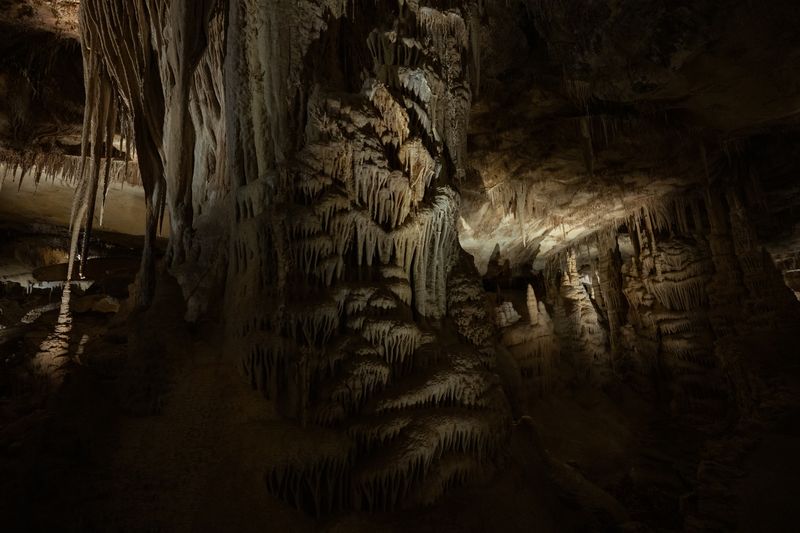
Lehman Caves is seen only on ranger-guided tours — a marble solution cave known for its dense shield formations. Tours range from the 30-minute Gothic Palace to the 90-minute Grand Palace, plus a 3-hour Introduction to Wild Caving in newly reopened passages.
Season: Year-round except Thanksgiving, Christmas, and New Year's Day.
Permit required
Regs: Ticketed, guided tours only. Reserve through Recreation.gov (facility 251853) — tours are small (~20–25 people), released 30 days in advance, and regularly sell out. Check in at the Lehman Caves Visitor Center at least 15 minutes early.
Cave is a constant ~50°F — bring a layer. Sturdy closed-toe shoes required.
Stargazing
Certified an International Dark Sky Park in 2016; in the Park Service's survey of forty-five park units at the time of its nomination, it ranked in the top five. Crews recorded Bortle 1 on the summit of Mount Washington in 2005 — and Bortle 2 is the class at which the Milky Way begins casting faint shadows on white objects. Every one of those readings was taken on a mountaintop above 11,000 feet. Down where the road goes, the park-wide handheld survey averages 21.48. Ranger astronomy programs run in season, and the park hosts an annual Astronomy Festival.
Season: Year-round; new-moon windows are best. Astronomy programs concentrate in summer.
No entrance gate or fee to be in the park after dark — bring a red light and let your eyes adapt.
Scenic Driving
The Wheeler Peak Scenic Drive climbs a paved 12 miles and gains over 4,000 feet to above 10,000 feet at the Wheeler Peak trailhead — one of the highest paved roads in Nevada, and the access point for the high trails.
Season: Upper road usually open by Memorial Day weekend through fall; closed in winter at Upper Lehman Creek Campground (mile marker 3).
Vehicles and trailers over 24 feet are not permitted beyond Upper Lehman Creek Campground (mile marker 3). Narrow, winding, 35 mph, no passing.
Backpacking
Backcountry camping is allowed in most of the park's wilderness with no permit and no fee, reaching the alpine lakes basins and the range crest. Voluntary registration is encouraged.
Season: Summer–fall for the high country.
Confirm current backcountry rules with the park before relying on the no-permit status; regulations can change.
Fishing
Small-stream fishing on Baker, Lehman, and Snake creeks, including native Bonneville cutthroat trout in restored reaches.
Season: Open water, roughly spring–fall.
Regs: A Nevada fishing license is required. Check current native-trout and catch-and-release rules.
Winter Sports
When the upper scenic drive closes, the snowed-in road and lower trails become a quiet snowshoe and backcountry-ski corridor. Lehman Caves stays open on guided tours through winter.
Season: Roughly November–May, snow depending.
No lifts, no grooming, no services — full winter self-sufficiency required.
Night Sky
Dark Sky Park Certified 2016 Bortle 1–3 measured 21.48 mag/arcsec² across 26 sites
No Bortle typical is recorded here on purpose: the Park Service never published one for Great Basin. What it published is three summit nights that came in at Bortle 1, 2 and 3 — and every one of those was taken on a mountaintop above 11,000 feet. The Bortle 1 belongs to the summit of Mount Washington, which the NPS observer reached by difficult 4WD and a quarter-mile walk, and described as 'very exposed, cold, windy.' Down where the road takes you, the park-wide handheld survey averages 21.48. In the Park Service's survey of forty-five park units at the time of its 2016 nomination, Great Basin ranked in the top five — but the number that made it famous was earned on a peak, not at a campsite.
What the sky does here
Across the park
-
Mount Washington and Buck Mountain summits
Bortle 1–3 range 21.11–21.79 2 sites 5,140 stars mag 7.2 limit
Where the famous numbers come from — and the only ground in the park anyone has measured with a CCD. Bortle 1 was recorded here once, on Mount Washington in 2005. The summits are also, paradoxically, where the light domes are visible: the Park Service counts three humanly visible from the peaks — Las Vegas at 193 miles, Salt Lake City at 180 miles, and Ely at 39 miles, the last resolvable into three separate sources thought to be Ely, Ruth and McGill. You climb above the sky glow and gain the ability to see it.
Light domes: Las Vegas, Salt Lake City, Ely, St. George, Mesquite, Cedar City, ranch lights
-
Park-wide at ground level (road-accessible sites)
21.48 mag/arcsec² 26 sites
The sky most visitors actually stand under, and it is measurably brighter than the summits. No Bortle class has ever been published for it. Baker, five miles away, is the one nearby town the Park Service says produces no visible light dome anywhere in the park — its power co-op agreed to full-cutoff fixtures.
Geology
Wheeler Peak is armored in resistant Prospect Mountain Quartzite; Lehman Caves formed in marble metamorphosed from Pole Canyon Limestone. A small cirque glacier — the only one in Nevada — survives on the shaded northeast face below the summit, ringed by a rock glacier of quartzite talus.
Province: Basin and Range Province — Great Basin / South Snake Range
Rock types: quartzite, marble, limestone
Major formations
Also present: Prospect Mountain Quartzite (Cambrian — Wheeler Peak summit and upper slopes), Pole Canyon Limestone / Lehman Caves marble (host rock of Lehman Caves)
Ecology
Biomes: Great Basin sagebrush steppe (valley floor); pinyon-juniper woodland; montane aspen and mixed conifer; subalpine bristlecone / limber pine; alpine tundra (Wheeler Peak)
Flora
- Great Basin bristlecone pine (Pinus longaeva) — among the oldest non-clonal organisms on Earth
- limber pine (Pinus flexilis)
- Engelmann spruce (Picea engelmannii)
- quaking aspen (Populus tremuloides)
- single-leaf pinyon (Pinus monophylla)
- Utah juniper (Juniperus osteosperma)
- big sagebrush (Artemisia tridentata)
Fauna
- mule deer (Odocoileus hemionus)
- mountain lion (Puma concolor)
- yellow-bellied marmot (Marmota flaviventris)
- American pika (Ochotona princeps)
- Bonneville cutthroat trout (Oncorhynchus clarkii utah) — native, in park streams
- golden eagle (Aquila chrysaetos)
Classic sky-island ecology: alpine and subalpine communities isolated on the range top, cut off from other high ranges by intervening desert. The bristlecone groves are the park's signature — slow-growing, wind-sculpted, and among the longest-lived organisms known.
History
The park grew outward from Lehman Caves — a monument since 1922 — to protect the whole South Snake Range in 1986. Its most famous chapter is a cautionary one: the 1964 felling of the Prometheus bristlecone.
Indigenous homelands: Western Shoshone (Newe), Southern Paiute
Key events
- 1885 Absalom Lehman promotes and develops Lehman Caves for visitors.
- 1922 Lehman Caves National Monument established.
- 1964 The bristlecone known as Prometheus (WPN-114) — likely the oldest tree then known — is cut down on Wheeler Peak.
- 1986 Great Basin National Park established (Oct 27), incorporating Lehman Caves National Monument.
- 2016 Certified as an International Dark Sky Park.
Notable figures
- Absalom Lehman
- Donald Currey
Modern issues
-
Dark-sky protection
Status: ongoing
The park actively manages lighting and partners with gateway communities to protect one of the darkest remaining night skies in the Lower 48.
Access & regulations
Roads
- Wheeler Peak Scenic Drive — paved. Upper road usually open Memorial Day–fall; winter closure at Upper Lehman Creek Campground (mile marker 3). Paved 12 miles, gains 4,000+ ft to above 10,000 ft. No vehicles/trailers over 24 ft past mile marker 3.
- Baker Creek Road — graded dirt. Seasonal; closed by snow in winter. Gravel access to Baker Creek Campground and trailheads.
Seasonal closures
- Upper Wheeler Peak Scenic Drive (above mile marker 3) — Roughly November–late May. Reopening usually by Memorial Day weekend; varies with snowpack.
Accessibility: Lehman Caves offers a First Room Accessible tour; the Great Basin Visitor Center and parts of the Lehman Caves Visitor Center area are accessible.