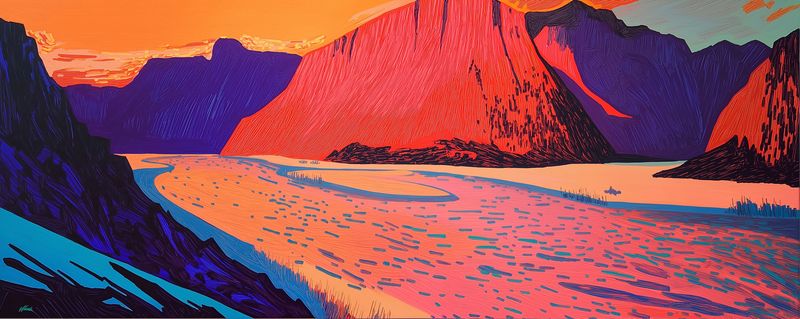
San Juan River
The San Juan moves through the heart of the Ancestral Puebloan world — 84 canyon miles from Sand Island to Clay Hills, warm water, dense rock art, and the ideal first desert river trip. · CO · NM · UT
The San Juan River rises in the high San Juan Mountains of southwestern Colorado and descends 383 miles through the Four Corners region before meeting Lake Powell — the reservoir that replaced its confluence with the Colorado River. The river passes through the heart of the Ancestral Puebloan world, through the Navajo Nation, and through one of the most densely inscribed cultural landscapes in North America. The lower canyon section — Sand Island to Clay Hills — is the reason most desert river travelers come here: 84 miles of Class I–II flatwater through thousand-foot canyon walls, past hundreds of petroglyphs and pictograph panels, past cottonwood beaches and alcoves and the silence of a canyon that has carried people through the desert for ten thousand years. The San Juan is beginner-accessible in a way that few desert multi-day rivers are, but it asks something of everyone who floats it. The canyon holds stories, and the walls will show them to anyone willing to move slowly enough to look.
Signature Experiences
- Hundreds of Ancestral Puebloan rock art panels throughout the canyon corridor
- Butler Wash panel — one of the most impressive Basketmaker rock art sites in the Southwest
- The Goosenecks of the San Juan — 1,000 feet of entrenched meanders in Pennsylvanian limestone (viewable from above at Goosenecks State Park)
- Slickhorn Canyon side hike — polished narrows rising from a Class II rapid
- Warm water and sandy beaches — the San Juan is the approachable desert canyon river for those building experience
3 sections, 383 miles
partially regulated — Navajo Dam (1962) on the upper river controls flow through the canyon sections; the river responds to Rocky Mountain snowmelt and monsoon season above the dam
San Juan River near Bluff, UT
Primary planning gauge for the Lower San Juan River. Located near Bluff, UT, this gauge provides the most directly useful reading for Mexican Hat to Clay Hills trip planning and permit holder flow decisions on the San Juan.
Current flow — San Juan River near Bluff, UT
The San Juan runs year-round at low flows but has two distinct peak seasons. Spring (April–May) brings snowmelt from the San Juan Mountains — flows 1,500–5,000 cfs — with cool mornings and warm afternoons, ideal conditions for the canyon. Fall (September–October) offers warm water, comfortable air temperatures, and dramatically lower crowds. Summer (July–August) is hot (100°F+), carries flash flood risk from monsoon storms entering side canyons, and is generally not recommended for beginner groups. Winter is cold and flows are low but the canyon is hauntingly solitary.
The San Juan canyon exposes one of the most complete sequences of Colorado Plateau stratigraphy in a single river corridor. At Mexican Hat, the Goosenecks — where the river makes a series of dramatic entrenched meanders in Pennsylvanian limestone — record nearly 1,000 feet of incision into ancient seabed. The Pennsylvanian Honaker Trail Formation that defines the lower canyon walls was deposited when this region lay near the equator under a shallow tropical sea. The Morrison Formation in the upper canyon is among the richest dinosaur-bearing sequences in North America.
Age range: Pennsylvanian through Jurassic
The San Juan corridor passes through the Navajo Nation and Bears Ears landscape — a region where ecological, cultural, and land management questions are inseparable. Tamarisk has significantly altered the riparian character of the lower canyon, displacing native cottonwood-willow communities on many beaches. Active removal efforts have been undertaken by BLM and tribal land managers. The accessible beginner character of the San Juan makes it one of the best canyon wildlife observation rivers in the Southwest — warm shallow water, abundant sandy beaches, and consistent bird activity throughout the canyon.
Notable Expeditions
- Macomb San Juan Expedition