Best Lightweight Outboard for Raft Support (Decision Guide by Use Case)
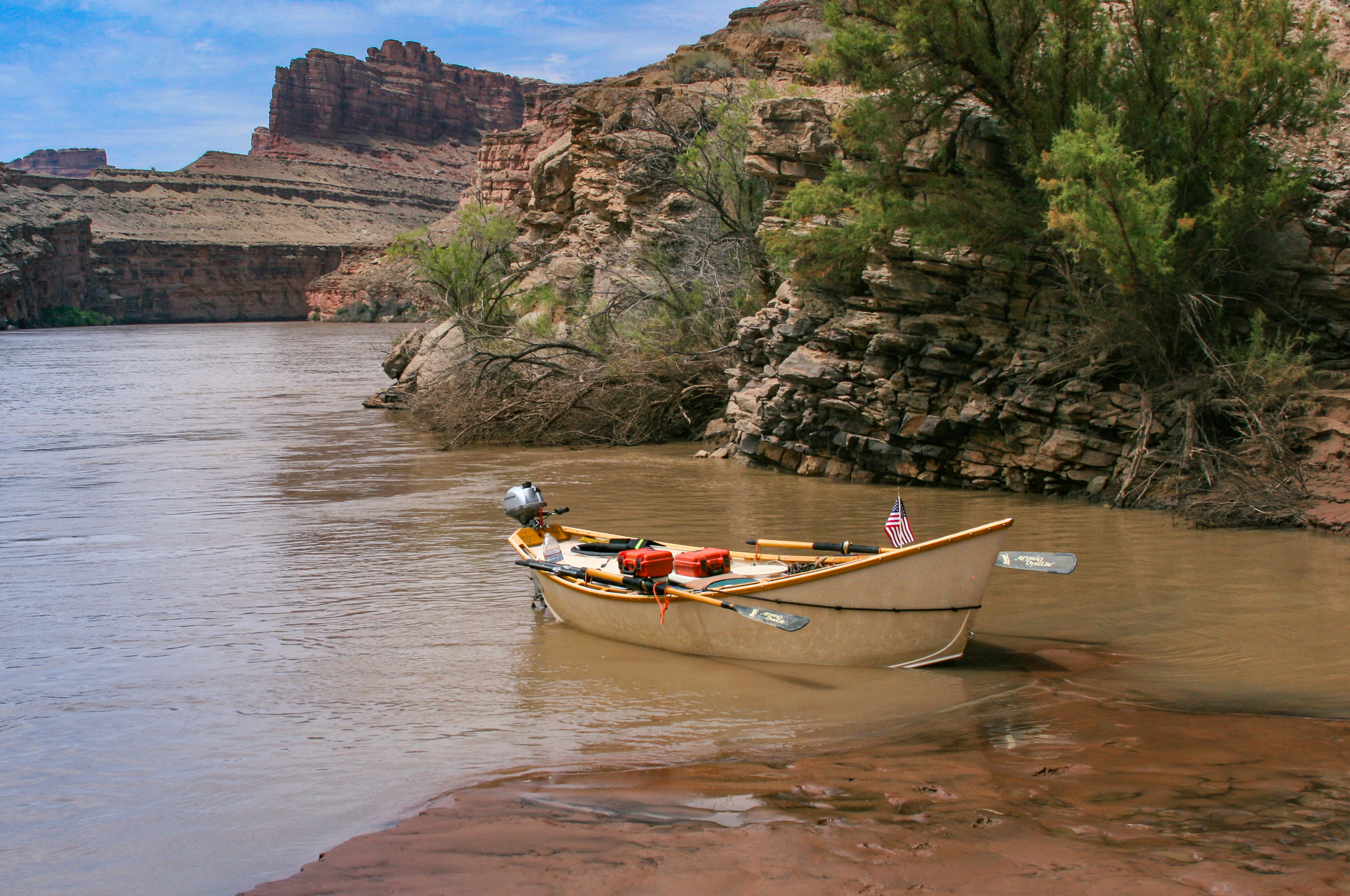
I've owned three motors on the Desert Maritime program. A Honda 2.3 since 2013. A Yamaha 6 hp from 2016 to 2021. A Mercury 5 hp four-stroke since 2021. Three different motors for three different jobs across roughly fifteen years of desert river work. The 2.3 is still the one I run most. The 6 hp got sold because it sat in storage 90% of the time. The 5 hp does the work the 2.3 can't and lives on a side-bracket I can install in 90 seconds.
The lesson from those three purchases: the motor decision is downstream of the use case, not the boat size. A 16-foot raft doing takeout-only assist needs a different motor than a 16-foot raft doing motor-trip flatwater. This article is the decision frame, not a brand ranking.
What "lightweight outboard" actually means
For raft support, "lightweight" means under 100 lbs and runnable by one person without help. That's the practical line. Above that, you're into hand-truck, two-person mounting, and trailer-bracket territory — a different conversation.
The lightweight class breaks into three sub-tiers:
- 2–3 hp class. ~30 lbs. One-person carry over a shoulder. Air-cooled (Honda) or water-cooled (Mercury, Tohatsu, Suzuki). Single cylinder, manual start, internal fuel tank. The Honda 2.3 is the standard.
- 4–6 hp class. ~50–60 lbs. One-person carry with a handle. Water-cooled, 4-stroke, single cylinder. External fuel-tank capable. Real torque for primary propulsion. The class where the trade-offs get interesting.
- 8–10 hp class. ~80–100 lbs. Two-person handle or one-person with a bracket cart. Water-cooled, multi-cylinder, EFI on newer models. This is "motor trip" territory — the motor does most of the work, the rower assists.
Above 10 hp, you're in serious motor-trip outboards (Glen Canyon, Lees Ferry to Phantom, lake-based commercial work). Different equipment, different doctrine.
The constraint stack — outboard version
Picking a motor is a four-constraint problem.
1. Use case. What job is the motor doing? Takeout assist? Primary propulsion? Sustained upstream? The most common mistake is buying a motor for a use case the trip doesn't actually need.
2. Weight on the transom. Raft frames are designed for distributed load. A 30-lb motor on the transom changes nothing. A 100-lb motor on the transom changes how the boat sits, how it tracks in wind, and how the rower can maneuver.
3. Shuttle handling. Every motor gets carried to and from the boat. If two people are needed every time, the motor doesn't get used as often as it could be — even when it would be useful.
4. Failure mode. What happens when it fails. Air-cooled motors fail differently than water-cooled. EFI motors fail differently than carbureted. Simpler motors fail in more recoverable ways.
The motor I used twice in five years
The Yamaha 6 hp I bought in 2016 was a logical purchase on paper. More power than the 2.3, still light enough for one person, four-stroke, water-cooled. I figured I'd use it on the Cataract reservoir, on Deso low-water, on any trip where the 2.3 felt anemic.
What actually happened: I used it twice in five years. The 2.3 was lighter and got grabbed every trip. The 6 hp sat in the garage. When I finally pulled it out for a low-water Cataract trip, the carb was gummed from sitting and it took three pulls plus a gas-line flush to get it running. The motor I didn't use was the motor I couldn't trust when I needed it.
I sold the 6 hp and bought the Mercury 5 hp four-stroke specifically because it was small enough that I'd actually use it — for the trips where the 2.3 was clearly the wrong tool but the 8 hp was overkill.
The lesson: the motor you don't run is the motor that fails when you finally try. Pick a motor sized to a use case you'll hit at least three times a year. Otherwise, rent one for the trip that needs it.
2–3 hp — the assist motor
Use case: takeout pushes, low-water flatwater assist, reservoir transit on calm days, camp-positioning. The motor is the help, not the engine.
The pick: Honda 2.3 (BF2.3). Air-cooled simplicity, 30 lbs, forward-neutral shift (no reverse gear — you spin the motor 180°), mature engineering. The desert-river standard for a reason. See the full review for details.
Alternatives:
- Mercury 2.5 / Tohatsu 2.5. Water-cooled, water-pump-equipped, and meaningfully cheaper than the Honda. Same power, same weight class. The downside is silt. On the silty San Juan or Lake Powell sediment fan, water-cooled small motors clog impellers in ways the Honda can't. For non-silty water (Deso, Yampa, Labyrinth) the Mercury and Tohatsu are reasonable substitutes.
- Suzuki 2.5. Solid, slightly heavier than the Honda (~37 lbs), water-cooled. Less common at dealers in the Mountain West. Service network matters when the carb gums up.
Weight on transom: ~30 lbs. Negligible impact on raft trim.
When this class is the wrong tool: sustained upstream work, motor as primary propulsion across an entire trip, or any plan that needs power on demand to fix a position you left too late. It will push two loaded boats along with the current — what it will not do is drive you somewhere you have not already set up for. The 2.3 hp class is assist. If you need the motor to carry the trip, scale up.
4–6 hp — the working motor
Use case: primary propulsion on flatwater sections, low-water assist where a 2.3 is anemic, pushing two boats in calm conditions, sustained reservoir transit, supported overnighter work where the motor is on for hours at a time.
This is the most versatile class for desert river support. The right motor in this range handles 80% of the jobs a 2.3 doesn't, without crossing into 8 hp weight and complexity.
The pick: a 4-stroke single-cylinder 5 hp. Mercury 5 hp 4-stroke, Yamaha F4 or F5, Tohatsu MFS5. All three are mature, all three water-cooled, all three around 55–60 lbs.
Mercury 5 hp 4-Stroke is the one I run. Single cylinder, F-N-R, external tank capable, electric start option (skip it — manual is more reliable on a raft). Fuel burn around 0.5 gph at half throttle, 1 gph at full.
Yamaha F4/F5 are the oldest design in the class — Yamaha's been making the F-series since the 1990s. Bombproof, well-known, parts available everywhere. Slightly heavier than Mercury at ~57 lbs.
Tohatsu MFS5 is the budget choice in this class. Same architecture, same weight class. Tohatsu makes Mercury's smaller motors under contract — there's significant parts overlap. The dealer network is thinner.
Weight on transom: ~55–60 lbs. Noticeable. The boat sits stern-low when fully loaded, especially with a passenger in the rear seat. Plan frame trim accordingly.
When this class is the wrong tool: day-trip rowboat work where the motor is overkill. Pure takeout-assist where a 2.3 does the job at half the weight.
8–10 hp — the motor-trip class
Use case: sustained upstream work, fully-motorized flatwater trips (Glen Canyon Dam-to-Lees, lake-based supported overnight runs), commercial assist work, multi-boat trains.
This is motor trip territory. The motor is the trip's engine. The rower is positioned for steering and emergency backup, not propulsion.
The pick: Yamaha F8 or Mercury 9.9 4-Stroke. Both are mature, multi-cylinder, EFI on the newest models, water-cooled, around 80–100 lbs. The Yamaha F8 is lighter (~84 lbs) than the Mercury 9.9 (~98 lbs) but produces less power.
Yamaha F8 is the lighter end of this class. Two-cylinder, 4-stroke, ~84 lbs. Smooth running, fuel-efficient. Used by many desert outfitters as the standard support motor.
Mercury 9.9 4-Stroke is the heavier, more powerful option. Two-cylinder, 4-stroke, ~98 lbs. Real propulsion. This is the motor on a Glen Canyon Dam-to-Lees support boat or a Lees Ferry assistance run.
Weight on transom: 84–98 lbs. Substantial. Requires frame designed for the load. May require trim weight in the front of the boat to balance the stern.
Shuttle handling: two people or a hand truck. Plan accordingly. The motor that takes two people to mount is the motor that doesn't get mounted on a 5am breakfast launch.
When this class is the wrong tool: any trip where the motor is on less than half the running time. The weight, fuel burn, and shuttle complexity make the 8–10 hp class overkill for assist-only use.
The common pitfalls
Buying for "what if." The 6 hp I bought because I might need it twice a year sat unused 90% of the time. The motor in the garage is not the motor on the river.
Skipping the external fuel tank. Every motor in this class benefits from a 1-gallon or 3-gallon external tank kit. The internal tanks are too small for serious work, and fueling from a jerry jug into the internal tank in a moving boat is a mess.
Ignoring prop selection. A 4-blade prop on a 5–6 hp moves a loaded raft better than a 3-blade. The 4-blade gives up top speed but makes the motor feel more powerful. Worth the swap on any motor doing primary propulsion work.
Underestimating sand and silt. Water-cooled motors hate silt. The cooling-water intake is a small slot near the gearbox. Silty river water clogs it. Run the motor in clean water before storage. Always.
Skipping the trailer transport plan. A motor that gets shaken to pieces on a 4-hour trailer shuttle is a motor that fails on the river. See Raft Trailer and Outboard Transport System.
The decision matrix
Use this to pick:
- You row most water and want a takeout assist: 2.3 hp Honda. Done.
- You want one motor for everything from takeout to low-water primary: 5–6 hp 4-stroke. Mercury, Yamaha, Tohatsu.
- You're running motor-trip work — Glen Canyon, lake supported, sustained upstream: 8–10 hp Yamaha or Mercury.
- You're doing all three across the year: two motors. A 2.3 for the assist work, an 8 hp for the motor-trip work. Skip the 5–6 hp middle.
- You only motor twice a year: rent. Don't buy a motor for two trips.
What to skip
- Two-strokes. Heavier penalty in fuel burn, oil mixing, EPA compliance, noise. The lightweight advantage of older two-strokes is real but no longer offsets the operational cost.
- Electric trolling motors. Don't have the torque for a loaded raft. Battery weight kills the lightweight advantage.
- No-name imports. Parts availability matters when the carb gums up at midpoint. Honda, Mercury, Yamaha, Tohatsu, Suzuki — those five have dealer networks. Anything else, you're rolling dice.
The motor that earns its place
The right outboard for a raft is the one that gets used three or more times a year, mounts in under five minutes, runs on the first or second pull, and weighs less than the rower wants to carry up the takeout.
For most desert river crews, that's a Honda 2.3. For some, it's a Mercury 5 hp. For a small minority running motor-trip work, it's a Yamaha F8.
For the field-tested specifics on the 2.3, see Honda 2.3 Outboard Review. For the trailer system that keeps any of these motors working trip after trip, see Raft Trailer and Outboard Transport System.