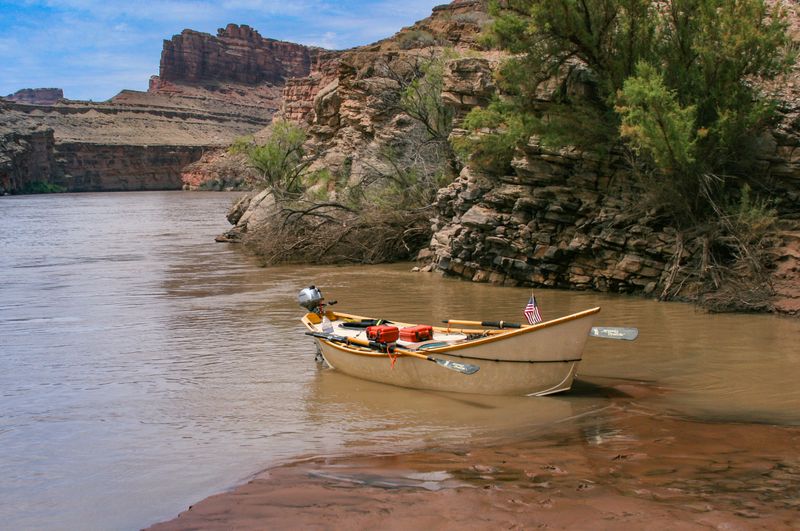
Forty miles left to go
Cataract Canyon, July 2023. North Wash was a no-go. The bottom of the trip came down to two choices: break the boats apart (not possible with a dory) and haul them up a very steep, slippery slope in 110-degree sun — or keep going, forty-odd miles of reservoir down to Bullfrog Marina.
We motored. A single Honda 2.3 makes that run. It is 2.3 horsepower against a lot of flatwater, and it gets there.
But that trip is not what the motor is for. The 2.3's sweet spot is a river with current, where the motor adds to what the water is already doing and a small push becomes real progress. That is where it shines. Dead water it will handle — you just have to embrace the situation and settle in. And Lake Powell is not entirely dead. There is current in it, and running a 2.3 you learn to go looking for it.
It is not a fast motor and it is not a powerful one. It is the lightest serious motor in its class, the only major air-cooled small outboard, and the one that asks least of you. On a river your attention is on the water, the boats, the crew, the unreal scenery — everywhere but the engine.
What the Honda 2.3 actually is
The Honda BF2.3 is a 2.3 horsepower, single-cylinder, four-stroke, air-cooled outboard motor. Designed for tenders, dinghies, and small inflatables. Honda has built it on the same architecture for over a decade — a sign it's mature engineering, not a product chasing market trends.
Specs that matter:
- Weight: 29.5 lbs short shaft, 31 lbs long shaft (Honda, dry)
- Cooling: air-cooled (no impeller, no cooling-water intake)
- Fuel: internal 0.29-gallon (1.1 L) tank, plus optional external connection
- Fuel burn: Honda rates the tank at up to an hour at full throttle, so call it 0.3 gallons/hour. Field number: roughly 3 gallons pushing two rafts and four people 75 miles on about 3 mph of current
- Shift: forward and neutral only — no reverse gear; to back down you spin the motor 180°
- Throttle: twist-grip on the tiller
- Prop: small 3-blade plastic — mine is the one it came with after eight-plus years; I carry a spare
What it's not: it's not a touring motor, not a planing motor, not a load-carrier. The 2.3 is a push motor for a hull that's already moving with current or that needs to make slow, steady headway on flatwater.

Where the 2.3 wins
1. Weight. This is the single most important advantage. A 30-lb motor that one person can carry up a takeout ramp is a different category than a 60-lb motor that needs two people or a hand truck. On a raft transom, 30 lbs vs 60 lbs vs 80 lbs changes how the boat sits, how it tracks, and how it handles in wind.
A loaded 14-foot raft at 1,000 lbs of gear and crew already rides stern-heavy with a frame. Adding 30 lbs back there is fine. Adding 80 lbs is a handling problem. You mount and unmount a motor standing on a rubbery tube, on a bank that slopes whichever way it wants, in sand that makes every ordinary movement complicated. Sometimes you do it mid-river, leaning out over the stern with the boat moving under you. A motor one person can manage is a different object from one that needs two. On a 16-foot raft running Big Drop with a passenger seat full, motor weight matters.
On a hard hull it stops being a trim question. I hung a 9.8 hp Nissan on my dory's transom and it broke the transom. A raft frame spreads a motor's load across the tubes; a dory transom is a piece of wood carrying all of it.
2. Air-cooled simplicity. Every other outboard in this class uses water cooling — an impeller pulls river water through the powerhead. That's two failure points: an impeller that grinds in silt, and a cooling intake that clogs in sediment. On the Colorado, this is a real issue.
The Honda 2.3 has neither. Air-cooled means the motor doesn't care about the water it's in. Silt, mud, weeds, shallow gravel, dry-running for 30 seconds during a transom check — none of these break the cooling system, because there isn't one.
3. Fuel. The internal tank holds 0.29 gallons — Honda rates that at up to an hour at full throttle, less when you are pushing into wind. Enough to be useful, not enough to plan around, so the real fuel system is whatever you carry to refill it.
I run two 3-gallon RotoPax and a 1-gallon can I have never opened. The form factor is the reason: they stack flat and lock down, where the big square cubes I used to carry rolled around and took up too much room both full and empty — a rigid box costs you the same space whether there is fuel in it or not, and by day four you are still hauling the volume without the range. The long spigot reaches the filler without a funnel. I have never bothered with a siphon — I would rather stretch out a little between fills than fuss with one.
4. Reliability. Honda's small-engine reputation isn't marketing. With basic maintenance — annual carb cleaning, fuel stabilizer between trips, fresh spark plug every 50 hours — the 2.3 starts on the first or second pull for years. I've run mine since 2013. Same motor.
Where the 2.3 doesn't win
1. Noise. The Honda 2.3 isn't terribly loud, at least not by outboard standards. But outboard standards don't mean much when you're floating through a canyon where the loudest thing ought to be a raven, a riffle, or somebody opening another beer.
If you're running the motor, you're also effectively removed from the conversation. Everyone else will keep talking, occasionally turn around to include you, and you'll smile, nod, and pretend you caught something other than the last three words.
I always feel a little guilty passing other groups, especially the ones who deliberately left their motors at home. They've committed to the quiet, and here I come, pushing a little raft through their afternoon with what sounds like an enthusiastic lawn mower. It's only a few minutes of noise as I pass, but still. They didn't come all this way to listen to my Honda.
And maybe that's the part that bothers me most. I'd rather not be running it either. I know how to row. I enjoy rowing. I'm perfectly capable of getting there without a motor. But I've got five days to do a trip that deserves two weeks, and the little Honda buys me time I don't have.
Someday I'll give the canyon those two weeks. Until then, I'll keep feeling a little guilty every time I pull the starter cord.
2. Headwind and upstream. A 2.3 adds about 2 mph to whatever the current is doing. A headwind takes maybe 1 mph of that back. It does not stop you — the motor holds the line and you keep making miles — but on a Lake Powell afternoon with the wind up from the south, you are making them slowly.
For sustained upstream work, or for any trip where the motor is the primary propulsion (ferry shuttles, lake transit, supported overnight runs), a 5–8 hp motor is the right tool. The 2.3 is the assist, not the engine.
Being able to run upstream is genuinely huge, and the 2.3 cannot really do it. The consolation is that you are never going fast, which makes it easier to see what is coming — the beach, the camp, the rock, the log, somebody's wind-blown hat — and easier to do something about it. Slow is not only a limitation.
3. Late corrections. You push boats, you do not tow them, and a 2.3 will push two loaded boats along with the river's current. What it will not do is power you into a position you left too late — there is no reserve to call on. Read the water early, set your line early, and it works. Decide late and the motor cannot save it for you.
4. Charging. No alternator. The 2.3 doesn't generate electricity. If you're running a chartplotter or charging USB devices off the motor, you need a different motor.
Comparison to 8–10 hp motors
A typical Yamaha or Mercury 8 hp 4-stroke is the next category up. The comparison:
| Spec | Honda 2.3 | Yamaha 8 (typical) |
|---|---|---|
| Weight | 30 lbs | 80 lbs |
| Power | 2.3 hp | 8 hp |
| Cooling | Air | Water (impeller) |
| Fuel/hr | ~0.3 gal | 1–1.5 gal |
| Push capacity | 2 boats with the current | 2 boats into wind |
| Shuttle handling | One person | Two or hand truck |
| Best use | Raft assist, takeout | Primary propulsion |
The 8 hp is a different tool. It pushes harder, holds against wind, and can serve as primary propulsion on motor-supported trips (Glen Canyon Dam-to-Lees, lake-based overnight runs). The cost is weight, complexity, fuel burn, and shuttle awkwardness.
For a Cataract trip where you're rowing the canyon and motoring the Narrow Canyon and reservoir miles to North Wash at the end, the 2.3 is the right call. For a Glen Canyon trip where the motor is the trip, the 8 hp is the right call.
See Best Lightweight Outboard for Raft Support for the full decision matrix.
Mounting and securing the 2.3
The 2.3 mounts to a transom plate or a side-mount bracket on a raft frame. Two real options:
1. Transom plate. A flat plywood or composite panel bolted to the rear frame bay, dimensioned to fit the motor's clamp screws. Standard for rear-mounted motor configurations. The motor sits behind the rower, prop in the water, tiller within reach.
2. Side-mount bracket. A pivoting bracket that holds the motor outboard of the frame on the side. Used when the rear of the frame is occupied by gear or when the rower wants to stay rear-position without the motor in the way.
For Cataract take-out work, the transom plate is the standard. For multi-day overlanding-river hybrid trips where the motor mounts and dismounts daily, the side bracket is faster.
Securement during transport — see Raft Trailer and Outboard Transport System. The 2.3 is light enough that it survives most trailer abuse, but the right transport setup is the difference between "the motor still works" and "the motor's tiller is loose now and the throttle cable's been chafed."
Maintenance reality
The Honda 2.3 is low-maintenance. Low-maintenance does not mean no-maintenance.
Per trip:
- Fresh, stabilized fuel.
- Visual inspection of the prop (rocks, sand abrasion, line wrap).
- Spark plug check at 50-hour intervals.
- Carb drain if storing more than 30 days.
Annual:
- Carburetor clean. Honda small-engine carbs are ethanol-sensitive. Stale fuel gums up the jets within a season.
- Spark plug replacement.
- Fuel filter inspection.
- Lower unit gear oil change. The lower-unit gearbox is the only fluid service the motor needs.
Don't:
- Don't store the motor with fuel in the carb. Drain or run dry.
- Don't run the motor dry for more than 30 seconds. Air-cooled doesn't mean cooling-immune — extended dry running heats the powerhead.
- Don't crank the throttle hard at startup. The 2.3 is a "warm up at idle for 30 seconds" motor. Treat it that way.
What I actually use it for
In practice, my Honda 2.3 does three jobs across the season:
- Cataract take-out push. The original use case. The Narrow Canyon and reservoir miles to North Wash — call it 90 minutes of motor running on average, longer in headwind. That is the easy version. Before North Wash got its constructed ramp, the bottom of a Cataract trip was whatever the bank happened to be that season, and the fallback was to keep going down-lake to Bullfrog Marina — forty-odd miles of reservoir and an extra night. The 2.3 is what made that doable.
- Low-water Labyrinth/Stillwater assist. Below 4,000 cfs in summer the meander is slow. A 2.3 assist gets a long day done before dark.
- Side-canyon days on the lake. Spending a day exploring the side canyons instead of grinding across open water. That is what makes a river rig versatile — the same boat that ran the whitewater can go poke into the coves, and camp positioning stops being a fight with the wind on the oars.
What it does not do:
- Not for navigating rapids. In whitewater the motor tilts up or comes off and you row — the lower unit is the first thing to find rock.
- Not for sustained upstream work. The motor isn't powerful enough.
- Not a late correction. It will push two loaded boats on the current, but it cannot drive you into a position you left too long.
Buying it
Pick: either shaft length. The short-shaft BF2.3DH is the catalogue answer for raft transoms. The long-shaft BF2.3DL is what I actually run, and it has been right on both my rafts and the dory. Frame and transom height vary enough between boats that shaft length is a fit question, not a rule — measure your mount before you order rather than buying the one the spec sheet assumes.
What the long shaft costs you is shallow water. The leg sits deeper, so you pay more attention to what's under you and you tilt it up sooner. That is a habit rather than a defect — and it is another argument for the 2.3 specifically. At 30 lbs one person can lift the whole motor off the transom without help, so tilting it, trimming it, or pulling it entirely is trivial in a way it simply is not with a 60- or 80-lb motor.
The motor is sold by Honda Marine dealers, most marine shops, and online retailers.
Used market: a 2013-and-newer 2.3 in good condition is the buy. Don't buy a pre-2013. Honda updated the carburetor and the early models had ethanol-related fuel system issues.
Still working with the river
The Honda 2.3 does make a trip faster, and that is why the motor is in the boat. What it really buys is a consistent pace: you keep jamming along through the wind, over the little eddies, across the flat miles that otherwise turn into a grind.
It makes the trip lighter too — less stress at the take-out, less worry on a windy reservoir afternoon, less doubt that the trip ends inside the shuttle window.
But the part worth keeping is that 2.3 horsepower is not enough to change the character of the trip. You are still reading water, still rowing when it matters, still working with the river instead of tearing through it. A bigger motor takes that away.
For the broader decision frame — when to scale up to a 5–6 hp, when to skip a motor entirely — see Best Lightweight Outboard for Raft Support. For the trailer transport system that keeps the motor working between trips, see Raft Trailer and Outboard Transport System.