Gates of Lodore Nature Trail
Short interpretive climb from Lodore Campground to the overlook where the Green disappears into the canyon Powell named in 1869.
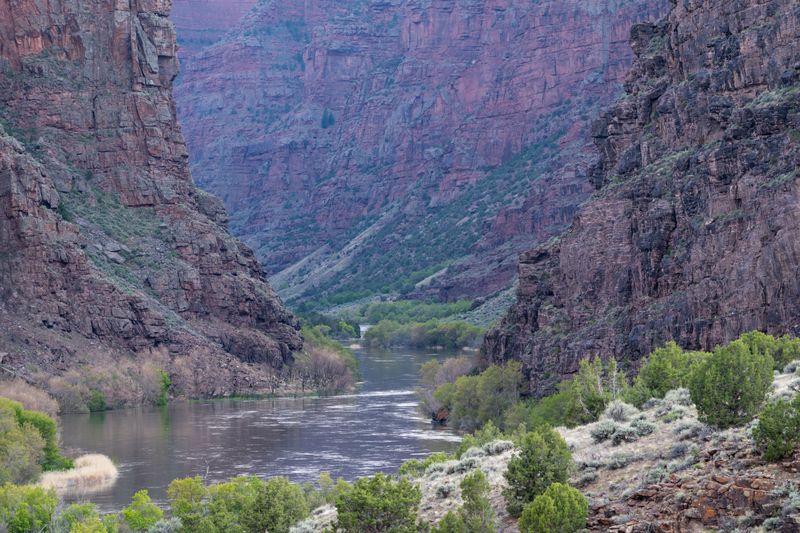
Short interpretive trail from Lodore Campground that climbs the bench above the Gates of Lodore put-in to an overlook of the canyon entrance. The viewpoint frames the Green River disappearing into the Uinta Mountain quartzite — the spot from which Powell's 1869 expedition first saw the canyon they would name Lodore. NPS interpretive signage along the trail covers the geology, the Powell expedition, and the Echo Park Dam conservation battle. The hike is the standard pre- or post-launch ritual for Lodore river trips and a short worthwhile stop for anyone driving in.
Quick stats
- Distance
- 2 mi round trip
- Elevation gain
- 350 ft
- Time
- 1–1.5 hrs
- Difficulty
- Easy · family-friendly
- Best months
- Apr, May, Jun, Sep, Oct
Know before you go
Within Dinosaur National Monument.
No hiking permit required.
The route
Short — most parties are out and back in 60–90 minutes.
- 0 mi · Lodore Campground trailhead — Signed trailhead inside the campground.
- — · Gates of Lodore overlook — Canyon-entrance viewpoint. Iconic image of the Green disappearing into the Uintas.
When to go
Accessible whenever the access road and campground are open. Midsummer is hot and exposed; spring and fall light are best for photographs of the canyon entrance.
Safety & hazards
Open bench with minimal shade — midsummer afternoons are hot and exposed. Carry water in summer even on a short hike.
Modest exposure at the overlook itself. Stay back from the edge.
Wildlife & geology
Open sage bench ecology — dry, exposed, and quick to read.
Wildlife you might see: peregrine falcon (Falco peregrinus), golden eagle (Aquila chrysaetos).
The overlook frames the structural boundary between the open Browns Park valley and the deep canyon cut into Uinta Mountain Group quartzite. The 'gates' are eroded fins of one of the oldest rock units on the Colorado Plateau.
History
Named after Robert Southey's poem 'The Cataract of Lodore.' Andrew Hall, on Powell's 1869 expedition, recited it as the boats entered the canyon — and the name stuck for both the canyon and the trail to its overlook.
Modern interpretive trail; the overlook itself has been a stopping point for river travelers and visitors since the early NPS era.
NPS interpretive signage covers the Powell expedition and the 20th-century conservation battle over the proposed Echo Park Dam.