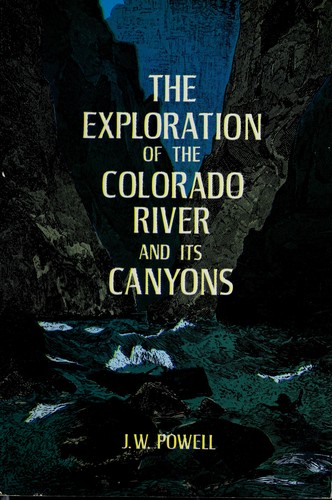
The Exploration of the Colorado River
Powell's original account of the first scientific expedition through the Grand Canyon, documenting the geology, natural history, and challenges of navigating the unknown Colorado River.
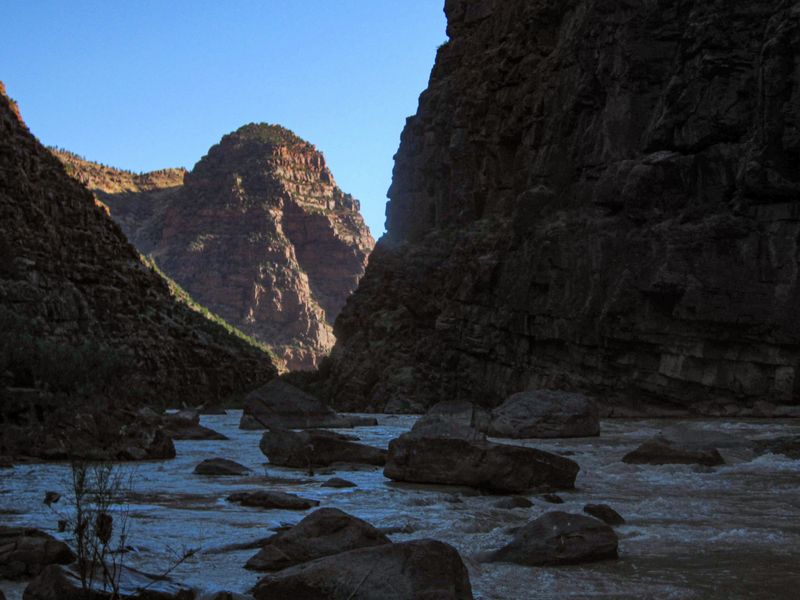
Powell named it after a poem about a waterfall crashing in disaster. Then he capsized. The canyon hasn't changed its mind since.
Lodore compresses everything that matters about western river running into seventeen miles. The Gates — two massive quartzite walls framing the Green River as it enters the Uinta Mountain uplift — are the threshold. Beyond them, the canyon narrows into billion-year-old rock and the rapids begin building toward the two that define the section: Disaster Falls, where Powell lost the No Name in 1869 and nearly lost the expedition, and Hell's Half Mile, a sustained Class IV drop that takes most of an actual half-mile to complete and will be the only thing anyone talks about at camp the night before they run it. Between and beyond the rapids, the canyon is austere and beautiful in a way that sandstone country isn't — dark quartzite polished by the river, cold water from Uinta snowmelt, side slots like Winnie's Grotto that open into shaded corridors sculpted by a million years of flash floods. The trip ends at Echo Park, where the Yampa enters from the east and Steamboat Rock rises eight hundred feet overhead, and the geology shifts abruptly from Precambrian to Mesozoic — a billion years of earth history crossed in a single confluence. This is also the canyon the Bureau of Reclamation proposed to drown in the 1950s. The dam was defeated. The river won. Every trip through Lodore is evidence of that victory.
Lodore is where American river exploration began to go wrong — and where the conservation movement proved it could win. Powell entered these quartzite walls in 1869, named the canyon after a poem about a waterfall crashing in disaster, and then immediately capsized at the rapid he'd call Disaster Falls, losing a boat and most of his remaining food supply six weeks into a journey no one had ever attempted. The canyon hasn't softened since. Seventeen miles of Class III–IV whitewater through billion-year-old Precambrian quartzite inside Dinosaur National Monument, with Hell's Half Mile producing one of the most consequential Class IV drops on the Green River system. In the 1950s, the Bureau of Reclamation proposed drowning all of it under the Echo Park Dam. The Sierra Club fought. The dam was stopped. The canyon is still here — the same river Powell ran, through the same rock he couldn't name because it predates the fossil record entirely.
Lodore's hydrology is Rocky Mountain snowmelt — Uinta Range runoff feeding the Green through Flaming Gorge Reservoir and released at Greendale Dam just upstream of the put-in. The Greendale gauge is the only number that matters for trip planning. At 600 cfs the canyon is technical and scrapy — you're threading lines between quartzite boulders in water that gives you no margin for imprecision. At 1,500 the rapids are well-formed and readable, the pools deep enough to recover, Hell's Half Mile a serious but navigable Class IV. Above 2,500 the hydraulics get powerful — holes develop real holding force, laterals push hard, the recovery windows between drops compress. Above 4,000 the canyon is a committed Class IV run for expert teams who have scouted the high-water lines and have rescue systems that work in cold, fast water. The temperature matters more here than on the Colorado. This is snowmelt from nine thousand feet, released from the bottom of a reservoir — 45 to 52 degrees through spring, cold enough that a swim at Hell's Half Mile is not a whitewater inconvenience but a hypothermia event. Wetsuits and drysuits aren't optional. They're what keeps a swim from becoming an evacuation.
Below 800 cfs — technical and rocky throughout. Disaster Falls requires precise low-water lines; Hell's Half Mile loses some power but demands careful reading. Shallow gravel bars between pools.
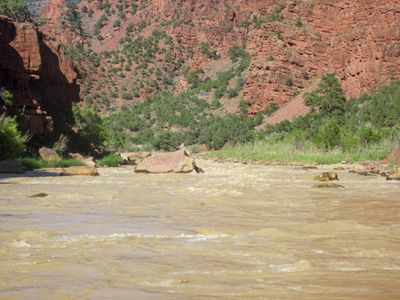
800–2,500 cfs — classic Lodore conditions. Most rapids run with clear, well-defined lines. Hell's Half Mile is Class IV with a defined route. Scouting recommended for first-timers at any flow.
Above 2,500 cfs — powerful hydraulics throughout. Hell's Half Mile becomes a serious Class IV commitment with larger holes. Disaster Falls is fast and complex. For teams experienced at high-volume whitewater. Camp options may be reduced at very high flows.
Water temperatures range from 40–52°F April through June (snowmelt). Hypothermia is a real risk; wetsuit or drysuit required for spring trips. Water warms in summer but remains colder than the Colorado River system.
Runnable but scrapy. Precise low-water lines required at Disaster Falls. Hell's Half Mile loses power but demands careful reading.
The sweet spot. Hell's Half Mile is Class IV with a defined route. Scouting recommended for all groups.
Powerful hydraulics throughout. Hell's Half Mile becomes a serious commitment with larger holes. Camp options may be reduced.
For teams experienced at high-volume Class IV in cold water. Full rescue systems required.
Peak flows April–June driven by Rocky Mountain snowmelt; drops significantly by August. July can still offer good flows in high-snowpack years.
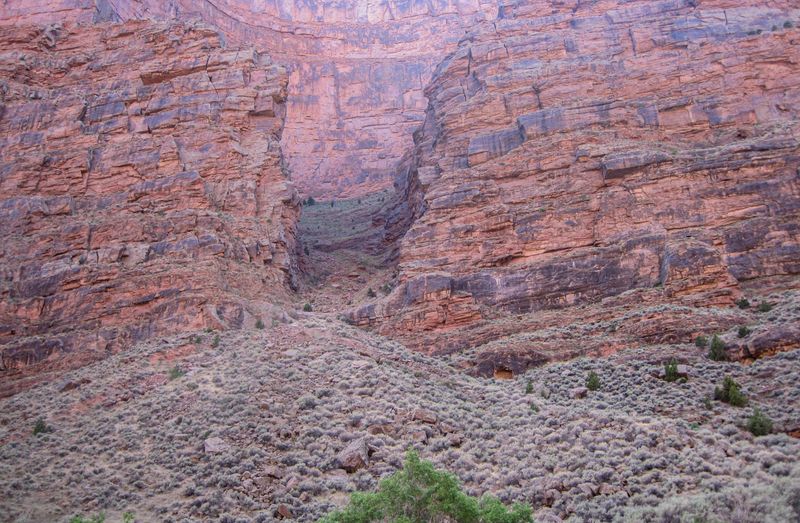
The Uinta Mountain Group quartzite that forms Lodore's walls was deposited as shoreline sand more than a billion years ago — before multicellular life existed — then metamorphosed under heat and pressure into the dense, dark, angular rock that gives the canyon its character. The Uintas are the only major east-west trending range in the Rockies, and the Green River predates them: it established its course before the uplift began and carved downward as the mountains rose, maintaining its path through antecedent incision. The rapids form where this billion-year-old quartzite refuses to erode — the river narrows, steepens, and accelerates around rock that is fundamentally harder than anything in the sandstone canyons downstream. At Echo Park, the geology shifts abruptly to Paleozoic Weber Sandstone and Morgan Formation — a transition that compresses a billion years of earth history into a single confluence.
↑ Rim
↓ River level
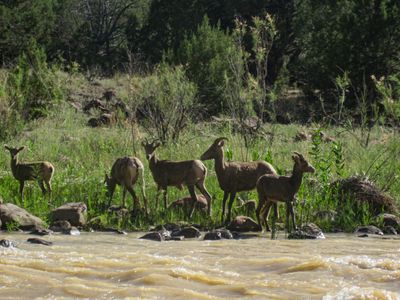
Dinosaur National Monument's protected status produces wildlife density you can see from the boat. Bighorn sheep work the quartzite rim and talus — you'll spot them above Disaster Falls if you look up while scouting. Peregrine falcons nest on the polished cliff faces because the walls are steep enough and smooth enough to be inaccessible to predators. Great blue herons stand in the pools below each rapid with the patience of creatures that have outlasted every management plan. River otters — reintroduced into the monument — are present if you're quiet and lucky. The plant communities have a montane character absent from the sandstone canyons to the south: Fremont cottonwood gallery forest at river level, coyote willow on the bars, big sagebrush on the higher terraces, serviceberry on the rocky slopes. This is the edge of the Rocky Mountain West, not the Colorado Plateau — the ecology reflects that transition. Below the canyon, the Green River provides critical habitat for Colorado pikeminnow and humpback chub — both federally endangered, both adapted to a river system that the dam infrastructure upstream has fundamentally altered. The cold, regulated releases from Flaming Gorge maintain the water temperature regime that Lodore's aquatic community now depends on.
Powell entered Lodore Canyon on June 8, 1869, and named it after Robert Southey's 1820 poem 'The Cataract of Lodore' — a piece of children's verse about a waterfall that comes 'rushing and gushing and flushing and crushing.' Two days later, the No Name hit a rock at Disaster Falls and broke apart. The crew survived. The barometers and much of the remaining food did not. It was six weeks into a journey no one had completed, and Powell was now short one of four boats, navigating blind, with men who were beginning to doubt whether the expedition would survive. Dolnick's account of the expedition captures the psychological texture of that moment — the mix of genuine scientific ambition and genuine terror that defined Powell's leadership. The second expedition in 1871 was better equipped and more deliberately scientific, but it's the 1869 journey that gave Lodore its place in American exploration mythology. The canyon's second great historical moment came in the 1950s, when the Bureau of Reclamation proposed the Echo Park Dam — a structure that would have flooded Lodore and the lower Yampa corridor entirely. The fight to stop it became one of the defining battles of the American conservation movement. David Brower and the Sierra Club led the opposition. The dam was defeated in 1956, partly through a compromise that allowed Glen Canyon Dam to be built instead — a bargain that Marc Reisner and others have called the conservation movement's original sin. Lodore survived. Glen Canyon did not. Every trip through Lodore carries both victories and that cost. The broader corridor connects to the frontier history Burroughs documented in Browns Park — the outlaw geography of the upper Green, where Butch Cassidy's landscape and the ranching culture of the Colorado-Wyoming border persisted because the canyon country made people invisible.
Powell entered Lodore on June 8, 1869, named it after Southey's poem about a waterfall 'rushing and gushing and crushing,' and two days later proved the name prophetic at Disaster Falls. The No Name broke apart; the crew survived; the barometers and most of the remaining food did not. Six weeks into a journey no one had completed, Powell was now short one of four boats. The second expedition in 1871 was better equipped but less dramatic — it's the 1869 journey that gave Lodore its mythology. The canyon connects upstream to the outlaw geography Burroughs documented in Browns Park, where Butch Cassidy's landscape persisted because the canyon country made people invisible.
The permit is the first constraint — lottery through Recreation.gov for May and June, with some shoulder-season availability first-come, first-served. Apply early. Demand for peak dates is high and the NPS controls group size, boat type, and campsite assignment with no flexibility. The shuttle is the second constraint. Gates of Lodore to Echo Park is sixty-five miles via Maybell and Dinosaur, Colorado — about ninety minutes on paved road. That's the easy part. The Echo Park road is thirteen miles of dirt that becomes impassable when wet. A single thunderstorm can strand your shuttle vehicle for days. Call Dinosaur National Monument before running the shuttle. Confirm conditions in person if you can. The canyon itself has no cell service, no road access between put-in and take-out, and NPS-assigned campsites with no substitutions. This is a national monument with enforcement — fire pans, groovers, waste pack-out, and campsite compliance are inspected at Echo Park. The logistical overhead is higher than the mileage suggests. Plan accordingly.
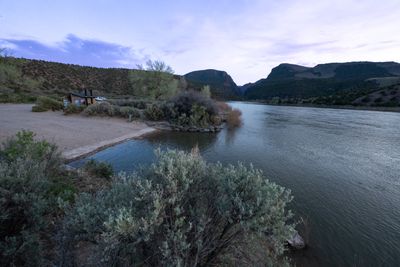
Gates of Lodore Put-in to Echo Park Boat Ramp
Shuttle requires backtracking from Gates of Lodore via Maybell, CO and Dinosaur, CO before taking the Echo Park road. Total drive is ~90 minutes in good conditions. Echo Park road is the vulnerability — a recent rain event can strand vehicles. Confirm conditions with Dinosaur NM (970) 374-3000 before running the shuttle.
Google used a car, their times do not account for towing a trailer, driving on washboard, pitted pavement, and dirt that goes to grease in the rain — our adjusted times help align to the reality of running real river shuttles.
Lottery-based permit system for peak season (May–July). Apply through recreation.gov well in advance — demand for May and June dates is high. Some first-come, first-served availability in shoulder months. The Dinosaur NM permit covers Lodore, Whirlpool Canyon, and Split Mountain as an integrated permit system. Group size and boat type restrictions apply — confirm with NPS at time of permit application.
Lodore is a cold-water Class IV trip that punishes the underprepared. Spring water is 45–52 degrees — Uinta snowmelt released from the bottom of Flaming Gorge Reservoir — and a swim at Hell's Half Mile puts you in that water for longer than you want. Wetsuit or drysuit is non-negotiable through June regardless of air temperature. Neoprene gloves help at high flows. Helmets are essential for all craft — the quartzite is harder than sandstone and the consequences of contact are different. Boats need to be appropriate for sustained Class IV: oar rigs, paddle rafts, or hardshell kayaks with solid self-bailing design. There is nowhere to empty a swamped boat between drops in the gorge section. Throw bags should be accessible and practiced with. The NPS requires fire pans and groovers for all river trips in the monument — they inspect at Echo Park takeout, and they're not casual about it. The short mileage (seventeen miles over three to four days) means you're carrying full expedition gear weight for a compact distance — which creates an opportunity for experienced teams to go light and fast, but also means there's no excuse for cutting corners on rescue, repair, or cold-water preparedness. Bring the gear you'd bring for a week. You'll use more of it than you expect.
On a seven-day trip, you'll cook roughly 20 meals on a folding table in the sand. The constraint isn't ambition — it's ice management. Days one through three, you have real cooler capacity. Days four and five are the transition zone. Days six and seven are pantry cooking.
The best river cooks plan backward from the last night. If your final dinner is still good — not just edible, but genuinely good — the trip ends on a high.
Two coolers, segregated by access frequency. A well-managed deep cooler will hold usable ice through day 6 in 100°F air temps.
Folding table, two-burner propane stove, cast iron skillet, Dutch oven, and a large pot. The Dutch oven is the single most versatile piece.
Books that shape the science, history, and stories behind this place.
Powell's original account of the first scientific expedition through the Grand Canyon, documenting the geology, natural history, and challenges of navigating the unknown Colorado River.
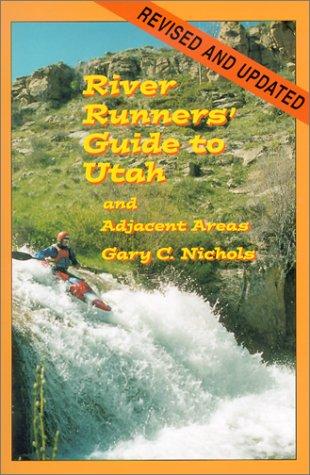
A comprehensive guidebook to whitewater rivers in Utah and neighboring regions, covering river access, rapids, flow considerations, trip logistics, and historical context for river runners.