Skip to content
Book

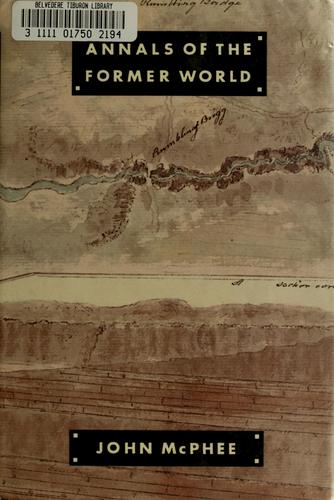
Annals of the Former World

Cover of Annals of the Former World

A landmark work of narrative geology that helps readers understand deep time, tectonics, and the geological forces that shaped North America, including the context needed to appreciate the Colorado Plateau.

OK, picture this. John McPhee is standing on the shoulder of Interstate 80, maybe six inches from semis doing eighty, and he's staring at a roadcut. Not looking at it. Reading it. Next to him is a geologist who's telling him what the rock used to be, a billion years ago, and McPhee is taking notes like it's the most important conversation he'll have all year. That scene happens over and over in this book. From New Jersey to California, state by state, highway by highway, geologist by geologist. It's patient. It's slow. It's the best thing ever written about how the continent got here.

What McPhee does that nobody else has quite pulled off is stay out of the rock's way. He lets the geologists talk. He lets them show you a layer, turn it over in their hands, and tell you what it was doing four hundred million years ago. You can almost feel him not interrupting. When somebody who knows something this specific is actually explaining it, the move is to shut up and write it down, and McPhee is an absolute master of the shutting up part.

I bring this book up around the fire when somebody asks why the layers in a Cataract cliff look the way they do, or why the Chinle sits where it sits, or what the hell a Kayenta even is. Annals doesn't teach you the Grand Staircase by name. That's a different book. What it teaches you is what a geologist is actually doing when she squints at a cliff — she's reading a sentence in a book that's been open for a long time. Once you've got that orientation, every canyon starts to read differently.

The other gift is scale. The Colorado River, as a feature, is not old. The Plateau, geologically, is recent. The rivers we run have been cutting their current courses for a span of time that geology barely registers. McPhee makes that math land in a way that isn't deflating — it's more like widening the frame so what we do on a ten-day trip fits differently. A canyon can be both new and very, very old. Both things are true in the same mile.

Give it a month. Read it on the couch, not in the boat. And accept that road trips are now ruined for you, because every cliff you drive past, you're going to want to know what it used to be.
Details

Genre
Geology, Natural History
Subjects
plate tectonics, geologic history, deep time
Geography
North America, Colorado Plateau
Tags
ISBN
0374105200
Story DNA Themes, moods, voice signals
Themes
deep geologic time, North American tectonics, the geologist as interpreter, roadcuts as autobiography of the earth, patience and scale
Moods
contemplative, wry, vast, humanizing
Motifs
the geologist reading roadcuts, deep time as humbling force, continents as moving objects, the rock record as narrative
Voice
McPhee's literary journalism, expert-in-dialogue, measured wit, deeply patient
Story function
scale-setter, knowledge-foundation, philosophical-anchor, humility-inducer
Setting
roadside geological outcrops, basin and range faulting, ancient sea floors now at eye level, exposed strata as time made visible
Why this book What it influences, what it teaches
Influence
tone, storytelling, knowledge, philosophy
Knowledge
North American tectonics, geological time, plate tectonics, Colorado Plateau formation context
Concepts
geologic deep time as cultural concept, basin and range extension, terrane accretion, the rock record as historical document
Use cases
grounding descriptions of Colorado Plateau geology within the larger context of North American tectonics, writing about the strangeness and scale of deep time in ways that engage a non-specialist reader, modeling how to bring a geologist's perspective into narrative nonfiction about canyon landscapes, calibrating a voice that treats geological complexity as literary subject matter
Related books
The Control of Nature

The Control of Nature

John McPhee · 1989

Three deeply reported narratives about humanity's attempts to stop rivers, lava, and debris flows — and what the land does in return. A masterwork of geological journalism that asks whether nature can ever truly be controlled.

tone storytelling philosophy knowledge
The Colorado Plateau

The Colorado Plateau

Donald L. Baars · 1983

A key geological reference for understanding the uplift, stratigraphy, tectonics, and erosional history of the Colorado Plateau.

knowledge
Canyon Country

Canyon Country

Donald L. Baars · 1989

An accessible introduction to the rock layers, canyon formation, and landscapes of the Colorado Plateau and canyon country.

knowledge
Cadillac Desert

Cadillac Desert

Marc Reisner · 1986

A foundational book on Western water development, dams, irrigation politics, and the long struggle over the Colorado River and the arid American West.

knowledge philosophy cultural context
Geology of Utah's Rivers

Geology of Utah's Rivers

William T. Parry · 2016

A geological exploration of Utah’s major river systems explaining how tectonics, sedimentation, and erosion shaped the canyon landscapes of the Colorado Plateau and surrounding regions.

knowledge

Connected in the graph

  • subject/geology
  • theme/canyon-geology
  • theme/desert-philosophy
  • region/colorado-plateau
  • region/american-west
  • region/colorado-plateau
Verified 2026-04-15 · Sources: open-library · Confidence: partial