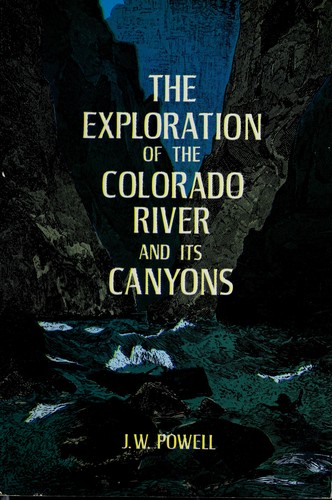
Powell's original account of the first scientific expedition through the Grand Canyon, documenting the geology, natural history, and challenges of navigating the unknown Colorado River.
Powell's own account of the 1869 and 1871 expeditions down the Green and Colorado. This is the primary source — the book Powell wrote when he got back, cleaned up and published to support further government funding of his western surveys. If you've read Dolnick on the expedition, you've read a modern historian working over the material. Powell's book is the material. It is where the later historians went to argue with his version of events, and it is worth reading on its own terms even when you know the factual corrections that have been made since.
The thing to understand up front is that Powell is not a transparent narrator. He conflates the two expeditions in the book. He cleans up certain episodes. He writes himself more heroically than some of the journals of his crew suggest he was. That's the trouble with primary sources when they're written by the leader. What you get is still valuable — Powell was a genuine scientist and a gifted observer, and the geological and ethnographic passages are often astonishing for their 1870s precision — but you read it knowing the later scholarship has annotated it heavily.
I bring this book up on the river when somebody's trying to understand what the canyon looked like before it was canyon country in the modern sense. Powell's descriptions of the Grand Canyon, in particular, are the first English-language accounts of what these walls actually look like from water level. Some passages are simply beautiful. The naming chapter — where Powell walks through how the specific features got their names, the Music Temple, the Marble Canyon, all of them — reads like the founding document of a specific descriptive vocabulary that river people still use.
The book also carries the texture of an era when the American West was being inventoried for the federal government. Powell was not purely an explorer. He was an arm of federal science policy, and the book is, among other things, a successful grant application for ongoing USGS work. Reading it in that frame makes certain passages land differently — the comfort with classification, the ethnographic descriptions of Native tribes, the emphasis on practical utility — because you can see Powell addressing his actual audience in Washington even when the ostensible audience is a general reader.
Read it next to Dolnick if you want the full picture. Powell gives you the view from the captain's boat. Dolnick gives you the modern historian walking the same trip and showing you what Powell left out. Both are useful. And when you are camped under the canyon walls Powell named, knowing the voice that first put English words on them is a specific kind of company to keep.