River Runners' Guide to Utah and Adjacent Areas
A comprehensive guidebook to whitewater rivers in Utah and neighboring regions, covering river access, rapids, flow considerations, trip logistics, and historical context for river runners.
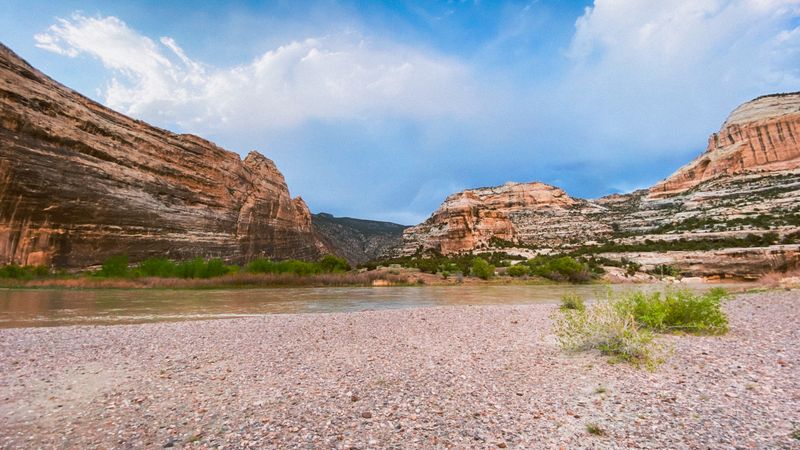
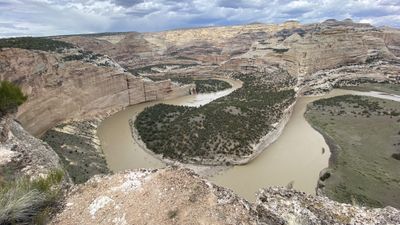
Two and a half miles below Steamboat Rock where the Yampa joins the Green — the confluence, the dam that was never built, and the point where two trips become one.
Two and a half miles from the Yampa confluence to the head of Whirlpool Canyon — the junction of the Lodore and Yampa trips, under Steamboat Rock.
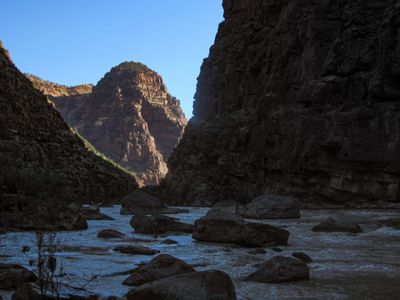
Echo Park is the 2.5 miles where the Green River leaves the Canyon of Lodore, meets the Yampa, and runs through open ground beneath Steamboat Rock before the walls close again into Whirlpool Canyon. It is a short stretch that carries more weight than its length: the Yampa arrives here as the last major undammed tributary in the Colorado system, and half a mile below the confluence is the site of the Echo Park Dam — the proposal that would have drowned this reach and backed water up the Green into Browns Park and up the Yampa into Deerlodge Park, and whose defeat in the 1950s is the fight conservation groups still date their modern era from. For a river party this is the junction: Lodore trips and Yampa trips become the same trip here, and everything below runs on one current.
The Echo Park Dam site sits half a mile below the confluence. The proposal was defeated in the 1950s; the reservoir would have flooded the Green upstream into Browns Park and the Yampa upstream into Deerlodge Park.
Through-trip segment of the Dinosaur National Monument permit system, not a stand-alone run. Echo Park is reachable by a 13-mile dirt road from Dinosaur, CO that closes when wet.
Part of the Dinosaur NM river permit system — the same permit covers Lodore, Echo Park, Whirlpool, and Split Mountain. Lottery for peak season; some walk-up availability in shoulder months.
On a seven-day trip, you'll cook roughly 20 meals on a folding table in the sand. The constraint isn't ambition — it's ice management. Days one through three, you have real cooler capacity. Days four and five are the transition zone. Days six and seven are pantry cooking.
The best river cooks plan backward from the last night. If your final dinner is still good — not just edible, but genuinely good — the trip ends on a high.
Two coolers, segregated by access frequency. A well-managed deep cooler will hold usable ice through day 6 in 100°F air temps.
Folding table, two-burner propane stove, cast iron skillet, Dutch oven, and a large pot. The Dutch oven is the single most versatile piece.
Books that shape the science, history, and stories behind this place.
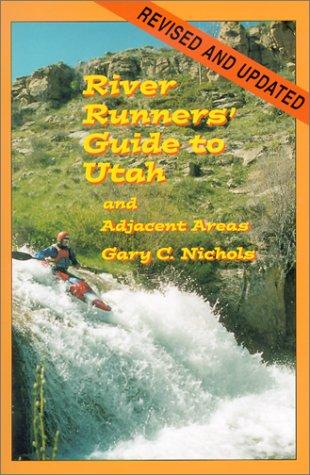
A comprehensive guidebook to whitewater rivers in Utah and neighboring regions, covering river access, rapids, flow considerations, trip logistics, and historical context for river runners.
Powell's original account of the first scientific expedition through the Grand Canyon, documenting the geology, natural history, and challenges of navigating the unknown Colorado River.