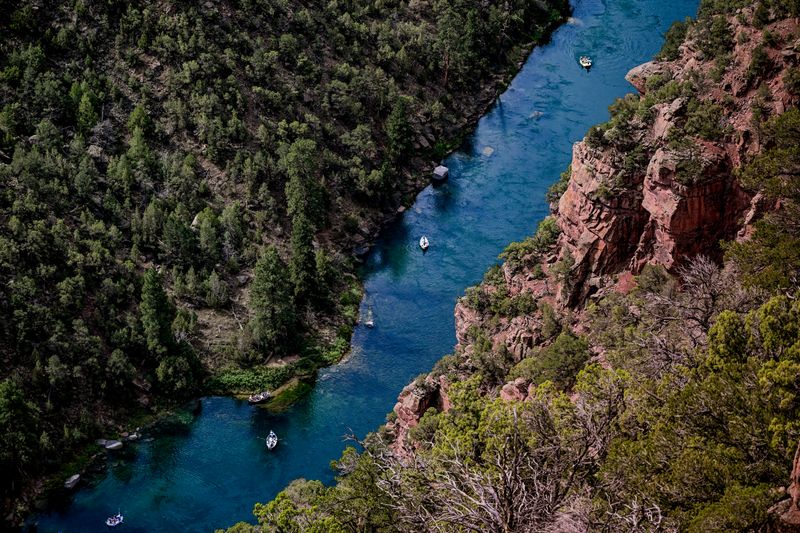
Floating the Green River
Eight hundred miles through the American West — compared section by section, with the decisions that shape each trip.
The Green River in One Sentence
The Green River is the largest tributary of the Colorado — 730 miles from the Wind River Range in Wyoming to the Confluence in Canyonlands National Park — and it runs through four distinct canyon environments that behave like four different rivers.
This is the Desert Maritime field guide to floating it. It covers each of the major sections, permit rules, flow windows, trip length recommendations, and the decision logic for picking a section that fits your crew.
Quick Comparison: Floatable Sections
| Section | Length | Difficulty | Typical Days | Permit | Best Entry-Level? |
|---|---|---|---|---|---|
| A Section (Flaming Gorge tailwater) | 7 mi | I | 1 | None (BLM) | Yes — day trip |
| Lodore Canyon | 44 mi | III–IV | 3–4 | Dinosaur NM (lottery) | No — whitewater skill gate |
| Whirlpool Canyon | 13 mi | II | 1–2 | Dinosaur NM (bundled) | Intermediate |
| Split Mountain | 9 mi | III | 1 | Dinosaur NM (day-use) | Intermediate |
| Desolation / Gray Canyons | 84 mi | II–III | 5–7 | BLM Price (lottery) | Yes — flagship trip |
| Labyrinth Canyon | 68 mi | I (flatwater) | 4–5 | BLM (non-lottery) | Yes — best beginner |
| Stillwater Canyon | 52 mi | I (flatwater) | 3–4 | Canyonlands NPS | Yes — committing |
Go deeper on each: Lodore · Desolation · Gray · Labyrinth · Stillwater · Split Mountain
Section by Section
Lodore Canyon
Upper-watershed whitewater through Dinosaur National Monument. The signature section for experienced private crews seeking Class III–IV in a dramatic red-walled canyon. Cold water well into July because of tailwater releases from Flaming Gorge Dam. Lottery permit via Dinosaur NM.
- Signature rapids: Disaster Falls, Triplet Falls, Hell’s Half Mile.
- Launch: Gates of Lodore.
- Take-out: Most trips continue through Whirlpool and Split Mountain to Rainbow Park or Split Mountain Boat Ramp.
- Skill gate: Class III–IV pilot competence, self-rescue, cold-water preparedness.
Desolation and Gray Canyons
The flagship Green River multi-day. Eighty-four miles from Sand Wash to Swasey’s Beach through the Tavaputs Plateau. Technical Class II–III whitewater concentrated in the Three Fords / Coal Creek / Nefertiti rapid sequences in Gray Canyon. The approach through Desolation is long miles of canyon wall and camp rhythm. Best flagship desert expedition for competent intermediate crews.
- Signature rapids: Three Fords, Coal Creek, Nefertiti.
- Launch: Sand Wash (shuttle from Price or Ouray).
- Take-out: Swasey’s Beach or Nefertiti take-out.
- Permit: BLM Price Field Office — lottery-based, limited launch dates.
- Skill gate: Class III pilot, multi-day self-sufficiency, ability to read eddy lines at scale.
Desert Maritime Desolation expeditions:
- Desolation / Gray Private 6-Day
- Desolation / Gray Family Expedition
- Desolation / Gray Photo Itinerary
Labyrinth Canyon
The quintessential desert flatwater expedition. Sixty-eight miles from Ruby Ranch (or Green River, UT) to Mineral Bottom through twisting red sandstone canyon. No rapids. Simple BLM permit, no lottery. Ideal for beginner crews, first-time desert-river families, and solo packrafters.
- Character: flatwater, long miles, quiet canyon.
- Launch: Ruby Ranch or Green River State Park.
- Take-out: Mineral Bottom.
- Permit: BLM Moab — non-lottery, required for overnight use.
- Skill gate: basic boat handling, multi-day camping competence, wind tolerance.
Related: Packrafting the Green River: Labyrinth Canyon guide
Stillwater Canyon
Fifty-two miles from Mineral Bottom to the Confluence inside Canyonlands National Park. Continues the character of Labyrinth — flatwater, spectacular canyon walls, deep solitude — but inside the park boundary with its own permit system. Most trips continue through Stillwater into Cataract if that permit is also held.
- Character: flatwater, deep canyon, committed backcountry.
- Launch: Mineral Bottom.
- Take-out: Confluence (jet-boat shuttle up the Colorado) or continue into Cataract.
- Permit: Canyonlands NPS — lottery-based.
Flaming Gorge Tailwater (A, B, C Sections)
Short, cold, clear water immediately below Flaming Gorge Dam. A Section is the most-floated 7-mile stretch. Day trips only; mostly fishing-oriented. Drysuit-required water temperatures year-round in A.
Decision Logic: Which Section For Your Crew
If you are a first-time desert-river crew → Labyrinth Canyon.
- Simple permit. No rapids. Long miles teach you what a desert river feels like.
If you have one Class III trip under your belt and want a flagship multi-day → Desolation / Gray.
- Apply for the lottery. Plan 5–7 days. This is the trip most private crews remember as their first real expedition.
If you want committed backcountry flatwater without whitewater decisions → Stillwater (or Labyrinth-plus-Stillwater).
- The Confluence is one of the great destinations in the American West.
If you are experienced Class IV and want cold-water whitewater → Lodore.
- Pick a 3–4 day Lodore-Whirlpool-Split itinerary. Drysuits in spring.
If you want to run the Cataract big water → Combine Stillwater with Cataract as a single-system trip.
- Green to Cataract Full System Trip
Flow Windows
The Green is a dam-influenced river with a large snowmelt signal. Flaming Gorge Dam controls the upper sections; the desert sections below the confluence with the Duchesne are driven by a mix of tailwater releases and snowmelt.
Gauges to watch:
- USGS 09315000 — Green River at Green River, UT (below Desolation/Gray, above Labyrinth)
- USGS 09261000 — Green River near Jensen, UT (below Split Mountain)
- USGS 09234500 — Green River near Greendale, UT (Flaming Gorge tailwater)
Typical brackets:
- < 4,000 cfs: low water on desert sections. Technical in Gray Canyon rapid sequences; bony in Labyrinth at the bends.
- 4,000–10,000 cfs: moderate, consistent. Good trip flow for most crews.
- 10,000–20,000 cfs: high water. Desolation moves faster; Gray rapids become more hydraulic than technical. Labyrinth current is noticeably pushier.
- > 20,000 cfs: high runoff. Watch for floating debris and eddy-line instability, especially in Gray Canyon.
Go deeper: Best time to raft the Green River, Utah · live USGS gauges are embedded on each section page.
Trip Length Recommendations
| Section | Fast | Standard | Comfortable |
|---|---|---|---|
| Lodore | 3 days | 4 days | 5 days with layover |
| Desolation / Gray | 5 days | 6 days | 7 days |
| Labyrinth | 3 days | 4 days | 5 days with layover hikes |
| Stillwater | 3 days | 4 days | 5 days |
| Labyrinth + Stillwater | 7 days | 8 days | 9 days |
Gear
Different sections ask for different systems:
Flatwater (Labyrinth, Stillwater):
- Self-bailing rafts, duckies, or packrafts all work.
- Wind tolerance matters more than whitewater rigging.
- Sunshades and kitchen wind-protection are the differentiators.
Moderate whitewater (Desolation, Gray):
- Rafts with frame-mounted oars standard.
- Helmets optional in Desolation, recommended through Gray rapids.
- PFDs and throw bags on every boat.
Big whitewater (Lodore):
- Full big-water rigging.
- Drysuits in spring; wetsuits year-round.
- Helmets, rescue gear, safety boat configurations.
Go deeper: River packing system · Big-water rafting gear · Desert river shade systems
Shuttle
Each section has its own shuttle profile:
- Lodore: Gates of Lodore to Split Mountain — ~2 hours through Dinosaur NM.
- Desolation / Gray: Sand Wash to Swasey’s or Nefertiti — 3–4 hours, complex logistics. Use a shuttle service.
- Labyrinth: Ruby Ranch / Green River State Park to Mineral Bottom — 2–3 hours via Moab.
- Stillwater: Mineral Bottom launch; jet-boat take-out from the Confluence.
Several Moab and Vernal shuttle services handle vehicle movement for these sections.
Season Choice
- April–May: spring flows, cool weather, peak canyon green on the Green.
- June: runoff peaking. Longer days, warming water, popular permit dates.
- July–August: hot in Labyrinth and Stillwater. Lodore and Desolation still comfortable at elevation.
- September–October: shoulder season. Cooler nights, stable flows, golden light, quieter canyons.
The Green has the longest floatable season of the desert-river system. Lodore is typically runnable April–September; Labyrinth and Stillwater can be floated nearly year-round, though winter trips are cold and uncommon.
The Desert Maritime Field Position
Our take, after running these sections for two decades:
- Labyrinth is the most underrated trip in the desert-river system. Solitude, simplicity, and canyon scale without whitewater decisions.
- Desolation is the flagship private-crew multi-day. The lottery is worth the discipline of applying yearly.
- Lodore rewards experienced crews that treat it as a genuine whitewater trip, not a longer version of Cataract at lower flows.
- Combining Stillwater with Cataract is one of the great river-system traverses in North America; few boaters have done it.
- The Green is the quiet alternative to the Colorado. Less fame, more canyon miles per permit.
Cluster Articles
The library is being rebuilt one field-checked article at a time. More are coming back soon.
Related Field Systems
- River packing system
- Utah rafting permits
- Big-water rafting gear
- Desert river shade systems
What Next
- Pick a section that matches your crew’s skill and time.
- Check the permit window and apply.
- Lock the shuttle — the Green’s take-outs are distant from the put-ins.
- Build the kit around the section, not around generic river-trip gear lists.
- Read the gauge the morning of launch, not yesterday.
See you on the water.