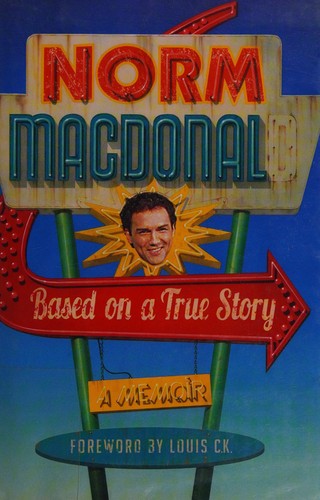
Macdonald's 'memoir' that is simultaneously a novel, a meditation on death, and a serious philosophical inquiry into the difference between a story and the truth. One of the strangest books a comedian has produced — structured around the joke as the only honest response to mortality, and the lie as the only honest form of autobiography.
Norm Macdonald wrote a memoir. Except it's not. Except it is. Based on a True Story is a 240-page object that presents itself as an autobiography of a Canadian comedian and is in fact a novel, a meditation on death, a gambling confession, a sustained joke about the form of the memoir, and — weirdly — maybe the most philosophically serious book any standup has ever published. The whole thing is built on a lie. The lie is that he's writing the truth. Which is, Macdonald will quietly let you know, the only kind of truth that you can actually trust a comedian to tell.
The structure sneaks up on you. It opens like any celebrity memoir — here's my hometown, here are my parents, here's how I got into comedy. By about chapter three you notice the seams. By chapter ten you realize the book has three different narrators, at least one of whom is lying on purpose, and the straight autobiographical content is being interrupted by a running second narrative about a kidnapping plot that never fully resolves. And somewhere in there, Norm is talking very plainly about his gambling addiction, about his friends who died, about what he actually thinks standup is for. Those pages are, not to overstate it, important.
Bring this book up at the fire when somebody gets to the question of why we tell stories about trips that didn't happen quite the way we remember them. Norm has the answer. The answer is that the story is always the true thing, and the facts are what you use to assemble the story. If the story doesn't land, the facts are lying. If the story does land, the facts got out of the way. Every trip report you've ever written has been negotiating that same line. Norm just put it in the title.
The humor is relentless, which you'd expect, but the book has a grief inside it that'll catch you off guard. There's a passage about a dead friend, played as a joke for two pages, that turns at the end into one of the truest descriptions of losing somebody I've read anywhere. It's the Norm move: build the joke so carefully that when you pull the legs out, the reader is already in too deep to get out of the feeling.
Read it slow. Read it twice. The second read is when the lie becomes legible as a structure, and the book becomes one of the strangest and best comic novels of the last twenty years.