Skip to content
Book

Fargo Rock City

A Heavy Metal Odyssey in Rural North Dakota

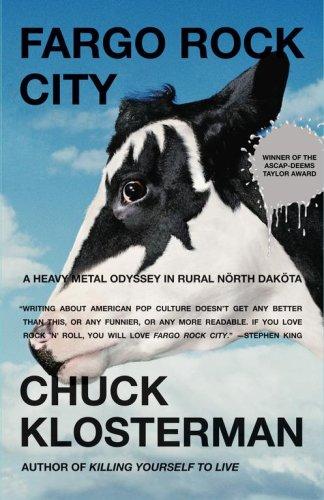
Cover of Fargo Rock City

Klosterman's debut makes a deeply earnest case for heavy metal as the defining cultural experience of growing up isolated and rural in the 1980s — arguing that the music wasn't escapism but identity formation, and that what looks like bad taste from the outside can be the most honest thing about a person.

Klosterman's first book, and the one where he figured out what he was going to do for a living. Fargo Rock City is a serious defense of hair metal — Motley Crue, Poison, Ratt, Warrant, the whole glammed-up late-eighties catalog that a certain generation has spent the last thirty years pretending not to have loved. Klosterman doesn't pretend. He grew up on a farm near Wyndmere, North Dakota, and this music was his. He argues that it was actually a good soundtrack for growing up isolated, that the bad taste people accuse it of was more honest than most coastal bands' good taste, and that dismissing it says more about the dismisser than the music.

The reason the book works is that Klosterman is not writing a defense in the academic-rock-critic sense. He's writing a memoir that happens to have a bunch of record reviews in it. The best passages are about what it felt like to be a kid in rural North Dakota with a cassette deck and four usable cassettes and absolutely nothing to do but listen to them until they wore out. That's the argument. The music wasn't escapism. It was the one place a teenager in a two-stoplight town could go to feel like his life was large.

Bring this book up at the river when somebody's looking down their nose at a cultural thing somebody else loves. Klosterman's framework is useful: the question isn't whether the thing is good, the question is what it was doing for the person who loved it. That's a better question, and it'll change how you have the conversation. It'll also make you more generous about the crew member who will not stop playing Def Leppard on the dry box speakers.

The writing is funnier than it needs to be, which is the Klosterman signature. He'll sneak a brilliant sentence past you in a paragraph that's ostensibly about Tommy Lee's drum kit, and if you're not paying attention, you'll miss it. The book is also, quietly, a small classic of rural-American writing, because it takes farm-kid experience seriously without making it precious. That's rare, and it's one of the reasons the book has outlived the bands it's about.

Read it on a long drive out west. The soundtrack writes itself. And if you find yourself halfway to a launch with Cherry Pie unironically in the rotation, Klosterman has already forgiven you.

Details

Genre
Essays, Cultural Criticism, Memoir
Subjects
heavy metal, rural isolation, identity formation through culture, taste and class, earnestness as critical method
Geography
North Dakota, Rural Midwest, American Plains
Tags
ISBN
9780743231572
Story DNA Themes, moods, voice signals
Themes
isolation as identity forge, the sincere defense of unfashionable things, rural consciousness vs. coastal condescension, subcultural belonging in emptiness, pop culture as survival mechanism
Moods
earnest, self-aware without being self-mocking, argumentative, nostalgic-but-clear-eyed, regionally defiant
Motifs
isolation as the condition that sharpens everything, the unfashionable thing that is actually true, identity formed in opposition to geography
Voice
the argument made with complete sincerity, pop culture reference as evidence, personal history as cultural theory, the outsider making the insider case
Story function
cultural-context, voice-model, philosophical-anchor, humor-anchor
Setting
flat empty landscapes that produce extremity, the small town that makes you who you are, regional identity as philosophical position
Why this book What it influences, what it teaches
Influence
tone, cultural-context, philosophy
Knowledge
subcultural studies, rural identity, music criticism, American regionalism
Concepts
the earnest defense as critical method, isolation as authenticity, regional consciousness as intellectual position
Use cases
writing about the DM audience — people formed by remote, marginal landscapes and the cultures that live there, defending expedition culture against charges of privilege or performance with earnest precision, writing about gear, music, or food culture that desert river people actually love without apology, making the case for canyon country as seriously as Klosterman makes the case for Mötley Crüe
Related books
Sex, Drugs, and Cocoa Puffs

Sex, Drugs, and Cocoa Puffs

Chuck Klosterman · 2003

Klosterman's breakthrough uses cereal, soccer, The Sims, and Pamela Anderson as serious philosophical raw material — arguing that what a culture throws away tells you more about it than what it keeps. A manifesto for treating low culture with the same rigor you'd give to high culture.

tone storytelling humor cultural context
A Supposedly Fun Thing I'll Never Do Again

A Supposedly Fun Thing I'll Never Do Again

David Foster Wallace · 1997

Seven essays that include a devastatingly funny account of a luxury cruise ship, a meditation on tennis and perfectionism, and a dispatch from the Illinois State Fair — all united by Wallace's relentless self-awareness, his footnote-addicted brain, and his genuine anxiety about what American leisure and entertainment are doing to us.

tone storytelling philosophy humor
Consider the Lobster

Consider the Lobster

David Foster Wallace · 2005

Wallace's second essay collection ranges from a piece on the Maine Lobster Festival (which turns into a moral inquiry into whether lobsters feel pain) to the 2000 McCain campaign to Kafka's humor to the Adult Video News Awards — each essay a demonstration that any subject, taken seriously enough, becomes a window into something large.

tone philosophy storytelling cultural context
Liar's Poker

Liar's Poker

Michael Lewis · 1989

Michael Lewis's first-person account of his years at Salomon Brothers during the 1980s bond trading boom — a world of staggering excess, ritualized absurdity, and the slow realization that none of it means anything. A masterclass in using financial culture as a lens on human nature.

tone storytelling humor
Generation X

Generation X

Douglas Coupland · 1991

Three friends retreat to the California desert to swap apocryphal stories and escape the soul-crushing logic of careerism and brand culture. Coupland's debut coined 'McJob' and gave a generation its name — a portrait of people who chose smallness and experience over scale and status.

tone philosophy cultural context
Born Standing Up

Born Standing Up

Steve Martin · 2007

Martin's precise, unsentimental account of a decade of grinding craft — playing near-empty clubs, developing a deliberately absurdist act, and surviving the long ambiguous middle before everything worked. A memoir about obsessive mastery that happens to be about comedy, useful as a model for writing about any discipline that requires years of invisible apprenticeship.

tone storytelling philosophy

Connected in the graph

  • theme/cultural-criticism
  • theme/comedy-as-criticism
  • theme/outdoor-voice
  • theme/counterculture
  • region/american-west
Verified 2026-04-15 · Sources: open-library · Confidence: partial