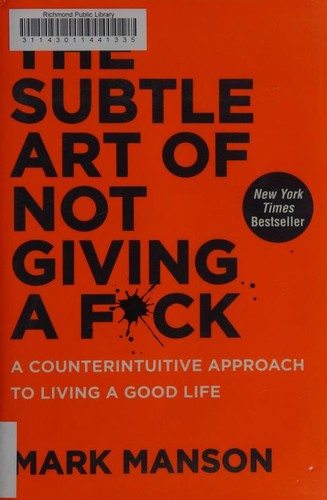
A rejection of toxic positivity disguised as a self-help book — Manson argues that meaningful life requires choosing what to care about deliberately, not optimizing everything. More philosophically honest than the title suggests, it draws on Stoic and existentialist thought to make a case for values-driven suffering.
Mark Manson's book is the self-help book for people who don't read self-help, and that's not a backhanded compliment. The central argument — that a meaningful life requires choosing what to care about deliberately, because giving equal weight to everything is the surest path to low-grade despair — is not new, but Manson's version is unusually plainspoken and unusually willing to make fun of the genre he is writing in. The title is the joke and the thesis both. You are going to care about something. The only question is whether you chose it.
The book is short, the prose is casual, and the anecdotes move fast. Manson is better at synthesizing other people's ideas than at generating his own, which is fine — most self-help books are better when they stop pretending to be original and just deliver a clean version of practical philosophy. Stoicism, some existentialism, a little pop Buddhism, a fair amount of hard-won practical advice from his own bad decade in his twenties. If you've read any of the source material, you'll recognize the ingredients. If you haven't, Manson is a reasonable introduction.
I bring this book up at the river when somebody is overwhelmed by the number of things they think they're supposed to care about. The Manson frame is useful. Pick three. Pick them deliberately. Let the rest go. If that sounds glib on the page, the book delivers it less glibly — Manson is not arguing for apathy, he is arguing for focus — and the frame holds up surprisingly well when you apply it to real decisions. The outdoor life in particular is one that rewards this kind of sorting. You cannot do every trip. Pick the trips that actually mean something. Accept that the others are not going to happen.
The weakness of the book is that it is written at a specific register and in a specific cultural moment. The voice will grate on some readers. The casualness will read as unearned to others. The examples are dated, and the book's willingness to curse frequently as a stylistic choice has aged into a period signature rather than the fresh move it was in 2016. If any of this will bother you, it will bother you quickly, and you can stop after thirty pages without losing anything the remainder has not also said.
Read it when you're mid-decision about something that has been consuming too much of you. Manson is not the philosopher you want for the long game, but he is a useful clearing house, and an hour with this book will often reveal the choice you were already trying to make under the noise of all the things you were only pretending to care about.