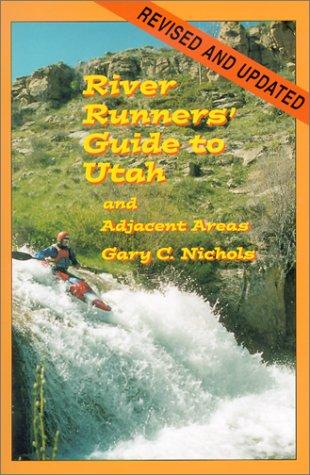
River Runners' Guide to Utah and Adjacent Areas
A comprehensive guidebook to whitewater rivers in Utah and neighboring regions, covering river access, rapids, flow considerations, trip logistics, and historical context for river runners.
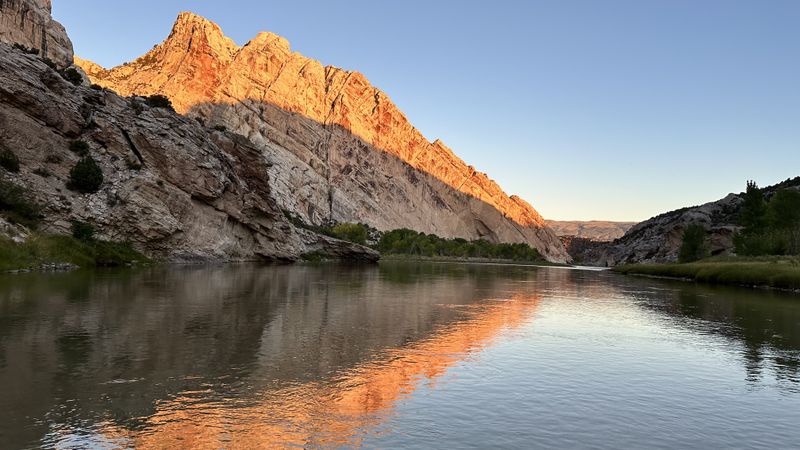
Split Mountain is the Green River's most concentrated whitewater — 9 miles punching through a breached anticline, capped by the Class IV SOB Rapid and one of the most dramatic canyon exits in Dinosaur National Monument.
Split Mountain is the dramatic finale of the Dinosaur National Monument river system — a 9-mile gorge where the Green River cuts directly through an anticline rather than around it, creating a canyon of tilted and folded rock unlike anything else on the Colorado Plateau. Four major rapids, including the Class IV SOB, deliver concentrated whitewater in a short distance that makes this the most intense day-trip on the upper Green. Whether run as a standalone day trip or as the capstone of a Lodore–Whirlpool–Split Mountain expedition, it's a worthy finish.
The Jensen gauge reads conditions directly at the take-out; flows above 4,000 cfs raise the stakes at SOB Rapid significantly.
Primary operational gauge for planning Split Mountain Canyon floats. Located near Jensen, UT, below Dinosaur National Monument, this gauge integrates snowmelt from the Uinta Basin watershed and is the most direct reading for Split Mountain and lower Lodore trip planning.
USGS #09261000Below 1,500 cfs — technical and punchy; SOB Rapid requires precise lines through exposed rocks.
1,500–4,000 cfs — classic Split Mountain conditions; all four major rapids run powerfully and cleanly.
Above 4,000 cfs — SOB Rapid becomes a serious Class IV commitment with large hydraulics; experienced whitewater teams only.
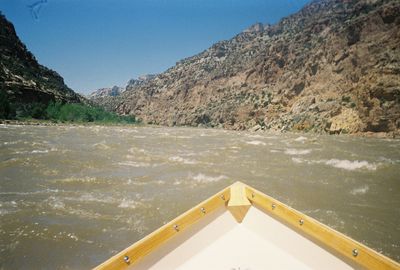
Peak flows May–June from Rocky Mountain snowmelt; frequently run in April at lower flows.
↑ Rim
↓ River level
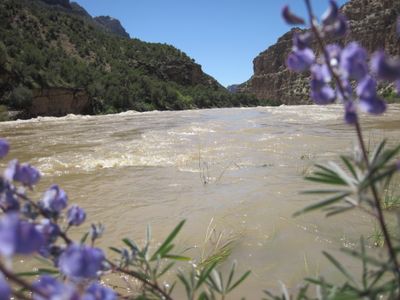
Split Mountain sits adjacent to the Dinosaur National Monument Quarry — one of the richest dinosaur fossil sites in North America. Powell's 1869 expedition exited Dinosaur through Split Mountain, completing the first recorded navigation of the upper Green River canyon system.
Permit required even for day trips; the short paved shuttle and nearby Jensen services make Split Mountain one of the most accessible Dinosaur permit runs.
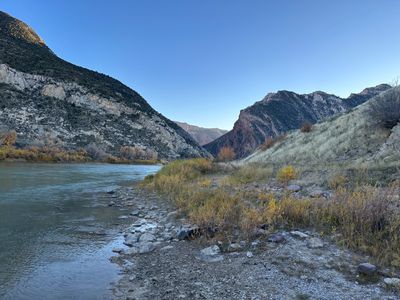
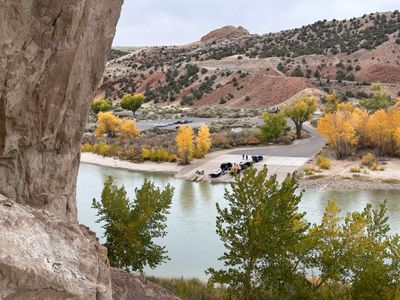
Rainbow Park Boat Ramp to Split Mountain Boat Ramp
Google used a car, their times do not account for towing a trailer, driving on washboard, pitted pavement, and dirt that goes to grease in the rain — our adjusted times help align to the reality of running real river shuttles.
Dinosaur NM requires a day-use permit to float Split Mountain (owner, 2026-09-02). This listing binds a party LAUNCHING here — the Rainbow Park to Split Mountain daily. A multi-day party arriving from upstream on a Lodore or Yampa river permit (recreation.gov 250014) is already covered and does NOT need this permit as well; dayUseOnly is what tells the trip permit rollup to skip it on those routes. appliesTo: day_use (2026-09-02, replacing the transitional dayUseOnly boolean) — this listing binds a party LAUNCHING here. A multi-day party arriving from upstream on the Dinosaur Green And Yampa River Permits (recreation.gov 250014) is already covered; rec.gov's own 250014 listing states it covers Split Mountain Canyon.
On a seven-day trip, you'll cook roughly 20 meals on a folding table in the sand. The constraint isn't ambition — it's ice management. Days one through three, you have real cooler capacity. Days four and five are the transition zone. Days six and seven are pantry cooking.
The best river cooks plan backward from the last night. If your final dinner is still good — not just edible, but genuinely good — the trip ends on a high.
Two coolers, segregated by access frequency. A well-managed deep cooler will hold usable ice through day 6 in 100°F air temps.
Folding table, two-burner propane stove, cast iron skillet, Dutch oven, and a large pot. The Dutch oven is the single most versatile piece.
Books that shape the science, history, and stories behind this place.
A comprehensive guidebook to whitewater rivers in Utah and neighboring regions, covering river access, rapids, flow considerations, trip logistics, and historical context for river runners.
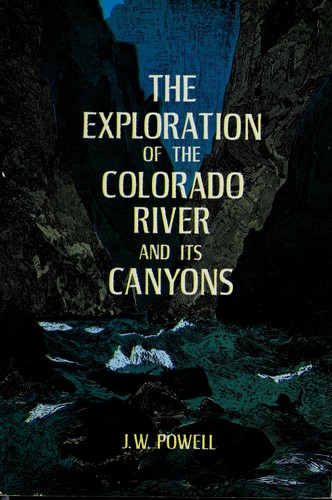
Powell's original account of the first scientific expedition through the Grand Canyon, documenting the geology, natural history, and challenges of navigating the unknown Colorado River.