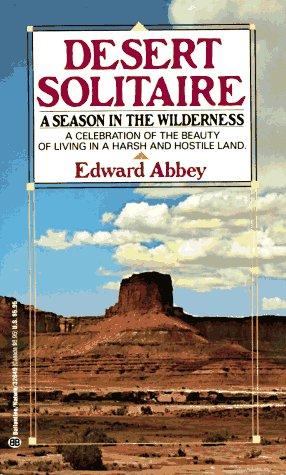
Desert Solitaire
Edward Abbey's classic portrait of canyon country, solitude, and wilderness, influential to the identity and mythology of the Colorado Plateau.
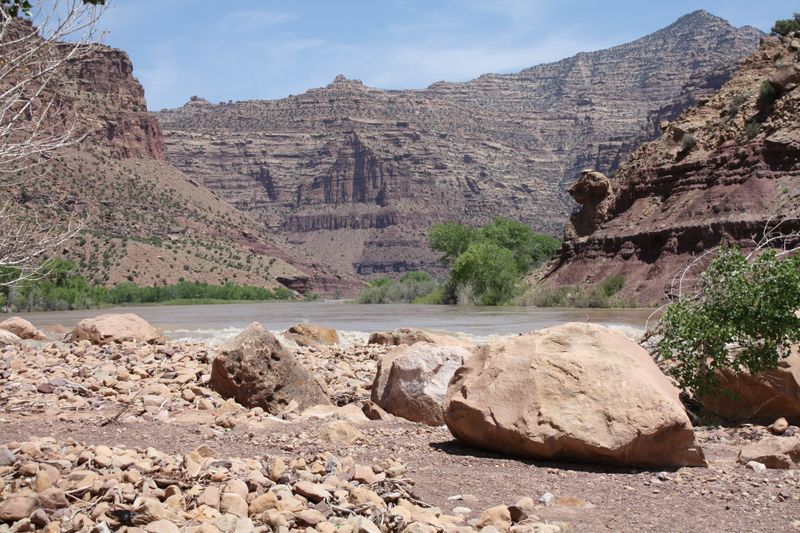
Powell called it desolation. He was wrong about the name and right about the scale.
Desolation is less about the rapids than about the accumulation of days inside something enormous. You launch from Sand Wash — a ranger station at the end of sixty miles of dirt — and for the next week the canyon is your geography. The walls build slowly from Uinta Basin badlands into stepped sandstone cliffs a thousand feet high. The rapids arrive the same way: riffles, then wave trains, then Steer Ridge and Surprise and the building sequence toward Joe Hutch and Three Fords, where the river narrows and the consequences become real. Between the rapids, there are Fremont petroglyph panels older than the Roman Empire, ranch ruins with fruit trees still producing, side canyons that open into country no one has visited since the last group that bothered to walk in. Camp life is the trip. Big sandy beaches, cottonwood shade, kitchen logistics that matter because you're out there for six or seven days and the quality of your camp systems determines the quality of your experience. This is the section that teaches new trip leaders what expedition temperament actually means — not the ability to run hard whitewater, but the discipline to plan well, move patiently, and pay attention to a landscape that reveals itself slowly.
Desolation is the trip that teaches you what a river expedition actually is. Not the whitewater — though the whitewater is real — but the accumulation of days in a canyon so remote and architecturally vast that you stop measuring progress in miles and start measuring it in light changes on the walls. Fifty-eight miles of Green River corridor through the Tavaputs Plateau, past Fremont rock art panels that predate English by a thousand years, through ranches that outlaws used because the geography made them invisible, and over rapids that build gradually from read-and-run riffles into genuine consequence at Three Fords and Joe Hutch. Powell named it Desolation in 1869 because he was starving and afraid. Most people who float it now name it something closer to the opposite.
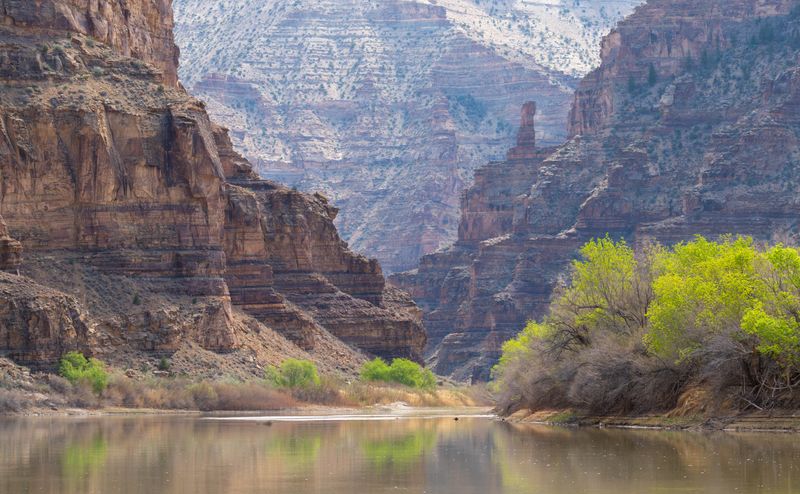
Named landmark at river mile 191.4, recorded on the owner's log.
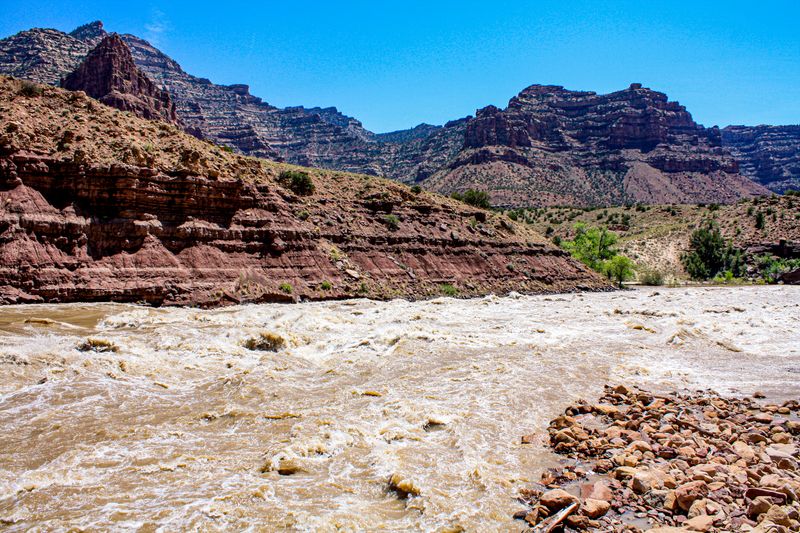
Joe Hutch / Cow Swim Rapid at mile 54.3 is one of the biggest rapids in Desolation Canyon. A 2008 debris slide from Joe Hutch Canyon on river-right dramatically changed the rapid character — what had been a moderate Class II–III became one of the largest drops on the run. The rapid carries both historical names: Cow Swim from earlier livestock-era usage, and Joe Hutch from the 2008 event and the creek that caused it.
The Green through Desolation reflects the integrated hydrology of the upper Colorado Basin — snowmelt from the Uintas, the Yampa's contribution upstream, the White River entering below Bonanza. It's not a flashy single-drainage response. The rise comes gradually, peaks in late May or early June, and recedes through summer into the base-flow regime that carries the river through fall. What changes with flow isn't difficulty so much as character. At 3,000 cfs the rapids are rocky and technical — you're reading water, picking lines between exposed boulders, making lateral moves that matter. At 8,000 the same features become splashy wave trains with real body, the kind of read-and-run whitewater that rewards attention without demanding expertise. Above 16,000 the river speeds up, laterals strengthen, eddies become harder to catch, and the consequence of a swim extends because the current carries you farther before you can self-rescue. The water is snowmelt-influenced and can be cold enough to matter well into June — cold enough that a swim in Steer Ridge at high water is a serious event, not a refreshing dip.
At lower flows the trip slows down, eddies become more relevant, rocky moves are more apparent in several rapids, and some landings become less straightforward. Camp selection can become more tactical.
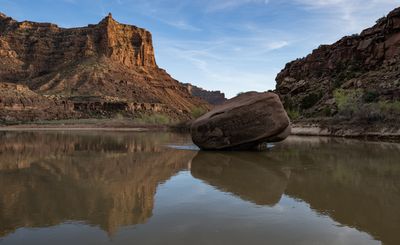
Classic Desolation character for many private groups: splashy wave trains, manageable read-and-run whitewater, good camp options, and balanced travel speed with time for hikes and interpretation.
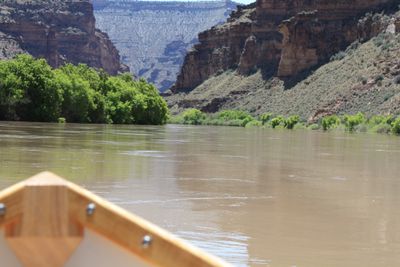
Higher flows increase pace, flatten some features while amplifying others, strengthen laterals and recovery consequences, and make downstream decision-making more important. Big-water experience improves comfort.
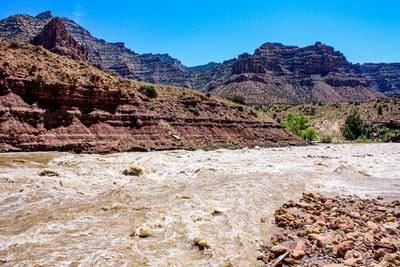
Water is snowmelt influenced and can remain cold enough to matter well into warm-weather launch windows. Wetsuit or splash planning should be flow- and season-dependent.
Mellow flatwater sections become shallow. Some dragging.
Classic desert float. Consistent current, engaging rapids.
Fast and pushy. Campsite availability changes. Great for experienced crews.
Most commonly boated from spring through fall, with late spring and early summer often offering the classic medium-to-high-water Deso character.
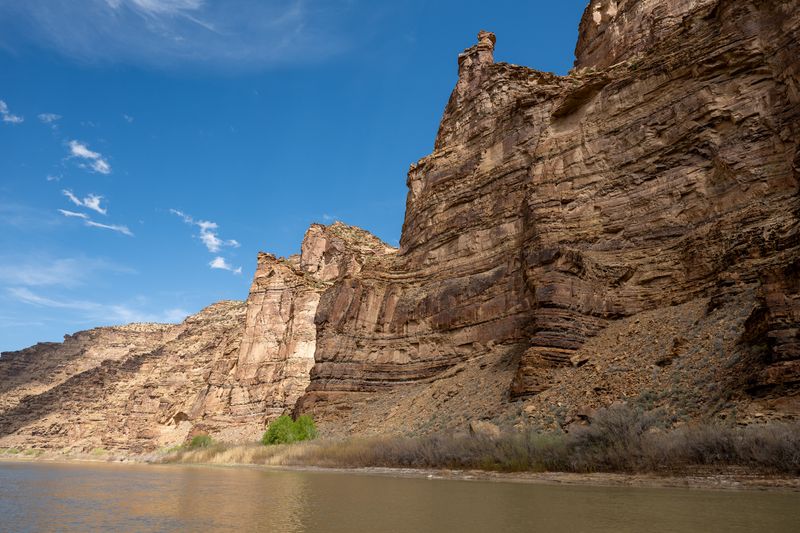
The upper canyon exposes Eocene lake and stream deposits from the Green River Formation — sediments laid down fifty million years ago when ancient Lake Uinta covered the basin. These pale, banded layers erode into the stepped badlands and crumbly bluffs that give upper Desolation its lunar character. Downstream, the river cuts deeper into Cretaceous Blackhawk Formation and Mancos Shale — marine and deltaic sediments from the Western Interior Seaway. By Gray Canyon, the walls are massive and dark, and the stratigraphic story has shifted from lakebed to ocean floor. The entire corridor demonstrates antecedent incision: the Green maintained its course as the Tavaputs Plateau rose, carving downward through sixty million years of sedimentary history. Rapids form at constriction points where resistant rock units narrow the channel and where tributary debris fans steepen the gradient.
↑ Rim
↓ River level
The riparian corridor is a narrow biological engine inside a vast arid landscape. Cottonwoods mark the water table along benches and camp beaches. Willow and tamarisk crowd the banks — the tamarisk invasive, persistent, and increasingly managed. Above the riparian zone, pinyon-juniper woodland grades into sagebrush and rabbitbrush on the uplands. Desert bighorn sheep work the ledges and side-canyon rims; golden eagles hunt from the thermals; great blue herons stand in the shallows with the patience of something that has done this for longer than you've been alive. Wild horses appear occasionally on the benches — feral, not native, but part of the corridor's visual character. Beaver activity is visible along tributary mouths. Rattlesnakes are present and generally uninterested in you unless you're uninterested in watching where you step. The ecology changes by season more than most groups expect: spring brings nesting raptors and high water that reshapes beach habitat; summer brings heat that drives wildlife to dawn and dusk activity; fall brings lower water, cooler air, and a river corridor that feels quieter in every measurable way.
The Fremont people were here first — or at least first among the cultures whose record is visible from river level. Their petroglyph panels at Flat Canyon and Rock Creek are among the most significant accessible rock art sites in Utah: anthropomorphic figures, bighorn sheep, geometric patterns, and imagery whose meaning is debated by archaeologists and immediately felt by anyone who stands in front of it. The Fremont occupied this corridor roughly from 200 to 1300 CE, overlapping with and distinct from the Ancestral Puebloan cultures to the south. Later, Ute people used the canyon as part of a broader seasonal territory — a fact that tends to get compressed into a single sentence in river guidebooks but represents thousands of years of continuous relationship with this landscape. Powell came through in 1869 on his first Colorado River expedition, named the canyon Desolation because his expedition was exhausted and underfed, and moved on. The name stuck even though it describes his state of mind, not the place. In the ranching era, families like those at Rock Creek built homesteads in the canyon because the geography provided water, grazing, and isolation — the same qualities that made Browns Park, fifty miles upstream, a refuge for Butch Cassidy and the regional outlaw culture that John Rolfe Burroughs documented. The cabin at Firewater Canyon tells a later, smaller story — moonshining during Prohibition, because the canyon was remote enough that no one would find your still. These layers don't compete. They accumulate. A six-day trip through Desolation touches all of them.
Fremont petroglyph panels at Flat Canyon and Rock Creek are among the most significant accessible rock art sites in the state — anthropomorphic figures, bighorn sheep, geometric patterns dating from roughly 200–1300 CE. Ute people used this corridor as part of a broader seasonal territory for thousands of years. Powell named it Desolation in 1869 because his expedition was exhausted; the name describes his state of mind, not the place. In the ranching era, families at Rock Creek built homesteads in the canyon because the geography provided water, grazing, and isolation — the same qualities that made the broader Green River corridor attractive to the outlaw culture Burroughs documented in 'Where the Old West Stayed Young.' The Firewater Canyon cabin tells a Prohibition-era moonshining story. These layers accumulate rather than compete — a six-day trip touches all of them.
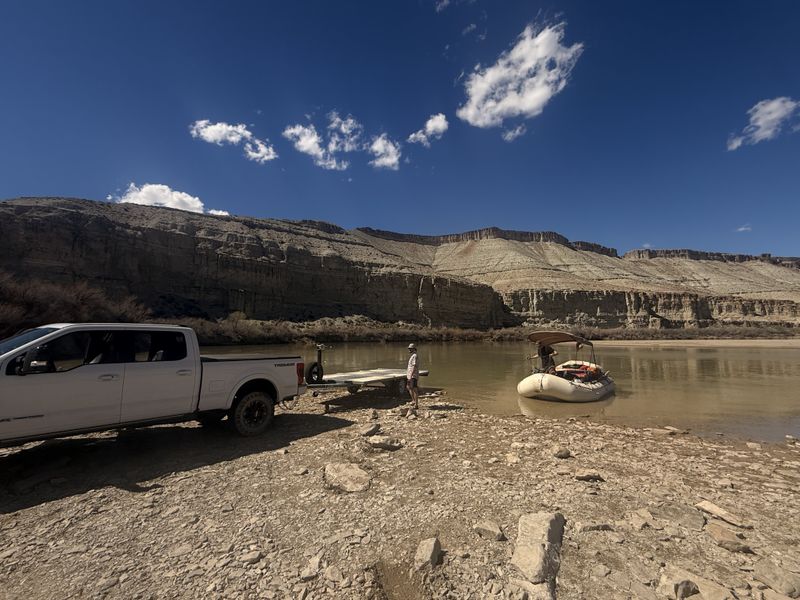
The shuttle defines the logistics. Sand Wash to Swaseys is 94 miles through Nine Mile Canyon — itself a significant cultural landscape — on graded dirt that takes four and a half hours in good conditions and longer when rain turns the clay sections into something your tires negotiate rather than drive on. Most groups arrange professional shuttle support because the alternative is leaving a vehicle at each end and solving a complex retrieval problem after a week on the river. The put-in has a ranger station, vault toilets, a primitive ramp, and screen cabins — genuine infrastructure by backcountry standards, but no services, no fuel, and no cell coverage. From launch, you are committed. Satellite communication is essential. Spare tires are essential. A realistic daily mileage plan that accounts for wind, side hikes, and the fact that camp selection takes longer when you're choosing between beaches you've never seen — that's essential too. The exit at Swaseys near Green River, Utah, is the most civilized thing that happens to you in a week.
Remote BLM launch with ranger presence in main season, primitive ramp, toilets, rigging area, and nearby primitive camping/screen cabins.
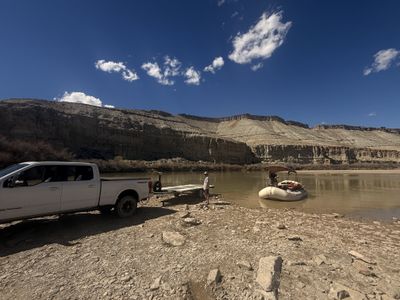
Sand Wash Ranger Station and Boat Launch to Roan Cliffs
For the remainder of the 2026 boating season, recreation.gov recommends that ALL travel to and from Sand Wash go via US-40 and Myton, and that the Nine Mile Canyon route from US-6 and Wellington be avoided (read 2026-10-14; re-check each season). From Myton the road south to Sand Wash is graded gravel; BLM: good tires and spare tires are a must. The Sand Wash–Swaseys shuttle historically ran through Nine Mile Canyon from Price or Wellington; either way expect long dirt segments, blind curves, dust and clay that stops being road when it rains. Road miles and drive time are not authored here: each maps app reports them for the route's own put-in and take-out coordinates (directionsLinks).
Google used a car, their times do not account for towing a trailer, driving on washboard, pitted pavement, and dirt that goes to grease in the rain — our adjusted times help align to the reality of running real river shuttles.
Private permits are administered through BLM/Recreation.gov. Pets are prohibited. Minimum trip length is 3 calendar days and maximum is 9. Group size may not exceed 25 people. Trip leaders should review current stipulations before launch. RIVER LEFT IS CLOSED. For about 65 miles, from the reservation boundary below Sand Wash down to Coal Creek, the left bank is the Uintah and Ouray Reservation, and the Ute Indian Tribe states that "Desolation Canyon still remains closed to non-members for any recreation, hiking, or camping." That is a closure, not a permit you can apply for — camping permits stopped being issued in August 2020 and there is no application path to reopen. It covers hiking and stopping to look around, not just overnights. Plan every camp on river right, which is BLM. Check current status with the Tribe's Fish & Wildlife Management office before you launch: https://utetribe.com/fish-wildlife-management/
Permit compliance is central here. Group size, required equipment, launch inspection, boat tags, and trip-length rules are enforced. Cultural-site respect and no-trace camp discipline are essential.
Desolation rewards comfort gear in a way that shorter whitewater runs don't. Camp life is the trip — six or seven days of kitchen logistics, shade management, sleep systems, and sand — and the quality of your expedition systems determines whether camp is a place you want to be or a place you endure between rapids. A good shade tarp matters more here than a dry top. A gravity water filter matters more than a pin kit. Camp chairs aren't luxury items when you're spending four hours at camp every evening for a week. The repair kit should be comprehensive because you're a long way from anything: spare oar, raft patches, pump parts, frame hardware. First aid should account for sun exposure, dehydration, and the kind of minor injuries that become significant on day five when the nearest road is forty miles away. Fire pan and groover are required. Satellite communicator is essential. And the single most underrated piece of gear for a Deso trip is practical camp footwear — something that handles sand, cobble, mud, and the short hikes to petroglyph panels without destroying your feet before the rapids even start.
Desolation tends to reward comfort gear more than shorter whitewater-centric runs because camp quality and daily living are such a large part of the trip. Shade, kitchen efficiency, and sand-management systems are worth their weight here.
Non-negotiable for this launch. Rangers may check for several of these at the put-in.
Field-tested picks that earn their place on this trip.
Not essential, but worth the boat space if you have it.
On a seven-day trip, you'll cook roughly 20 meals on a folding table in the sand. The constraint isn't ambition — it's ice management. Days one through three, you have real cooler capacity. Days four and five are the transition zone. Days six and seven are pantry cooking.
The best river cooks plan backward from the last night. If your final dinner is still good — not just edible, but genuinely good — the trip ends on a high.
Two coolers, segregated by access frequency. A well-managed deep cooler will hold usable ice through day 6 in 100°F air temps.
Folding table, two-burner propane stove, cast iron skillet, Dutch oven, and a large pot. The Dutch oven is the single most versatile piece.
Books that shape the science, history, and stories behind this place.
Edward Abbey's classic portrait of canyon country, solitude, and wilderness, influential to the identity and mythology of the Colorado Plateau.
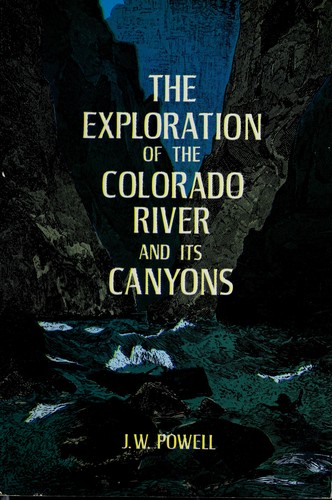
Powell's original account of the first scientific expedition through the Grand Canyon, documenting the geology, natural history, and challenges of navigating the unknown Colorado River.
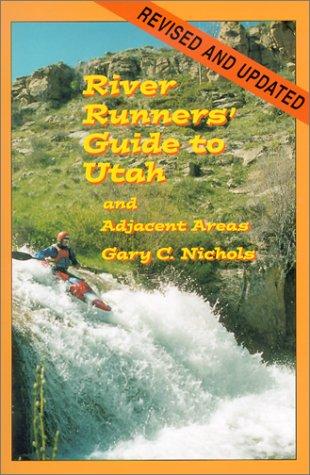
A comprehensive guidebook to whitewater rivers in Utah and neighboring regions, covering river access, rapids, flow considerations, trip logistics, and historical context for river runners.