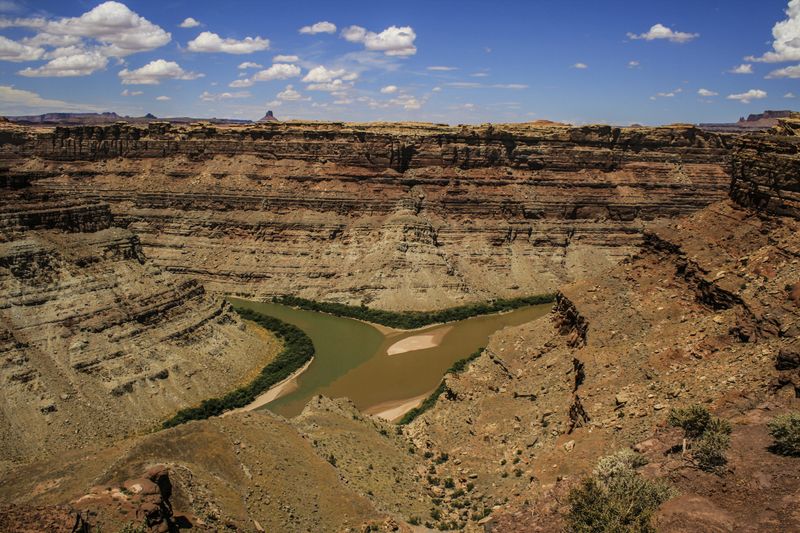
Rafting Cataract Canyon
The definitive field guide to running 100 miles of the Colorado through Canyonlands — from Potash to Hite, with the Big Drops in the middle.
Cataract Canyon in One Sentence
Cataract Canyon is 100 miles of the Colorado River through Canyonlands National Park — a flatwater approach, a 14-mile whitewater corridor with the Big Drops sequence, and a long lower-canyon finish that ends at Hite or North Wash depending on reservoir conditions.
This is the definitive Desert Maritime field guide to running it. It covers permits, skill gates, flow windows, trip length, shuttle logistics, and the decisions that shape the trip. Every section links out to the specific entity page, cluster article, or planning document where you can go deeper.
Quick Facts
| Variable | Detail |
|---|---|
| Length | ~100 miles (Potash to North Wash) |
| Difficulty | Class III–IV (flow-dependent, up to Class V at extreme high water) |
| Season | April–October; peak runoff late May–early June |
| Typical trip length | 4–6 days |
| Permit | Required — Canyonlands NPS via recreation.gov |
| Put-in | Potash Boat Ramp, UT |
| Take-out | North Wash / Dirty Devil (or Bullfrog at high reservoir) |
| Shuttle | ~3 hours one way via Hwy 95 |
| Crew size | Up to 25 per permit |
Related entities: Cataract Canyon section dashboard · Colorado River overview · Canyonlands National Park
Who Should Run Cataract
Cataract is not a beginner trip. The flatwater approach is casual, but the Big Drops corridor is not negotiable — once you are downstream of the Confluence, you are committed to running the whitewater.
Skill gates, in approximate order of importance:
- Experience reading big water and identifying hydraulic features at scale.
- Self-rescue competence in cold, silty flatwater above the Big Drops.
- A capable pilot for each boat — oars or motor — who has seen similar water before.
- Cold-water preparedness in spring: water can be 40–50°F well into June.
If the trip is your first encounter with Class IV whitewater, hire a commercial outfit. If you are a competent private boater who has run at least one other multi-day Class IV river, Cataract is within reach with appropriate craft and crew.
The Permit System
Canyonlands National Park manages Cataract Canyon permits. There is no lottery — permits are issued through recreation.gov on a first-come-first-served basis. The system changes periodically; confirm current process on recreation.gov before planning.
Rules of thumb:
- Apply early.
- Group size caps apply — plan crew and boat counts before you lock a permit.
- Bring the approved toilet system (groover), fire pan, and ash-out kit. Rangers check.
- Register vehicles at Potash; retrieve via shuttle to the take-out.
Go deeper: Utah rafting permits guide · How to apply for a river permit lottery (stub)
The Big Drops Sequence
Three Class IV rapids sit in sequence in the middle of the whitewater corridor: Big Drop 1, Big Drop 2, and Big Drop 3. Big Drop 3 is where Satan’s Gut lives — the corkscrewing pourover on river left that most river runners scout for. At flows under 15,000 cfs they are technical and rocky. Between 20,000 and 30,000 cfs they are powerful pool-drop big water. Above 40,000 cfs they are washed into a continuous hydraulic corridor with reduced pool recovery.
Treat the Big Drops as a connected sequence:
- A flip or swim in Big Drop 1 has downstream consequences in Drop 2 and Drop 3.
- Camp above Spanish Bottom the night before gives you a rested, organized start.
- Scout all three. Scout them at matching flow, not yesterday’s flow.
- Every boat should know the signal for “I’m running” vs. “holding for safety.”
Safety considerations:
- Cold water near snowmelt peak — dress for immersion.
- Throw bags on every boat and at scout points.
- Helmets on through the corridor.
- A safety boat below the runouts is standard practice.
Go deeper: Cataract Canyon section dashboard — rapid descriptions, camp locations, feature map.
Flow Windows
Cataract is a dam-influenced but snowmelt-driven river. Glen Canyon Dam does not sit above Cataract; flow is the combined Colorado-above-Confluence and Green-above-Confluence systems. USGS gauges to watch: 09185600 (Colorado at Potash) and 09328920 (Green at Mineral Bottom) for the launch-day combined flow, and 09328960 (Gypsum Canyon) for the post-Big-Drops reading. Combined peak typically lands between 15 May and 15 June.
Practical brackets:
- 5,000–10,000 cfs: technical, rocky, Class III with Class III+ Big Drops. Low margin for error at the boulder gardens.
- 10,000–20,000 cfs: classic moderate. Big Drops are powerful but scout-and-run with good lines.
- 20,000–35,000 cfs: big-water Class IV. Hydraulics stack. The sequence feels compressed. Rewarding.
- 35,000–50,000 cfs: serious big water. Pools start to wash out. Experienced crews only.
- 50,000+ cfs: expedition-grade high water. Commercial outfits shift tactics or cancel. Private trips should plan around it only with deep big-water resume.
Go deeper: Best time to raft the Green River, Utah (related seasonality) · section-page live USGS gauge.
Trip Length
| Days | Pace | Fits |
|---|---|---|
| 3 | Speed run, motor-assisted | Not recommended unless experienced + motor |
| 4 | Standard with motor | Experienced private crews, efficient kits |
| 5 | Balanced | Good margin for scout, weather, layover |
| 6 | Comfortable | Hikes, rest, rock-art side trips |
| 7+ | Uncommon | Depends on permit dates and reservoir conditions |
The Potash-to-North-Wash run is the standard route. At low Lake Powell elevation, the take-out may move further downstream to Hite or Bullfrog; build that contingency into the plan.
Go deeper: Cataract Canyon Standard 4-Day expedition · Cataract Canyon Big Water expedition
Gear
Cataract is a big-water trip through a committing canyon. Gear choices should reflect that.
Non-negotiables:
- Self-bailing rafts with full big-water floor rigging.
- Straps for every load, redundant where possible.
- Helmets, PFDs, throw bags on every boat.
- Approved toilet system (groover) and fire pan.
- Cold-water paddling clothes for spring — drysuits if runoff is peaking.
- Spare oars and frames.
- Satellite communication (inReach or equivalent) — cell service ends at the Confluence.
Comfort items that matter in the lower canyon:
- Shade structure for long afternoons at camp (desert sun).
- Wind-ready kitchen setup — the lower canyon funnels afternoon headwinds.
- Paco pads or equivalent — camp beaches are sandy but uneven.
Go deeper: Big-water rafting gear · River packing list · Desert river shade systems
Logistics
Put-in: Potash Boat Ramp, about 15 miles from Moab via paved then graded road. Adequate rigging space, vault toilet, ranger presence during season. Leave vehicles at the upper lot.
Take-out: North Wash / Dirty Devil at typical Lake Powell levels. At low lake, the take-out migrates downstream to Hite or Bullfrog. Expect a muddy, steep carry.
Shuttle: Approximately 3 hours one way via US-191, I-70, and UT-95. Several Moab-based shuttle services handle vehicle movement. Self-shuttle requires two drivers and a long day.
Communication: No cell service below the Confluence until Hite. Satellite communication is required for group safety. File a float plan with a contact at home.
Season Choice
- April: cool, lower flows, fewer crews. Spring storms possible.
- May: runoff rising. Water still cold. Bigger crowds closer to peak.
- June: peak flows, longer days, warming water. Popular.
- July–August: hot (100°F+ in canyon), moderate flows, quieter.
- September–October: low flows, cool nights, golden light. Technical Big Drops at low water.
Pick based on the experience you want, not just the permit you drew. A June permit at peak runoff is a different trip than a September permit at low water.
How the Canyon Changes With Reservoir Level
Lake Powell backs into the lower canyon. Over the last two decades, as the reservoir has dropped, formerly drowned rapids have re-emerged. Expect:
- Reservoir sediment shelves, some soft, some quicksand-adjacent.
- New or re-emerged rapids below the Big Drops.
- A take-out location that shifts with the year’s water management.
- Navigational features that do not match older guidebooks.
Check current conditions with Canyonlands NPS boater information before launch.
The Desert Maritime Field Position
Our take, after two decades of running this canyon:
- Cataract rewards patience on the approach and decisive action at the Big Drops.
- Most incidents happen when a crew rushes the approach miles and arrives tired at Spanish Bottom.
- The best trips camp above Spanish Bottom, scout the Big Drops in morning light, and commit.
- Low-water Cataract is a different river than high-water Cataract. Train for both if you want to run it consistently.
- The lower canyon — below the whitewater — is underrated. Build days for it.
Cluster Articles
Deeper reading on specific Cataract topics:
- Cataract Canyon Rafting Guide — trip-level breakdown with logistics, camps, and notes from the water.
- How Difficult Is Cataract Canyon Rafting? — plain-language skill gate assessment.
- Best Camps in Desolation Canyon — parallel thinking for the sister trip north of the Confluence.
Related Field Systems
- River packing system — modular approach to gear, kitchen, and camp loads.
- Desert river shade systems — mid-day heat management.
- Utah rafting permits — all Utah permit systems in one reference.
What Next
If Cataract is on your calendar, start here:
- Confirm permit and dates.
- Build the crew — minimum one Big Drops-level pilot per boat.
- Lock the shuttle.
- Pack the system, not a gear list. See the river packing system.
- Scout on the water, not on yesterday’s flow.
The canyon does not reward hurry. It rewards observation. See you on the water.
Evidence behind the claims on this page — agency rules, maps, gauges, books, and field notes.
Permits
Hydrology
Access
Rapids
- book-excerpt Cataract Canyon (Webb / Belnap / Weisheit) — Selected Pages
- book RiverMaps Guide to the Colorado & Green Rivers in the Canyonlands of Utah & Colorado
Geology
- geology-ref USGS Geology of Canyonlands National Park (with Huntoon / Billingsley / Breed geologic map) ·
- book-excerpt Cataract Canyon (Webb / Belnap / Weisheit) — Selected Pages
History
Management
Books
Logistics
- field-note Desert Maritime — River Packing System Notes ·
Safety
- book-excerpt Cataract Canyon (Webb / Belnap / Weisheit) — Selected Pages