Colorado River
The Colorado carves the deepest canyons of the Southwest — from Westwater's technical gorge to Cataract's flood-season violence to the 226-mile Grand Canyon traverse. · CO · UT · AZ · NV · CA
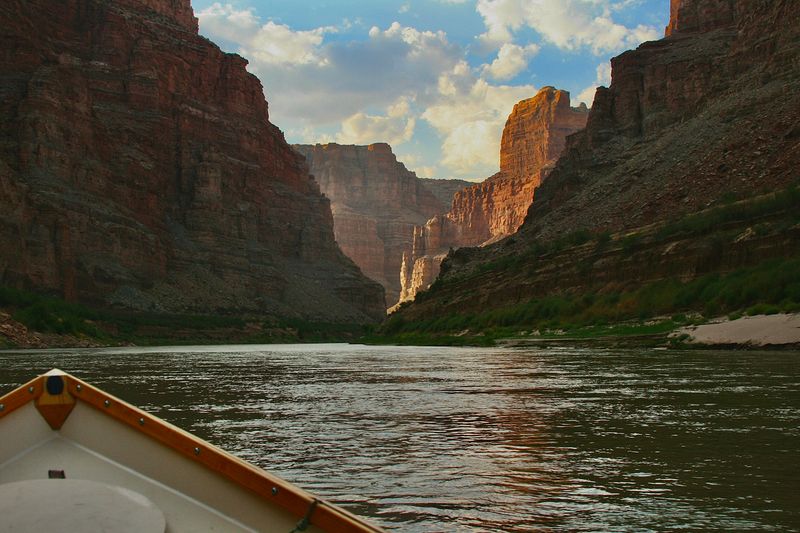
The Colorado River is the defining waterway of the American Southwest — 1,450 miles from the Rocky Mountain headwaters in Colorado to its historical terminus at the Gulf of California. The river carved the Grand Canyon, built the Canyonlands, and divided the Colorado Plateau into the architecture of high desert civilization. For boaters, it is a system of systems: the technical pool-drop of Westwater Canyon; the 40 miles of Cataract Canyon, where the whitewater concentrates in the first fourteen below the Confluence; the 226 miles of permit-controlled wilderness in the Grand Canyon; the quiet flatwater of Moab Daily and Meander Canyon between them. The Colorado is simultaneously one of the most over-allocated rivers in the world — every drop spoken for by compact law — and one of the most powerful wild experiences available to those who can access its permits. It flows through the ancient Precambrian basement of the Colorado Plateau, through a mile of exposed rock in the Grand Canyon, and through the heart of the most contested water politics in the Western United States.
Colorado River Sections
-
Ruby–Horsethief Canyon
25 mi Ruby–Horsethief Canyon is the Colorado Plateau's most welcoming multi-day float — 25 miles of... -
Westwater Canyon
17.2 mi Westwater compresses the entire Colorado River experience into a single day. The first six miles are... -
Cisco to Dewey Bridge
16.1 mi The quiet flatwater extension of a Westwater trip — 14 miles between Cisco and Dewey Bridge through... -
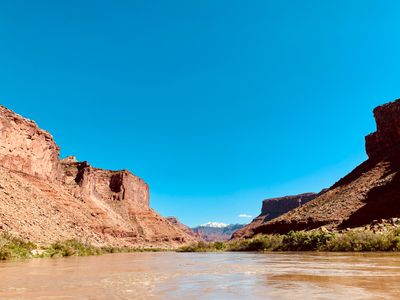
Dewey Bridge to Hittle Bottom
6.3 mi The most accessible mellow float above Moab — a redrock half-day on the Colorado with zero... -
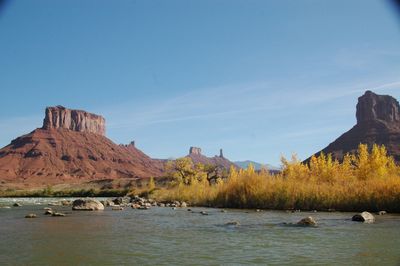
Professor Valley
13.8 mi The 13-mile Hittle Bottom to Take Out Beach float — the most-run day section on the Colorado... -
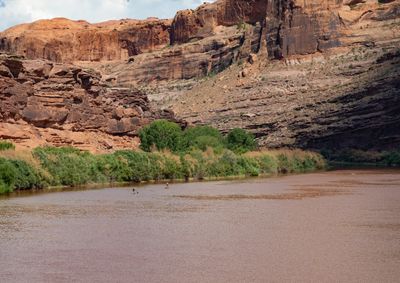
Take Out Beach to Moab Bridge
10 mi 10-mile Class I float from Take Out Beach through Moab to the US-191 Moab Bridge, with seven BLM... -
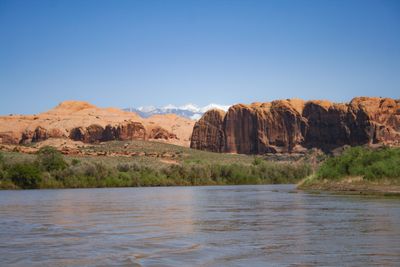
The Portal
17 mi 17-mile Class I flatwater through The Portal — where the Colorado exits the Moab Valley through a... -
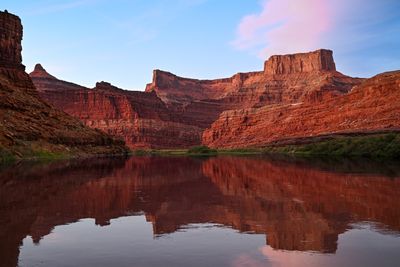
Meander Canyon
48 mi Meander Canyon is the quiet before the storm — 48 miles of total flatwater through the heart of... -
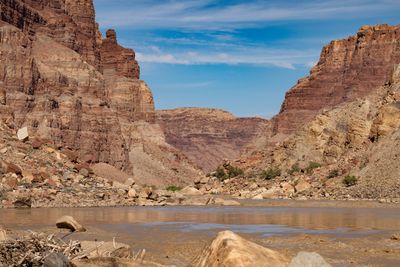
Cataract Canyon
40 mi Cataract Canyon begins where the Green meets the Colorado, deep in Canyonlands. Above the rapids,... -
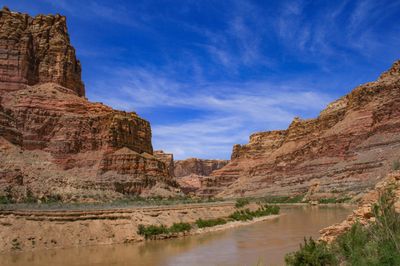
Narrow Canyon
7.5 mi Narrow Canyon is where Cataract Canyon exhales — tight walls, still water, and the eerie transition...
heavily regulated — Glen Canyon Dam (Lake Powell), Hoover Dam (Lake Mead), Davis, Parker, and many upstream diversions control flow throughout
Colorado River near Cameo, CO
USGS #09095500Current flow — Colorado River near Cameo, CO
USGSColorado River Near Cisco, UT
USGS #09180500Current flow — Colorado River Near Cisco, UT
USGSColorado River at Potash, UT
USGS #09185600Current flow — Colorado River at Potash, UT
USGSColorado River at Gypsum Canyon, UT
USGS #09328960Current flow — Colorado River at Gypsum Canyon, UT
USGSColorado River above the Dirty Devil River, near Hite, UT
USGS #09328990Water surface — Colorado River above the Dirty Devil River, near Hite, UT
USGSLake Powell at Glen Canyon Dam, AZ
USGS #09379900Pool elevation — Lake Powell at Glen Canyon Dam, AZ
USGSColorado River at Lees Ferry, AZ
USGS #09380000Current flow — Colorado River at Lees Ferry, AZ
USGSColorado River above Diamond Creek, AZ
USGS #09404200Current flow — Colorado River above Diamond Creek, AZ
USGSElevation still to drop
—
Between the river gauge above the Dirty Devil and the Lake Powell pool.
Both water surfaces on the NAVD 88 datum. This is the vertical distance between two elevations, nothing more — it is not a gradient, not a difficulty rating, and it says nothing about the ramp, the carry, or whether the reach is worth running.
Best conditions vary dramatically by section. Cataract Canyon peaks in May–June runoff for big water; Grand Canyon is prime March–May and September–October; Westwater runs year-round with irrigation season (March–September) providing consistent flows. Summer (July–August) is viable but hot — 100°F+ in canyon bottoms. Spring runoff from Rocky Mountain snowmelt drives Cataract and upper sections. Fall offers ideal temperatures and lower crowds throughout.
Reading the Rock Record
Rock sequence of Colorado River
↑ Rim
- Navajo Sandstone
- Kayenta Formation
- Wingate Sandstone
- Hermit Formation
- Redwall Limestone
- Tapeats Sandstone
- Vishnu Schist
↓ River level
The Colorado River corridor supports four federally listed native fish — Colorado pikeminnow, razorback sucker, and bonytail, all endangered, and humpback chub, downlisted from endangered to threatened in 2021 — that evolved over millions of years in the warm, silt-laden, seasonally variable flows of the pre-dam river. Dams, diversions, and altered water temperatures have severely impacted native fish populations. Recovery programs operate throughout the system. Tamarisk, established throughout much of the riparian corridor since the mid-20th century, has displaced native cottonwood-willow communities across large reaches.
Notable Expeditions
- Powell Colorado River Expedition
- Powell Second Colorado River Expedition