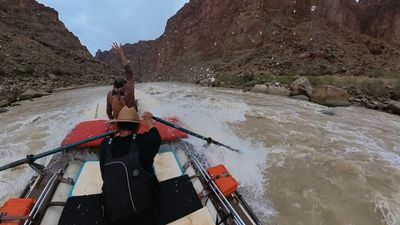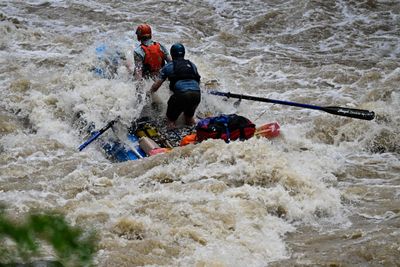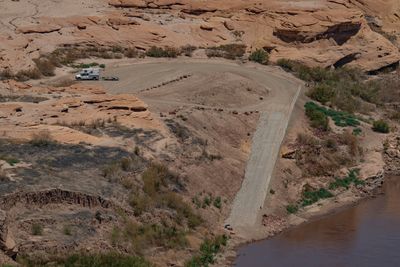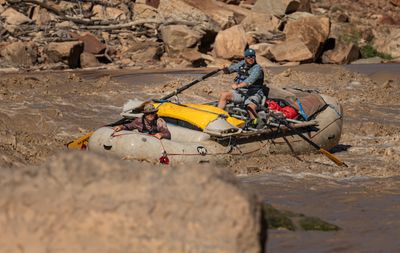
Cataract Canyon's reputation tends to split into two extremes — either "Utah's wildest whitewater" (true, at high water) or "totally manageable for any rafter" (not true at any water level). The real answer depends on when you go, how much water is running, and whether you're self-guided or with a licensed outfitter. Here's an honest breakdown. For the full planning view — flow bands, launch choice, permits, and the takeout — see Rafting Cataract Canyon.
The Rapid Inventory
Cataract Canyon holds 29 numbered rapids in roughly 14 miles, per Webb's canonical Table 8-1 — Rapids 1–27 plus Lower Rapid 5 and Lower Rapid 23. That's one of the highest rapid concentrations in the Southwest. Only a handful carry proper names; the rest are numbered Powell-style. Most of the 29 are Class II–III — wave trains, eddies, and moderate holes that give you a good ride without serious consequence. A handful are Class III–IV that require clear entry lines and basic boat control.
Then there are the Big Drops.
Big Drop 1, 2, and 3 come in rapid succession near mile 10 of the canyon. They're the crux of every Cataract trip and the main reason paddlers either love or fear the canyon. The sequence unfolds over roughly half a mile, with limited recovery time between each drop.
- Big Drop 1: Class III–IV. A wide drop with a significant hole on river right. The line is left of center, threading the main tongue. At moderate flows, it's runnable with confidence.
- Big Drop 2 (Little Niagara): Class IV. A broad hydraulic ledge that spans most of the river at high flows. Scout carefully. The left channel offers the cleanest line.
- Big Drop 3 (Satan's Gut): The hardest rapid in Cataract. Class IV through most of the runnable range; above 50,000 cfs, Webb, Belnap and Weisheit warn, the canyon can be very dangerous and boats frequently flip. Long, complex, with Satan's Gut — a corkscrewing pourover anchored on river left. The standard run threads right of center at most flows down to about 10,000 cfs; it requires a clean entry and confident execution. At flood-stage flows the rapid begins to wash out except for the far left side, which becomes a near-waterfall over rocks normally on shore.
How Flow Changes Everything
Cataract Canyon is not the same river twice. Flow transforms the character of every rapid.
Below 5,000 cfs: Extra boney. Rocky and technical throughout. Big Drop 1, 2, and 3 become boulder mazes with precise, narrow lines. Flips are less dramatic but more frequent due to rock strikes. The flatwater approach feels longer. Campsites are excellent — beaches are wide and dry.
5,000–10,000 cfs: Technical low water. Rocky, technical lines through the Big Drops, with distinct pools between drops. The flatwater approach drags.
10,000–20,000 cfs: Classic moderate water. The sweet spot for most experienced self-guided groups. Big Drop hydraulics are well-defined and readable. Scouting is productive. The lines are demanding but manageable. Beaches are mostly above water.
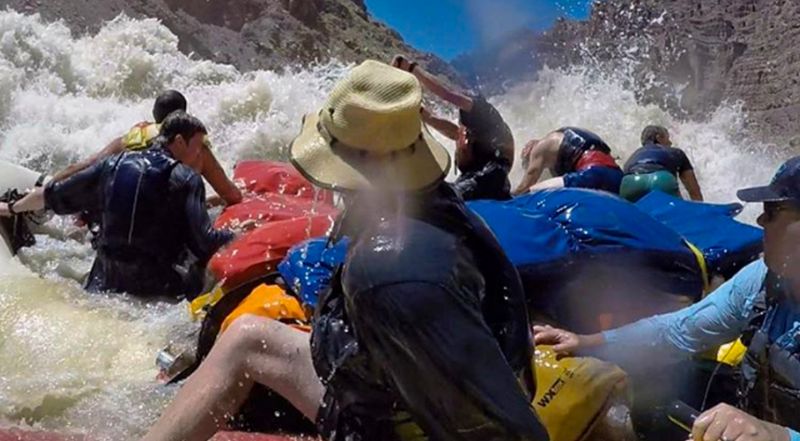
20,000–35,000 cfs: High water, big-water Class IV. The canyon becomes a continuous roar. Wave trains merge. Big Drop 3 stays Class IV but with serious consequence — pool recovery shrinks, hydraulics intensify, swims have real cost. Appropriate for experienced big-water paddlers only.
35,000–50,000 cfs: Big water. The Big Drops are heavily consequential. Campsites at the bigger beaches flood. Self-guided trips at this level demand expedition-level skill and organization.
Above 50,000 cfs: Serious big water to 100,000 cfs, historical flood beyond. Rare — only happens in big-snow runoff years. Webb, Belnap and Weisheit warn that at these flows the canyon can be very dangerous and boats frequently flip. The Big Drop sequence transforms. Campsites flood, navigation becomes complex, swims are catastrophic. Expert teams only.
Monitor flows at the USGS Potash gauge (09185600) for Colorado-side launches or Mineral Bottom (09328920) for Green-side launches in the weeks before your trip; sum the two for the combined flow you'll see at the Big Drops. Below the Big Drops, the Gypsum Canyon gauge (09328960) reads the post-rapid combined flow.
Experience Requirements
Self-Guided
To responsibly run Cataract Canyon self-guided at moderate flows, you should have:
- Completed 2–3 multi-day self-guided raft trips including Class III–IV whitewater
- Strong oar technique: ferrying, eddy turns, aggressive upstream angles
- Water-reading ability: identifying lines, holes, and hydraulics from upstream
- Swiftwater rescue skills — ideally, a formal swiftwater rescue certification (SRT I or equivalent)
- Proper rigging: a minimum 14-foot oar rig with D-rings, dry boxes, and a high-volume bail pump
- A trip plan your group has discussed: who scouts first, what are the swim signals, what happens if a boat flips above Big Drop
At high water, raise the bar for every category above. Big Drop 3 at 30,000+ cfs is not a rapid you learn on.
Guided
A licensed outfitter removes most of these skill requirements. Guides read water, make real-time decisions about lines, and carry rescue equipment and training. If you're new to multi-day rafting or your group has mixed experience levels, a guided Cataract trip is the right call. Expect to pay $1,500–2,500 per person for a 5–7 day guided trip, all-inclusive.
Cataract vs. Other Utah Rivers
How does Cataract compare to the other major Utah rafting options?
| River | Class | Crux | Best For |
|---|---|---|---|
| San Juan | I–II | None | Beginners, families |
| Green River (Labyrinth) | Flatwater | None | First-timers, canoes |
| Westwater Canyon | III–IV | Skull (Class IV) | 1–2 day whitewater trips |
| Cataract Canyon | III–IV | Big Drop 3 | Experienced multi-day paddlers |
Westwater Canyon is the best comparison point: also on the Colorado River, also Class IV at the crux, but 17 miles vs. 14 miles of rapids with a much shorter overall trip. Many paddlers run Westwater as preparation for a Cataract expedition. It's not a bad idea.
The Honest Bottom Line
Cataract Canyon at moderate flows (10,000–20,000 cfs) is a serious Class III–IV river trip that rewards experience and punishes overconfidence. The Big Drop sequence is unforgiving of poor positioning. The canyon is remote — if someone swims above Big Drop 3, you have seconds to react before they're into the next rapid.
At high water, Cataract Canyon is a different undertaking entirely. Big Drop 3 from 30,000 to about 48,000 cfs is one of the most powerful Class IV rapid environments in the continental United States — and above 50,000 cfs, Webb, Belnap and Weisheit warn, the canyon can be very dangerous and boats frequently flip. Treat it accordingly.
If you have solid multi-day river experience and good swiftwater skills, plan a self-guided trip at moderate flows in June or early July. If you're newer to the river, book with a reputable outfitter and let the guides do what they do best. Either way, Cataract Canyon is worth the effort.