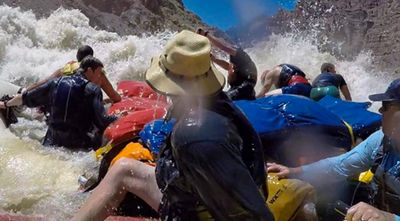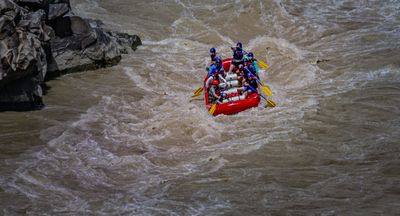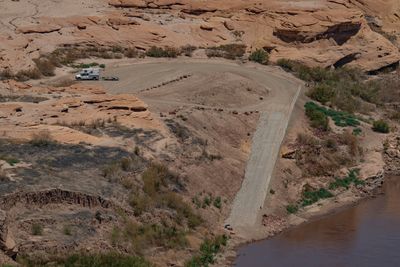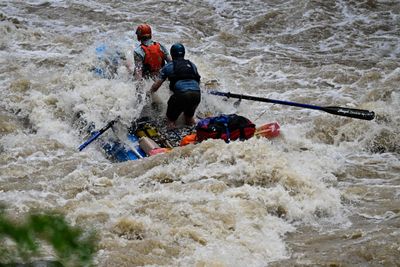
Every Cataract trip begins the same way. Somebody standing over the straps and the ammo cans and the coffee steam asks the question nobody asks politely, because the river isn't polite either.
Is your shit tight?
It was never about tidy gear. It's about whether your systems will still make sense when everything starts moving. And the thing nobody tells you is that on Cataract, the answer gets decided about forty-eight miles before the first rapid.
Here's the trip. Cataract Canyon is the whitewater section of the Colorado River inside Canyonlands National Park, in southeast Utah, beginning where the Green River comes in from the north and roughly doubles the Colorado's volume. From the Potash ramp outside Moab it's forty-eight river miles of flatwater to that confluence, then forty-seven more to the takeout — with fourteen miles of rapids stacked in the first half of that. Call it ninety-five miles, four to six days, Class III–IV at most flows and genuinely worse at some. You need a permit from Canyonlands; there's no lottery. Most people launch at Potash, some at Mineral Bottom on the Green, and everybody now takes out at North Wash, on a ramp that didn't exist two years ago.
That's the shape of it. Now the part the guidebooks skip.
Cataract is usually sold as fourteen miles of whitewater with a long float attached. That framing is exactly why trips go sideways. What actually happens is that the flow sets your speed, your speed sets your day count, your day count sets how much water and food and shade you're carrying, and an afternoon of headwind in the lower canyon can erase a day you'd already spent. The Big Drops are the part you'll rehearse in your head for six months. The flatwater is the part that decides whether you arrive at them rested or already behind.
We've run this canyon twenty-one times, on rapid day between roughly 3,400 and 47,900 cfs, with Lake Powell anywhere from 3,526 to 3,677 feet. Those aren't different water levels on the same trip. They're different trips that happen to share a canyon.
So the useful question isn't how hard is Cataract. It's how hard is Cataract in the third week of June, at whatever the river gives you, in the boat you actually own, with the crew you actually have.
That's what this is for.
Cataract Canyon in 60 seconds
| Where | Colorado River, Canyonlands National Park, southeast Utah |
| Length | ~95 miles Potash to North Wash; 14 miles of rapids |
| Difficulty | Class III–IV, entirely flow-dependent. Above 50,000 cfs, Webb, Belnap and Weisheit warn, the canyon can be very dangerous and boats frequently flip. |
| Permit | Required. Canyonlands, via recreation.gov. No lottery. |
| Launch | Potash, Moab, or Mineral Bottom on the Green |
| Takeout | North Wash — steep, 4WD, one party at a time |
| Season | High water early May–late June; lower flows after |
| Trip style | Guided or private — decide this first |
Everything below is the consequence of those eight lines. For the persistent corridor data — every rapid, camp, gauge and side canyon — see the Cataract Canyon section dashboard.
First question: guided or private?
This fork decides everything downstream of it, so make it before you start comparing launch dates.
Guided. Outfitters run Cataract from two days to five, and they change boats with the water — big motor rigs through the May–June peak, smaller oar and paddle rafts as flows drop into summer and fall. That's not a marketing detail; it's the same craft-selection logic a private crew has to work out for itself, done by people who run it thirty times a season. If this is your first Class IV water, or you're bringing family who aren't boaters, this is the right answer and it isn't a compromise.
Private. Once you're below the Confluence you're committed. There's no road, no shortcut, and NPS prohibits upstream travel between the first rapid and Imperial Canyon — you cannot motor back up to reconsider. The park recommends the canyon for experienced boaters, and the honest gate is whether your crew has run multi-day Class IV before, not whether one strong boater has.
If you want the skill question answered properly rather than summarized, we wrote it up separately: how difficult is Cataract Canyon, honestly.
Choose your approach: Colorado or Green
There is no single hundred-mile Cataract trip. There are several ways to build one, and the choice changes your mileage before you ever reach moving water.
| Launch | To the Confluence | NPS float time |
|---|---|---|
| Potash (Colorado) | 48 mi | 2–3 days |
| Moab (Colorado) | 63 mi | 3–4 days |
| Mineral Bottom (Green) | 54 mi | 3–4 days |
| Green River State Park (Green) | 122 mi | 6–9 days |
Then it's 47 miles from the Confluence to North Wash, another 2–3 days, with the rapids in the first fourteen of it.
Two notes on those numbers. NPS publishes 48 miles from Potash; our own Canyonlands mileage log puts the ramp at river mile 47.3. We're citing both rather than picking, because the difference is smaller than the error in anyone's float time. And it reconciles the two ways this canyon gets measured: 40 miles of Cataract Canyon proper, ending at mile 176.5, plus 7.5 miles of Narrow Canyon below it to the ramp at mile 169.
Most private crews launch at Potash. Mineral Bottom trades six extra miles for a quieter, more committing approach down Stillwater and a genuinely awful access road.
The whitewater is only part of the trip
Read the trip as a chain, because that's how it fails.
Each link sets up the next. Flow sets your travel speed, which sets your day count, which sets your load. Wind on the approach or in the lower canyon costs hours you budgeted for the rapids. Camps you can't reach push your Big Drops run later in the day than you wanted. And the takeout — a sixteen-foot ramp that fits one party at a time — is the least flexible node in the whole chain. A forty-person permit does not come off that ramp quickly.
The crews that get in trouble are almost never the ones who misread Big Drop 3. They're the ones who arrived at Spanish Bottom a day behind, tired, in wind, and ran the crux on somebody else's schedule.
The Confluence
The Green and Colorado meet in a wide, sandy bend inside the park. It's worth stopping.
In summer and fall the dam-regulated Green often runs visibly clearer than the silt-rich Colorado, and the line between the two waters stays visible downstream until they fully mix. In spring runoff that distinction disappears — the Yampa and other Green-side tributaries load the Green with sediment and both rivers run heavy together. Either way, downstream of the Confluence the combined river is what Webb describes as "usually muddy and changes temperature seasonally," which is the working condition for most of Cataract.
Below here, life jackets are worn, not stowed. That's a regulation, not a suggestion.
What flow actually changes
Every other Cataract page maps CFS to a difficulty class. That mapping is the least useful thing flow does. The number decides how fast you travel, how many camps you get, how hard it is to land a loaded boat, how long a swim lasts, and whether you needed a motor. The rapids are downstream of all of it.
Three things before the table.
The number is a sum. The Colorado at Potash and the Green at Mineral Bottom both sit above the Confluence. Neither one is what runs the Big Drops — the sum is. Below the whitewater, the Gypsum Canyon gauge reads that combined flow on a single dial.
The number that matters is the one on the day you reach the rapids, not the day you launch. From Potash that's two to three days downstream, and on a rising or falling limb it can be thousands of cfs different. Every figure below is measured on rapid day.
The bands are ours. Where NPS or the canyon's standard reference sets a threshold, we say so. Where a band rests on our own trips, we say how many. We have never run this canyon above the high forties, and the last row is the historical record rather than our experience — labelled that way.
| Flow on rapid day | Rapids | Camps & landings | Pace | Water & exposure | Boat & rigging | Basis · confidence |
|---|---|---|---|---|---|---|
| Under 5,000 — extra boney | Rocky and technical; precise moves, obstacles often unavoidable. Rapid 5's river-left hole is the significant hazard above Mile Long. Big Drop 3 doesn't soften — it goes bony, and rock contact becomes unavoidable rather than optional. | Beaches at their largest; camp choice is the easiest it gets. Landings shallow and cobbly. | Slow. The approach drags and the flatwater feels twice as long. | Late-season heat compounds. In winter, cold water is the primary hazard — not the whitewater. | High pin and wrap risk. NPS notes non-motorized craft 16 ft or less handle the tighter lines more easily. | NPS threshold + 3 DM trips · high |
| 5,000–10,000 — technical low water | Class III–IV technical rather than big-water. Distinct pools between drops. Big Drop 2's ledge wave is what catches people. Ben Hurt runs right of the island. | Good availability. Beaches exposed and workable. | Steady but unhurried. Four days comfortable, five generous. | Our December run in this band rated cold water and hypothermia — not the rapids — as the trip's real hazard. | Smaller craft do well. Rock contact routine; a repair kit earns its weight. | 7 DM trips · high — our densest band |
| 10,000–20,000 — classic moderate | Powerful but readable. Hydraulics well-defined. The Button Hole in Rapid 18 activates here but hasn't reached its crescendo. | Beaches still good. Landings straightforward. | The efficient band. Four days without pushing. | The most forgiving conditions the canyon offers. | Standard oar rigs. Read-and-run works. | 3 DM trips · moderate |
| 20,000–30,000 — big water begins | Wave trains lengthen and stop resolving into discrete rapids. Mile Long runs as one continuous event. Above roughly 30,000 there's no pull-over between Big Drop 2 and Big Drop 3 — they have to be scouted together. Equipment failure stops being an inconvenience: a broken oar in Big Drop 2's ledge wave put one of our boats into Mother-in-Law. | Beaches beginning to go under. Landing a loaded boat takes real deliberation. | Faster. The canyon compresses; days shorten whether you wanted them to or not. | Runoff water cold enough that a swim is a serious event regardless of air temperature. | Rig to flip, and mean it. Spare oars accessible, not buried. | Whitewater Guidebook + 4 DM trips · high |
| 30,000–48,000 — serious big water | Pools wash out and hydraulics stack. The Claw in Big Drop 2 becomes the major gotcha; the Button Hole washes out entirely. Tail waves below Big Drop 3 flip boats that ran the rapid clean. | Most good beaches gone. Camp strategy becomes a real constraint; NPS notes camps get hard to find at high water, especially for large groups. | Fast. Three days achievable and sometimes unavoidable. | Recovery distance shrinks. Rapids arrive before the last one has released you. | Motor-assisted rigs common and defensible here. Rescue capacity practiced, not just packed. | 4 DM trips · high — this is our ceiling |
| Above 50,000 — beyond our experience | Rapid 7 becomes the North Sea. In 1993 at 70,000, Webb's party counted eleven waves in that train, the largest exceeding twenty feet trough to crest. Their summary judgment: the canyon "can be very dangerous at water levels above 50,000 ft³/s and boats frequently flip." | — | — | — | — | No DM field evidence. Webb/Belnap/Weisheit + historical record |
Check the live combined flow on the section dashboard, which sums Potash and Mineral Bottom for you.
Above our ceiling: what the record holds
We stop in the high forties because that's where our experience stops. The canyon doesn't.
| Year | Party | Flow |
|---|---|---|
| 1889 | Brown–Stanton survey | ~40,000 |
| 1927 | Clyde Eddy | 54,200 |
| 1938 | Clover · Jotter · Nevills · Harris | ~59,000 |
| 1993 | Webb party (North Sea measurement) | 70,000 |
| 1914 | Loper · Russell | ~85,000 |
| 1957 | Georgie Clark | 88,600 |
| 1984 | Witkopf · Coombs · Bathemas · Williams, with local river runners | ~114,000 |
| 1917 | Highest daily flow the gauges ever recorded — not a descent | 130,100 |
Bigger water came through before anyone was measuring it. The upstream Colorado gauge recorded nothing from 1918 to 1922, and Webb, Belnap and Weisheit put the 1921 flood — the largest of the twentieth century — at about 147,000 cfs.
Every one of those expeditions had boat flips. None of them lost anyone. That's the record, and it isn't a recommendation.
The Big Drops are the crux, not the whole story
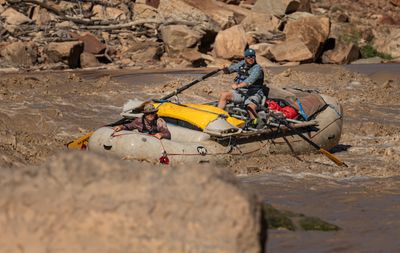
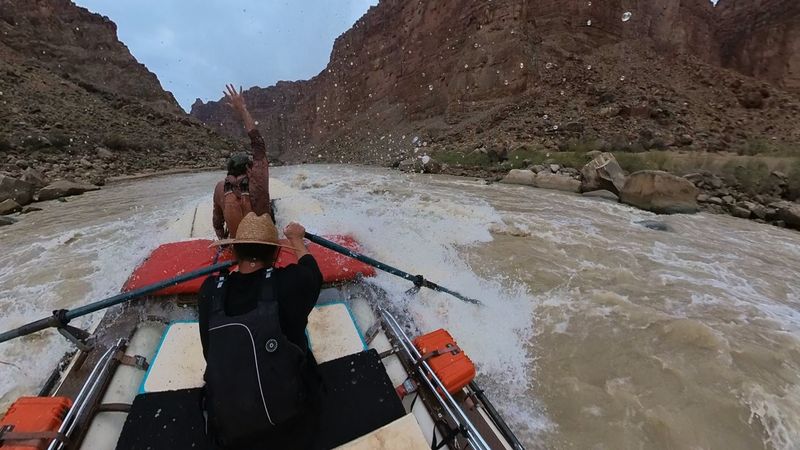
At high water, Big Drop 2 stops being a rapid you read and becomes a change in government. Upstream everyone's still pretending it's a conversation — angle here, pull there, keep the bow light, stay off that lateral — and then the horizon folds, the sound thickens, and the rocks that usually explain the route are buried, half-buried, or just gone. The waves do the talking now. You stop watching the biggest one and start watching the space before it: the one moving seam that still looks like a door. The boat drops, the bow climbs, the stern goes light, the oars load and vanish and load again. Hold the line and you punch through with more luck than you'll admit. Miss it, and the river starts editing your trip report in real time.
That's the crux. Three rapids inside about half a mile, at section miles 13.7, 14.1 and 14.3 below the Confluence:
Big Drop 1 → Big Drop 2 → Big Drop 3
Treat them as one sequence, not three decisions. An upset in the first has consequences in the other two, and above roughly 30,000 cfs you cannot pull over between the second and the third — they have to be scouted together, from above. Below that, most crews scout on river left and run them in order with safety set below.
We're deliberately not printing lines here. Lines change with flow, with the year's debris flows, and with what your boat is. The per-rapid intelligence — named features, hazards, mile, class by flow — lives on the rapid pages, where it can be kept current. What belongs in an article is the decision: scout at the flow you have, not the flow you read about.
The Big Drops also aren't the only water that matters. Mile Long is a continuous reach from Range Canyon's debris fan down to the island at Rapid 20 — Rapids 13 through 19, running as one rapid at high water, with the South Seas through 16–19 named for its irregular chop. Capsize (Rapid 15, also "Hell to Pay") is the first real technical problem in the canyon. Webb tabulates 29 numbered rapids through here — Rapids 1 through 27 plus Lower Rapid 5 and Lower Rapid 23. The full mile-ordered ledger is on the section page.
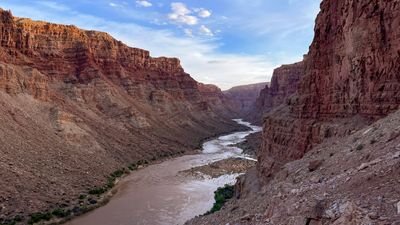
After the Big Drops, the river is changing
This is the part of Cataract that no longer matches the guidebooks, and it's the most interesting thing happening on this stretch of the Colorado.
Lake Powell backed into the lower canyon for decades, drowning rapids and burying camps under reservoir sediment. As the reservoir has dropped, the river has been cutting back down through that sediment and features are re-emerging. Webb's 2007 account describes Cataract as "only sixteen miles of free-flowing river." That number was true when it was written and is no longer — which is exactly the point. This is a reach where a fact has a shelf life.
What that means for you on the water:
- Rapids below the historic pool that aren't in older guidebooks, and sand waves that form and vanish between seasons.
- Sediment terraces and mud banks where camps used to be — some soft, some genuinely dangerous to walk on.
- A river-to-reservoir boundary that moves year to year, so "where the flatwater starts" is not a fixed mile.
- Navigation features that don't match printed maps.
Build a margin for it. This is the part of the trip most likely to differ from whatever you read while planning — including this page.
North Wash changes the end of the trip
Current as of August 2026.
The takeout is North Wash. The old Hite ramp is no longer usable at current Lake Powell levels.
A rebuilt ramp opened at North Wash in June 2026, built by the Utah Division of Outdoor Recreation with Glen Canyon National Recreation Area for about $500,000, surfaced with articulating concrete block mats for traction on a steep, shifting shoreline. The specifics that affect your planning:
- High-clearance 4WD only. Not a suggestion; the grade is serious.
- Roughly 16 feet wide — one party at a time. With a permit that can carry forty people, your takeout is a queue, not an event. Budget hours, not minutes.
- Explicitly temporary. Agencies have framed it as a bridge to a longer-term facility while a permanent replacement is planned.
- NPS describes it as a steep, dirt takeout. Rain changes it.
Confirm current ramp and road conditions before you launch. The full picture, including what happens if it's out, is in our North Wash takeout guide.
Parties who want to continue down-lake to Bullfrog or Halls Crossing still can, but that's a different trip with its own logistics and its own wind.
Motor or no motor?
This is a real decision, not a packing question, and the flow table above is most of the answer.
You are rowing or motoring roughly 48 flatwater miles to the Confluence and then a lower canyon and reservoir transition on the far end. Neither has whitewater. Both have wind. Afternoon headwinds in the lower canyon are the single most reliable way to lose a day on this trip, and a lost day at the end lands on the least flexible part of the itinerary.
Motor if: you're on a four-day permit, your crew is small, you're running the high-flow season where the canyon compresses and the flatwater doesn't, or anyone in the group can't row a loaded boat into wind for hours.
Row if: you have the days, the crew, and you want the trip that Cataract is when nobody's in a hurry. It's a better trip. It's also a longer one, and the canyon does not care which you intended.
We've written up the small-outboard end of this in detail — the Honda 2.3 after a decade of takeout pushes and how to choose a lightweight outboard for a raft.
Camps and side trips
Camps are the constraint people plan last and regret first. Availability is a direct function of flow — beaches are largest at low water and disappear as it rises, and NPS specifically notes camps get hard to find for large groups at high water. Below the Confluence, river users are directed to register campsites; the park describes this differently in different places, so check the current boater information rather than trusting any secondhand summary, including this one.
Spanish Bottom is the standard last camp above the whitewater, and camping there means starting the Big Drops rested and in morning light instead of arriving at them already spent. Downstream, the good beaches thin out fast.
We hold twenty-one Cataract camps as individual records with side, mile and character — plus the side hikes worth the time, including the Doll House above Spanish Bottom, Dark Canyon, and Gypsum Canyon. All of it is on the section dashboard.
Permits, waste, fire and required gear
Permits come from Canyonlands National Park through recreation.gov. There is no lottery.
- When it opens. The April 14–October 15 season opens December 14; the October 16–April 13 season opens June 15. Reservations close two days before launch.
- Cost. Overnight is $36 (including the $6 recreation.gov fee) plus $25 per person. A Cataract day-use permit is $6 plus $10 per person. Rates verified against NPS 2026-08-13 — confirm at booking.
- Group size. Maximum 40 people, including when multiple permitted groups travel together.
- Duration. Up to 14 consecutive nights in the river corridor.
Worth knowing before you panic about dates: NPS states there are no daily launch limits. Cataract is not the lottery scramble that Grand or the Middle Fork is.
Life jackets. PFDs must be worn below the Confluence and above the last active rapid. Above the Confluence they must be readily accessible. Children 12 and under wear them at all times on the river. Type I, III or V — inflatable PFDs are not legal on Utah rivers. Carry one spare per ten people.
Human waste. All solid waste is contained and packed out. NPS requires an approved containment system — a washable reusable toilet with RV dump fittings, or an approved bag system like a Wag Bag or Restop II. A groover satisfies this; it isn't the only thing that does.
Fire. A rigid, durable metal fire pan large enough to hold all ash and debris. NPS is explicit that turkey basting pans don't qualify. Driftwood only, and every bit of ash goes out with you. A fire blanket makes cleanup easy.
Upstream travel is prohibited between the first rapid in Cataract and Imperial Canyon.
After takeout, Utah and Arizona law requires you to clean, drain and dry every vessel. Invasive mussels. It's enforced.
The gear list that goes with all this is in the Cataract Canyon packing list.
Before you launch
Do this again in the last 48–72 hours, not at the planning stage. Most of it changes.
- Permit in hand and printed.
- Observed flow — Potash plus Mineral Bottom, summed. Then look at the trend, not just the number.
- Forecast from the Colorado Basin River Forecast Center, so you know what the river's doing on your rapid day rather than your launch day.
- NPS notices for the river corridor.
- North Wash ramp and road condition. The one that most often changes.
- Weather and wind, especially afternoon wind in the lower canyon.
- Launch road — Mineral Bottom's in particular.
- Shuttle confirmed, with a contingency.
- Mussel inspection requirements for your takeout and your next water.
The two books worth carrying
Cataract has a better literature than most rivers, and two books do most of the work. Webb, Belnap and Weisheit's Cataract Canyon: A Human and Environmental History is the standard reference and the source behind most of the rapid history on this page — it's where the 29-rapid table, the North Sea measurements and the high-water record come from. The RiverMaps Guide to the Colorado & Green Rivers in Canyonlands is what you actually carry.
Both are in our field library, along with what else is worth reading before you go.
Set your systems in the flatwater. The Big Drops don't take questions.