Cataract Canyon
An in-depth environmental and human history of Cataract Canyon and the rivers of Canyonlands, exploring Indigenous presence, exploration, dam impacts, river ecology, and the evolution of modern river running.
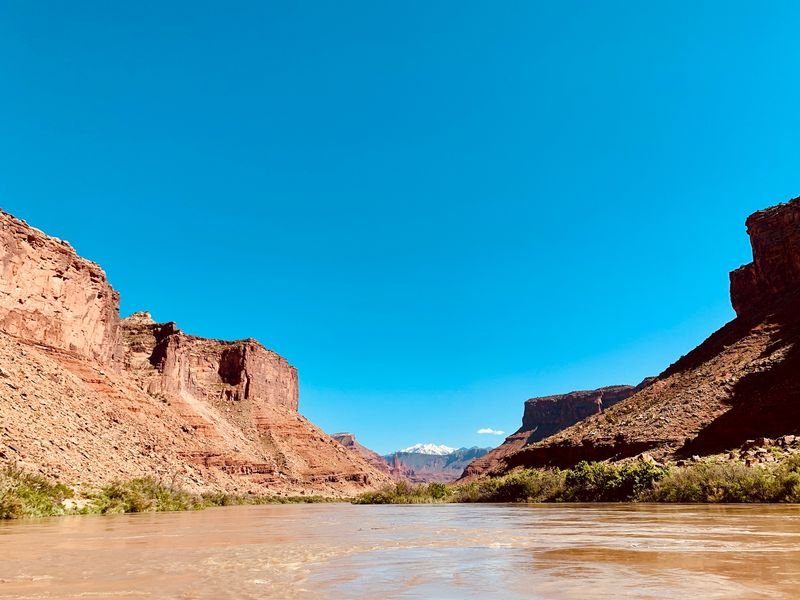
The most accessible mellow float above Moab — a redrock half-day on the Colorado with zero whitewater and stunning canyon scenery the whole way.
A short, mellow flatwater stretch on the Colorado River between the old Dewey Bridge site and Hittle Bottom Campground, running through the heart of the UT-128 scenic highway corridor above Moab. The river winds through open redrock canyon country with easy riffles and cottonwood-lined banks — a classic half-day float accessible to paddlers of all skill levels. UT-128 parallels the entire section, making roadside access simple and shuttle logistics easy.
Monitored by the USGS Cisco gauge; 2,000–8,000 cfs is the sweet spot for easy flatwater paddling.
Primary upstream Colorado River gauge used in Westwater and Moab Daily runoff interpretation.
USGS #09180500Shallow riffles and slower current; may require lining in spots at very low flows.
Ideal conditions — good current, easy riffles, comfortable depth.
Faster moving water and stronger current; flatwater character maintained but paddlers should be alert.
Spring runoff (Apr–Jun) and shoulder season (Sep–Oct)
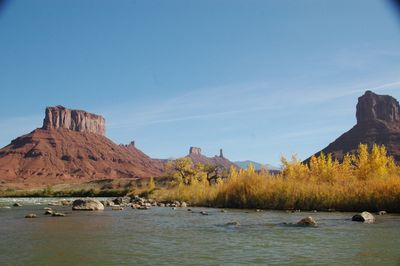
The UT-128 corridor exposes classic Colorado Plateau canyon geology — warm-toned Entrada and Moenkopi layers carved by the ancestral Colorado River into a broad, open canyon.
↑ Rim
↓ River level
UT-128 has been a working corridor for a long time, threading early ranching and homesteading through this stretch of redrock. The original Dewey Bridge, built in 1916, was one of the longest remaining suspension bridges in Utah and served as the primary Colorado River crossing here for decades — until a child accidentally set it on fire in 2008. The put-in still carries the bridge's name; the crossing it marked is gone.
The original Dewey Bridge, built in 1916, was one of the longest remaining suspension bridges in Utah before a child accidentally set it on fire in 2008.
No permit, easy paved shuttle on UT-128, BLM day-use parking at both ends.
BLM day-use site at the former Dewey Bridge location on UT-128. The historic 1916 suspension bridge was destroyed by fire in 2008; piers remain. Serves as the standard take-out for Cisco-to-Dewey floats and the put-in for the scenic Dewey-to-Hittle-Bottom / Professor Valley stretch.
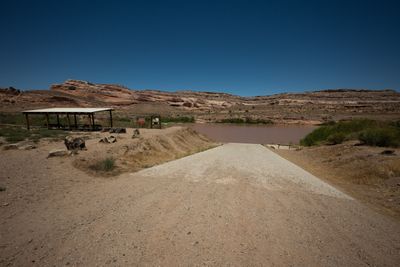
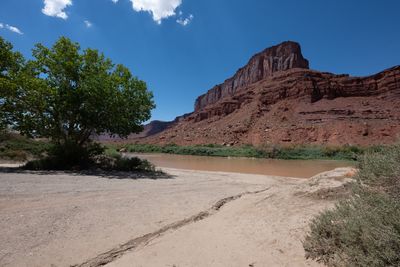
Dewey Bridge Boat Ramp to Hittle Bottom
UT-128 parallels the entire section — shuttle is straightforward paved highway driving.
Google used a car, their times do not account for towing a trailer, driving on washboard, pitted pavement, and dirt that goes to grease in the rain — our adjusted times help align to the reality of running real river shuttles.
No permit required. Free day use on this BLM section.
On a seven-day trip, you'll cook roughly 20 meals on a folding table in the sand. The constraint isn't ambition — it's ice management. Days one through three, you have real cooler capacity. Days four and five are the transition zone. Days six and seven are pantry cooking.
The best river cooks plan backward from the last night. If your final dinner is still good — not just edible, but genuinely good — the trip ends on a high.
Two coolers, segregated by access frequency. A well-managed deep cooler will hold usable ice through day 6 in 100°F air temps.
Folding table, two-burner propane stove, cast iron skillet, Dutch oven, and a large pot. The Dutch oven is the single most versatile piece.
Books that shape the science, history, and stories behind this place.
An in-depth environmental and human history of Cataract Canyon and the rivers of Canyonlands, exploring Indigenous presence, exploration, dam impacts, river ecology, and the evolution of modern river running.
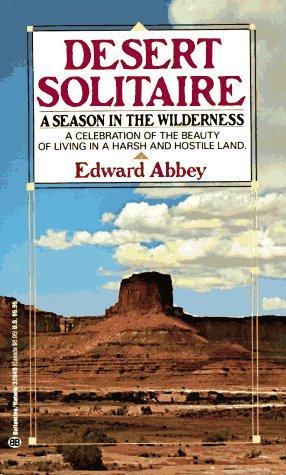
Edward Abbey's classic portrait of canyon country, solitude, and wilderness, influential to the identity and mythology of the Colorado Plateau.
A river-running memoir by Roy Webb capturing the spirit, humor, and culture of Western river expeditions and the people who chase moving water through canyon country.
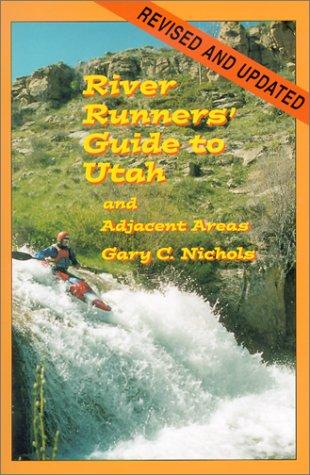
A comprehensive guidebook to whitewater rivers in Utah and neighboring regions, covering river access, rapids, flow considerations, trip logistics, and historical context for river runners.
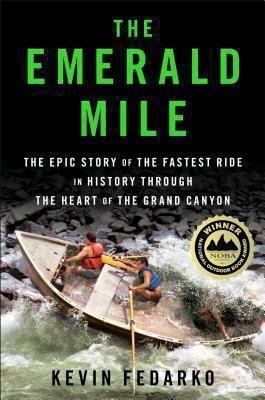
The thrilling story of the dory daredevils who set a speed record through the Grand Canyon at the height of the legendary flood of 1983 — and of the river that made it possible.
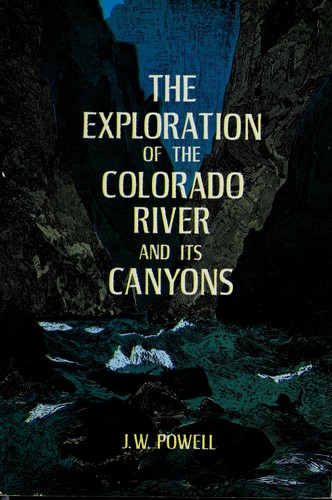
Powell's original account of the first scientific expedition through the Grand Canyon, documenting the geology, natural history, and challenges of navigating the unknown Colorado River.