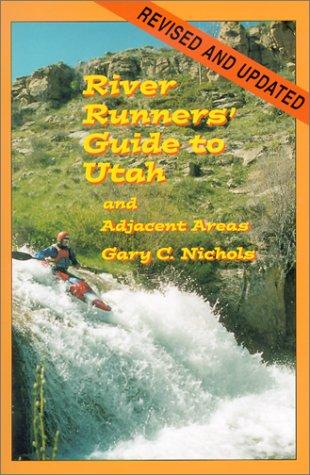
River Runners' Guide to Utah and Adjacent Areas
A comprehensive guidebook to whitewater rivers in Utah and neighboring regions, covering river access, rapids, flow considerations, trip logistics, and historical context for river runners.
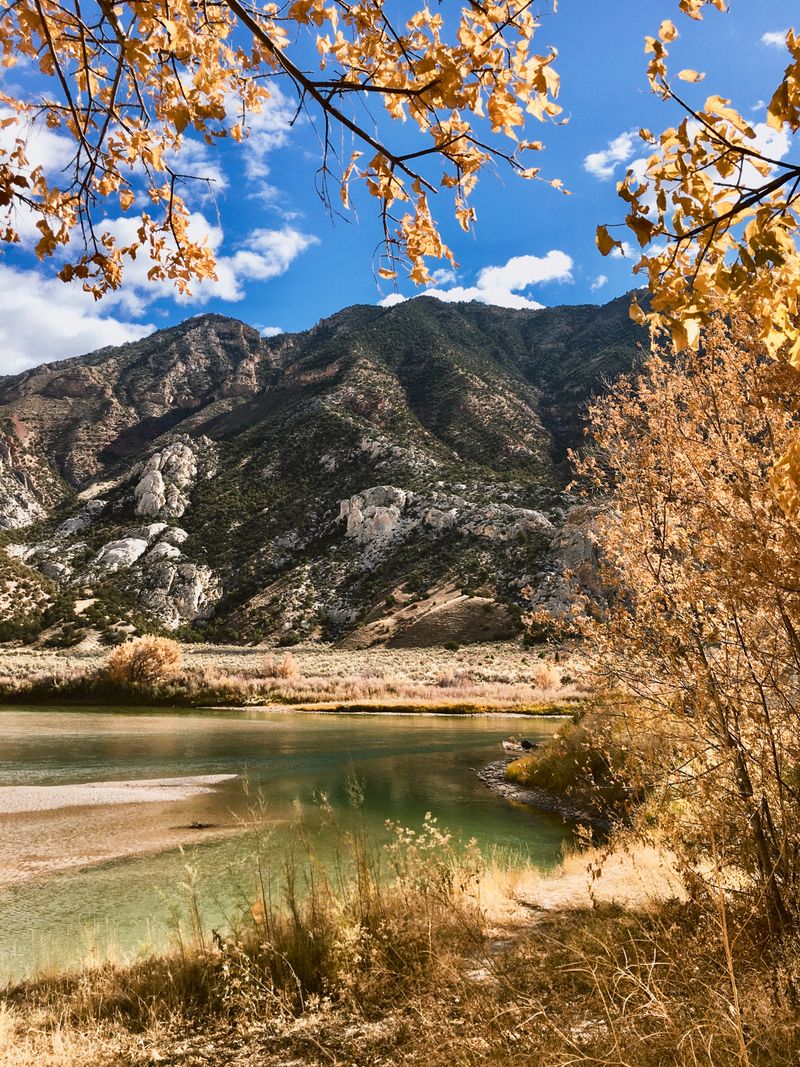
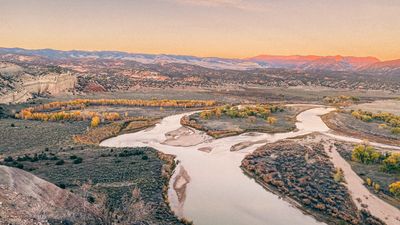
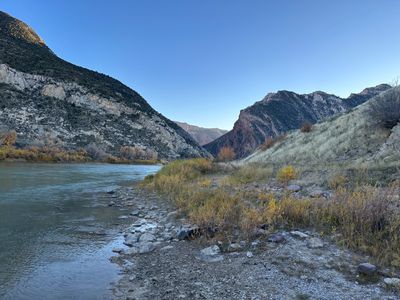
Rainbow Park is a brief cottonwood bench between Island Park and Split Mountain — 1.7 miles of mellow flatwater ending at the boat ramp that serves as the standard staging area for Split Mountain day trips and overnight camps.
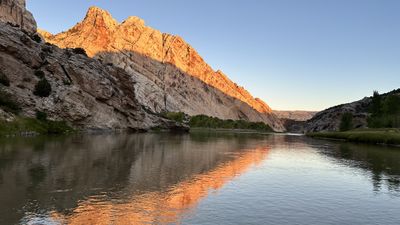
Rainbow Park is the short, calm bench between Island Park and the Split Mountain gorge — 1.7 miles from the sharp right bend where the island-dotted valley ends to the Rainbow Park boat ramp. It is the last easy water before the canyon closes in: multi-day parties coming down from Lodore or the Yampa float through it on their way into Split Mountain, and day-trippers meet the river at its downstream end, where the Rainbow Park ramp is the standard put-in for the Split Mountain daily. The ramp is an NPS facility with road access from Jensen, Utah.
Flow is best tracked at the downstream Jensen gauge; this flatwater segment has no hydraulic hazards and flow primarily affects travel speed.
Primary operational gauge for planning Split Mountain Canyon floats. Located near Jensen, UT, below Dinosaur National Monument, this gauge integrates snowmelt from the Uinta Basin watershed and is the most direct reading for Split Mountain and lower Lodore trip planning.
USGS #09261000Below 1,000 cfs — minimal current; slow float through the valley.
1,000–3,000 cfs — good downstream movement; pleasant flatwater float through cottonwoods.
Above 3,000 cfs — faster current; camps may be reduced as water rises against cottonwood banks.
Follows Green River snowmelt pattern — peak May–June, tapering through summer.
↑ Rim
↓ River level
Rainbow Park and the Island Park area were used by early ranchers who appreciated the open valley and river access. The area is part of the broader Dinosaur National Monument landscape that Powell traversed on his 1869 expedition.
Rainbow Park is the most accessible point in the Dinosaur river system — paved approach from Jensen, short shuttle to Split Mountain take-out, and NPS facilities at both ends.
Rainbow Park shares the Split Mountain day-use listing (recreation.gov 250987) because the Rainbow Park ramp is where that daily launches. A multi-day party floating through from Lodore or the Yampa is covered by its own river permit (250014) and does not need this one; dayUseOnly makes the trip permit rollup skip it on any route that does not begin here. appliesTo: day_use (2026-09-02, replacing the transitional dayUseOnly boolean) — Rainbow Park shares the Split Mountain day-use listing because the Rainbow Park ramp is where that daily launches.
On a seven-day trip, you'll cook roughly 20 meals on a folding table in the sand. The constraint isn't ambition — it's ice management. Days one through three, you have real cooler capacity. Days four and five are the transition zone. Days six and seven are pantry cooking.
The best river cooks plan backward from the last night. If your final dinner is still good — not just edible, but genuinely good — the trip ends on a high.
Two coolers, segregated by access frequency. A well-managed deep cooler will hold usable ice through day 6 in 100°F air temps.
Folding table, two-burner propane stove, cast iron skillet, Dutch oven, and a large pot. The Dutch oven is the single most versatile piece.
Books that shape the science, history, and stories behind this place.
A comprehensive guidebook to whitewater rivers in Utah and neighboring regions, covering river access, rapids, flow considerations, trip logistics, and historical context for river runners.
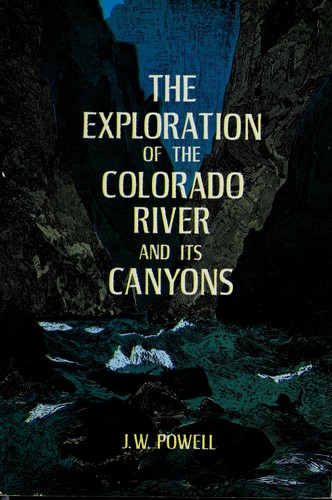
Powell's original account of the first scientific expedition through the Grand Canyon, documenting the geology, natural history, and challenges of navigating the unknown Colorado River.