Skip to content
Colorado River — Utah/Colorado Border

Westwater Canyon

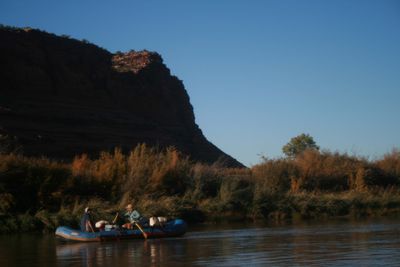
The canyon walls go from red to black. The rock goes from 200 million years old to 1.7 billion. The river doesn't slow down for any of it.

17.2 river miles Class III–IV 1 day typical BLM permit required Skull Rapid: crux Class IV
Flow The Cisco gauge near the takeout tells you which Westwater you're getting....
Season Spring runoff (April–June) delivers the classic Westwater — snowmelt-cold water,...
Duration 1–2 days (typical 1)
Permit BLM permit required for all launches — day and overnight. Spring weekends sell...
Shuttle 20 mi — 0.4 hrs
Logistics The simplest logistics on the Colorado: 20-mile paved shuttle, ranger station...

The canyon walls go from red to black. The rock goes from 200 million years old to 1.7 billion. The river doesn't slow down for any of it.

Westwater Canyon
Overview

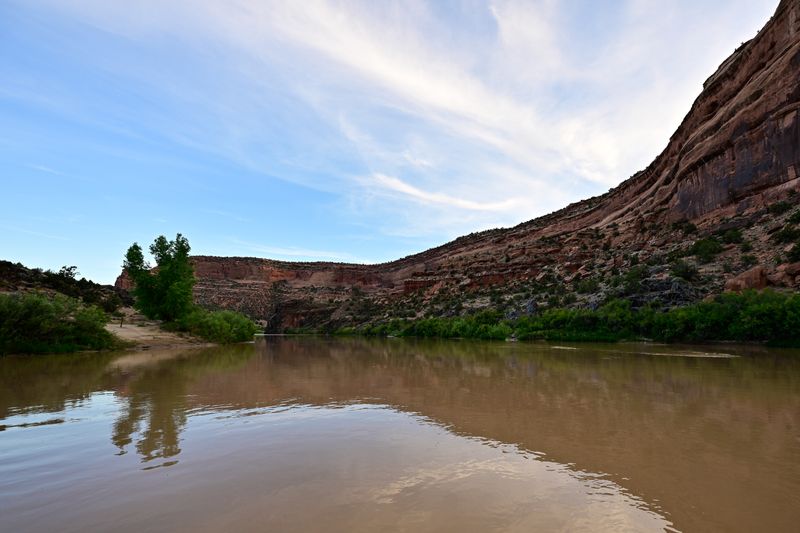
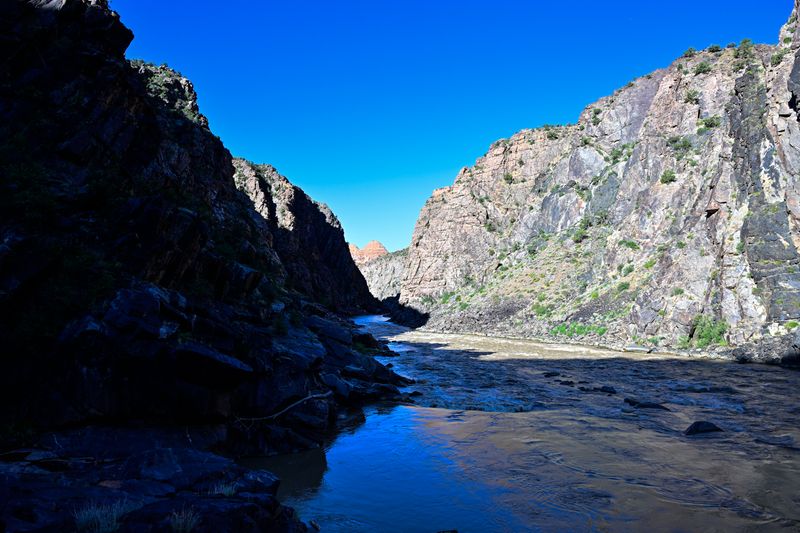
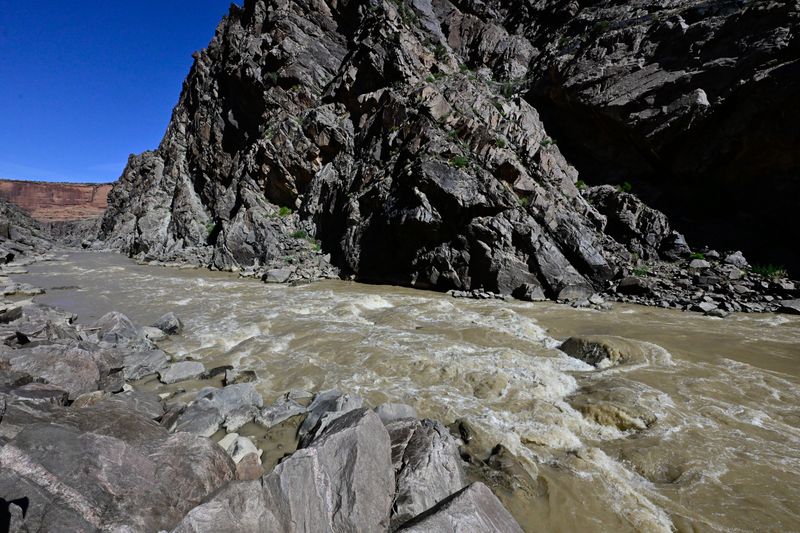
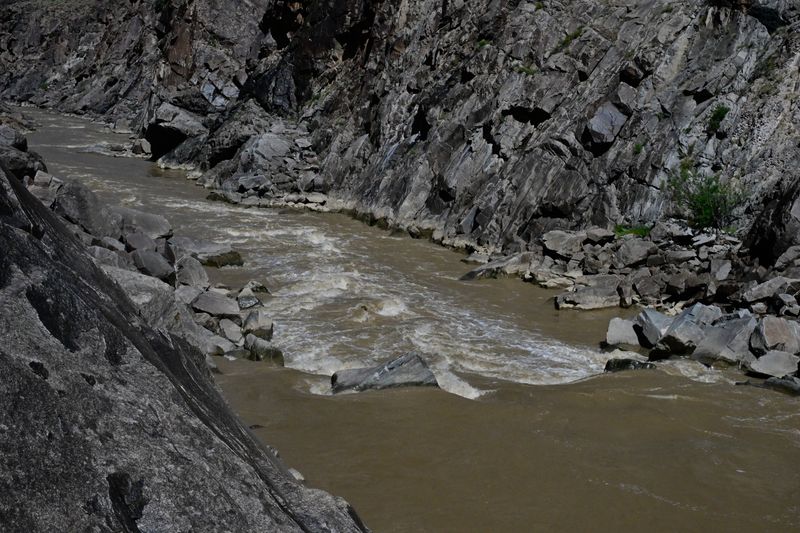
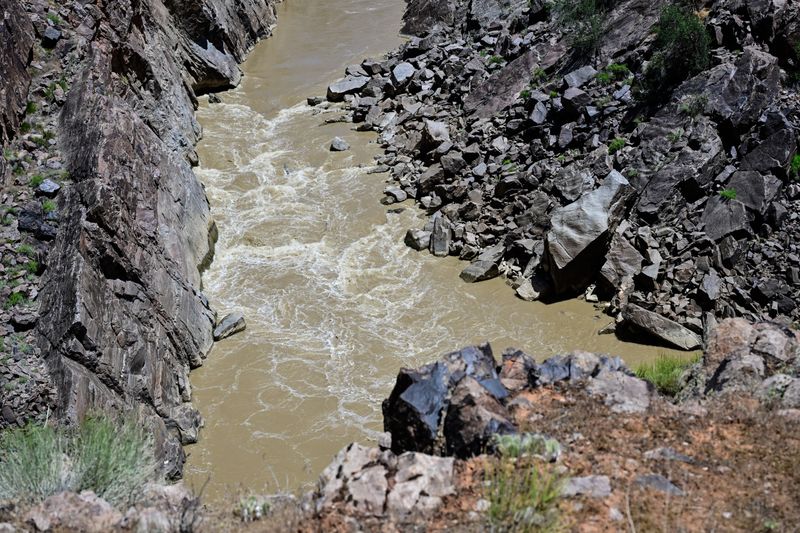
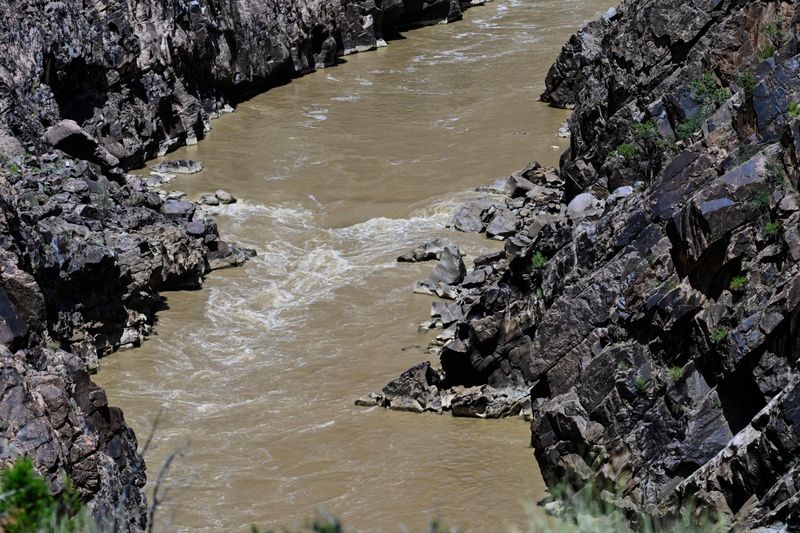
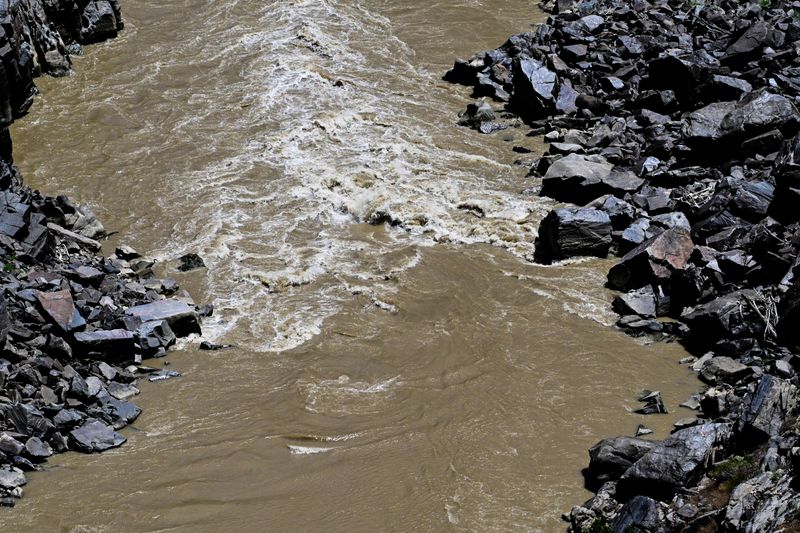
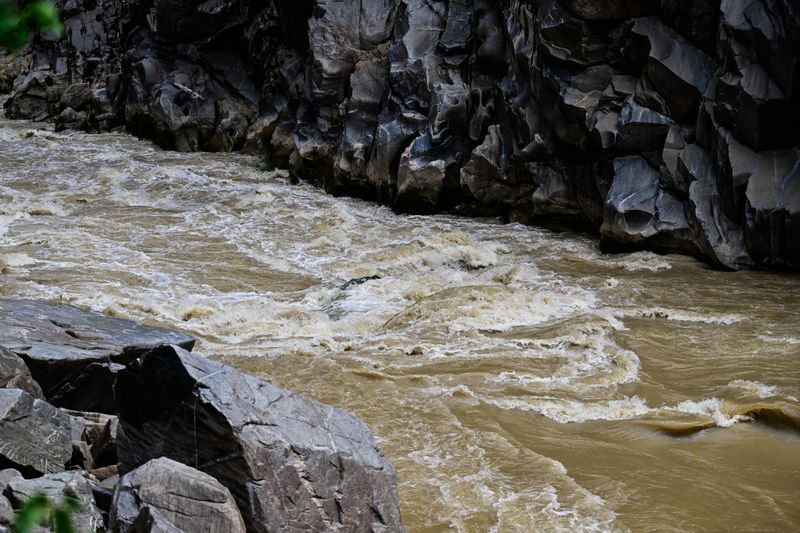
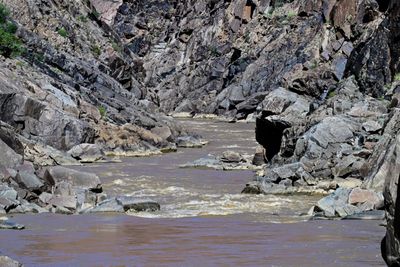
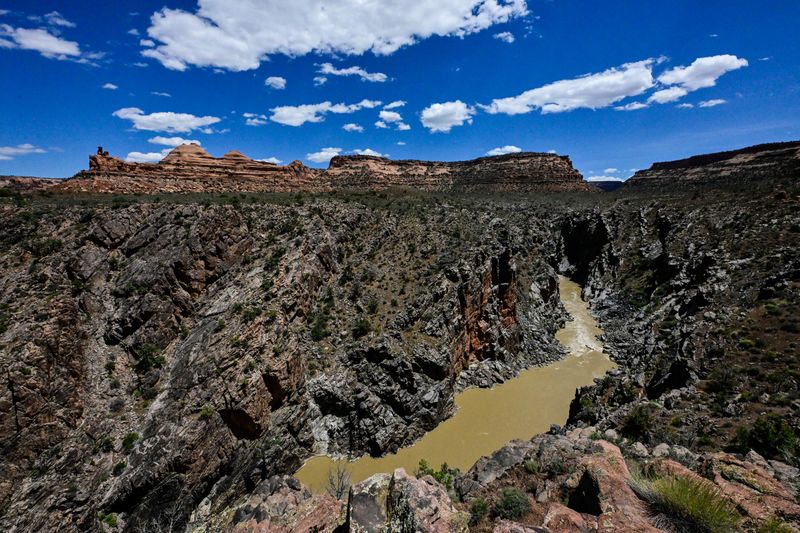
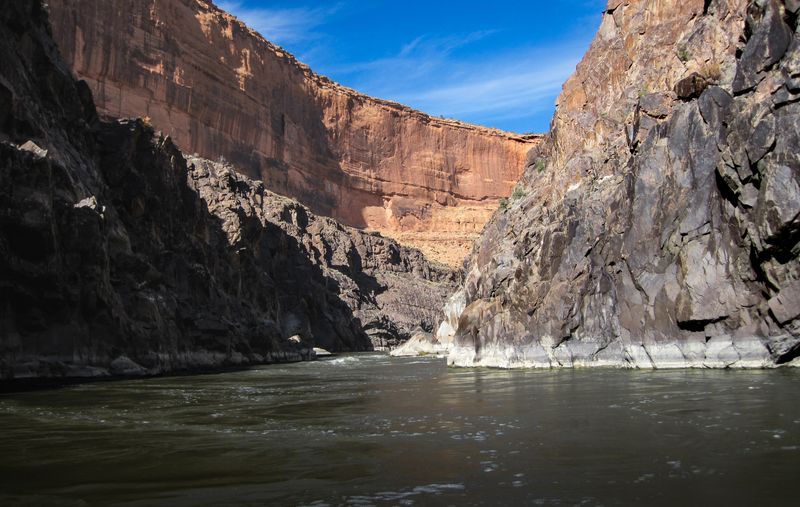
Westwater compresses the entire Colorado River experience into a single day. The first six miles are pleasant, open, sandstone — the kind of easy floating that lets you forget what you're about to enter. Then the walls change. The red rock disappears and the Precambrian basement rises around you — polished black granite and schist, 1.7 billion years old, narrowing the river into a corridor where the current accelerates because the rock won't get out of the way. The rapids build through Last Chance and Funnel Falls, and then Skull arrives: a technical Class IV drop through a skull-shaped rock feature where the line matters and the consequence of missing it is a long swim through the Room of Doom, where Sock-It-To-Me waits with a recirculating hydraulic that has held boats and swimmers at flows above 12,000 cfs. Below the gorge, the canyon opens back out into sandstone, the current relaxes, and you have four miles to think about what just happened. Most groups are back at the take-out by mid-afternoon. Everyone remembers their Skull line.

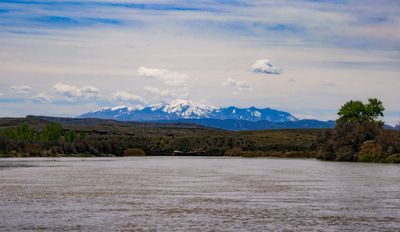
Westwater is where the Colorado shows you what it's made of — and what it's cutting through. For six miles the river moves through open red sandstone country, the kind of canyon that looks like every postcard of the Colorado Plateau. Then the walls go black. The Precambrian granite and schist of the inner gorge are 1.7 billion years old — the same basement rock that forms the Grand Canyon's Inner Gorge, exposed here in a setting you can reach in a day. The polished black walls narrow around the river until the current has nowhere to go but through, and the rapids compress into the sequence that ends with Skull and the Room of Doom. About seventeen miles, start to finish. Short enough for a day trip. Serious enough that every boatman who's run it remembers their Skull line.
Trip styles
day trip, overnight canyon camp, combined Ruby-Horsethief multi-day
Ideal for
intermediate to advanced rafters wanting a technical day run, raft and kayak groups, groups combining with Ruby-Horsethief for a multi-day trip, first technical Colorado River experience
River type
canyon river, whitewater gorge, technical pool-drop, day trip or overnight
17.2 miles
1 days typical
11 named rapids
8 camps

Flows & Hydrology

Westwater's hydraulics respond to flow changes more dramatically than sandstone canyons because the bedrock is harder, smoother, and doesn't erode to absorb energy. The Precambrian granite channels the current into features that intensify predictably with discharge — the same hydraulic principles Leopold described for bedrock-constrained reaches, where stream power concentrates rather than dissipates. At 3,000 cfs the gorge is technical and rocky — you're picking lines between exposed ledges, reading pillow water off the granite. At 6,000 the rapids are well-formed, the hydraulics engaging but readable, Skull has defined routes. Above 10,000 the physics change. The Room of Doom develops a keeper that recirculates debris and boats. Above 12,000 it becomes one of the most dangerous single features on the Upper Colorado — a place where McPhee's observation about the limits of engineering applies to your line choice. The water is snowmelt-cold through June — Elk and Sawatch Range runoff that hasn't warmed up by the time it reaches you — and a swim in the gorge at high water is a serious cold-water event, not a refreshing inconvenience.

Reference Gauges

Colorado River Near Cisco, UT

Primary upstream Colorado River gauge used in Westwater, Moab Daily, and Cataract Canyon runoff interpretation.

Current flow — Colorado River Near Cisco, UT

Updating… Provisional

Primary planning gauge — located near the takeout.

The Cisco gauge (USGS 09180500) is located near the takeout and gives a reliable read on flows through the gorge. Optimal range is roughly 3,000–12,000 cfs.

Seasonality
Jan Feb Mar Apr May Jun Jul Aug Sep Oct Nov Dec

Optimal flows typically 3,000–12,000 cfs at Cisco gauge. Spring runoff provides the most consistent conditions.

Spring
cold water — snowmelt, high flows — powerful hydraulics at Skull and Room of Doom, limited rescue access in gorge
Summer
heat above gorge, low water — exposed ledges and rockier lines, afternoon thunderstorms near ramp
Fall
low water, early cold snaps
Recommended Flow Ranges
1,500–3,000 cfs Low

Runnable but more technical — scraping possible on exposed ledges. Razor rock is out; time the eddy above so the boat spin doesn't need a counter-spin.

3,000–12,000 cfs Sweet spot

Best conditions for most groups. Skull is well-formed and readable.

12,000–16,000 cfs High water

14,400 cfs is the fabled level where expert boaters say Westwater's frequency peaks. Expert paddlers and properly-rigged boats only.

16,000– cfs Big water

Some features flooded, others max punishment; more room to get around the big stuff. Room of Doom a serious keeper. Expert paddlers and properly-rigged boats only.

Geology

The inner gorge is a window into the basement of the continent. The Precambrian granite and metamorphic schist exposed here — approximately 1.7 billion years old — formed during the mountain-building events that assembled the core of North America long before multicellular life existed. These are the same rocks you'd see at the bottom of the Grand Canyon's Inner Gorge, where the Vishnu Schist and Zoroaster Granite form the dark walls above the Colorado. At Westwater, you can touch them from a day-trip. The transition is visually violent: you float through Mesozoic sandstone — Wingate, Kayenta, Chinle — rocks deposited in the last 250 million years, and then the walls drop away and the Precambrian rises up, black and polished and absolutely indifferent to the sandstone above it. The Great Unconformity — the missing billion-year gap between the basement rock and the oldest overlying sediments — is legible here. What those polished walls represent isn't just old rock. It's the foundation that everything else in the canyon country sits on, exposed by a river that has been cutting downward through the entire stratigraphic column of the Colorado Plateau.

The inner gorge exposes the continental basement — Precambrian granite and metamorphic schist approximately 1.7 billion years old, formed during the assembly of the North American craton. These are the same rocks visible in the Grand Canyon's Inner Gorge as Vishnu Schist and Zoroaster Granite, accessible here in a day-trip setting. The transition from Mesozoic sandstone (Wingate, Kayenta, Chinle) into the black Precambrian walls is one of the most dramatic geological boundaries visible from any river in the West. The Great Unconformity — the billion-year gap between basement rock and the oldest overlying sediments — is legible at the contact zone. Rapids form where the hard, non-erodible granite constricts the channel and concentrates stream power into features that intensify predictably with discharge. The polished walls are the product of millions of years of abrasion by sediment-laden current — the river as sculptor, working at geological timescales on the hardest material in the plateau.

Rock Record
Black Quartzite / Metamorphic Suite
Wingate Sandstone
Kayenta Formation
Chinle Formation
Province
Colorado Plateau
Rock types
Precambrian granite · Precambrian schist · sandstone · shale
Landforms
Precambrian inner gorge · polished bedrock walls · bedrock rapids · sandstone canyon approaches · talus slopes
Ecology

The Precambrian inner gorge creates microhabitats that don't exist anywhere else on the Upper Colorado. The black rock has different thermal properties than sandstone — it absorbs and radiates heat differently, holds less moisture, supports different vegetation in its cracks and seams. Peregrine falcons nest on the polished granite walls because the surfaces are steep enough, smooth enough, and inaccessible enough to predators. Desert bighorn sheep work the sandstone approaches above the gorge but don't enter the inner canyon. Colorado pikeminnow — federally endangered, adapted to the warm, turbid river that pre-dam conditions provided — use this stretch as part of their range. The fast, cold water of the gorge during spring runoff creates a distinctly different aquatic environment from the slower sandstone canyons downstream. Single-leaf ash and cliffrose cling to the transition zone where the geology changes. The ecology is compressed here, like everything else — a narrow biological band squeezed between rock types that are separated by more than a billion years.

History

The canyon's name comes from a settlement that no longer exists — a small pioneer community near the current put-in that appeared on maps in the late 1800s and disappeared from them not long after. The gorge itself was essentially impassable overland, which made it useful to the outlaw networks that moved through the broader Colorado-Utah border country during the same period. The black walls offered concealment; the river offered transit; the remoteness offered the one thing every outlaw needed, which was time. The benchlands above supported cattle ranching — the canyon rim is gentler terrain than the gorge suggests — and early twentieth-century mining exploration probed the Precambrian rock for minerals that never materialized at commercial scale. The modern river-running history is shorter but more specific: Westwater became a proving ground for Upper Colorado boaters in the 1960s and '70s, and Skull Rapid acquired its lore from the accumulated stories of flips, swims, and hard-won clean runs that define any rapid serious enough to have a reputation. The gorge is short. The stories aren't.

Logistics

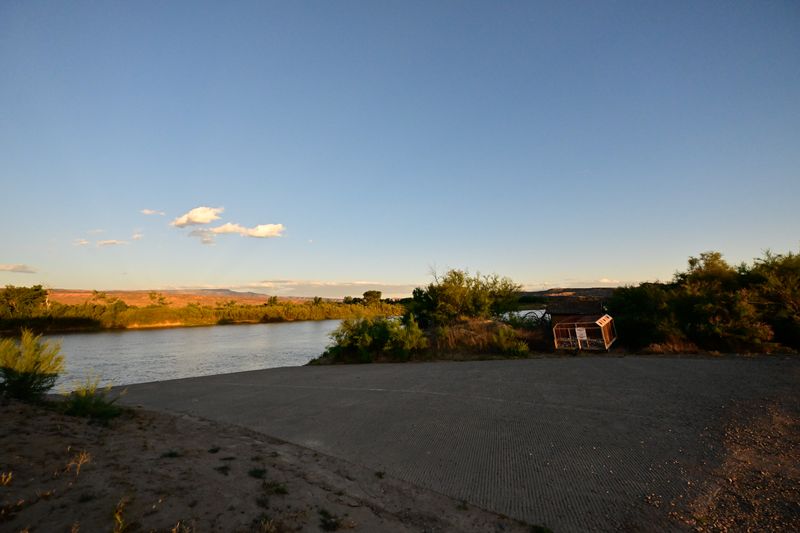
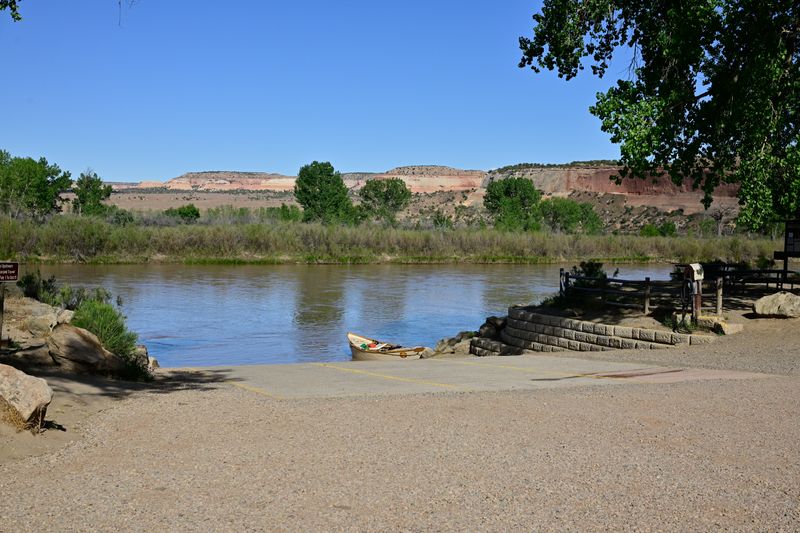
This is the section where the logistics are simple and the river isn't. Twenty-mile paved shuttle along US-128 and I-70. Ranger station put-in with a permit check, good ramp, staging area. Cisco Boat Ramp take-out with parking. No dirt roads, no four-wheel-drive questions, no satellite phone required. You can drive from Grand Junction to the put-in in forty minutes. Everything that's difficult about Westwater happens between mile six and mile twelve, inside the gorge, where the walls are too steep to walk out and the nearest road is the one you drove in on. Plan for six to eight hours on water. Bring the throw bag you've practiced with, not just the one you bought.

Gear

Westwater is a day trip that demands expedition-grade preparation for six miles. Helmets are non-negotiable — the gorge walls are polished granite, not sandstone, and a swim into the Room of Doom means contact with rock that doesn't yield. Throw bags should be accessible and practiced with, not buried in a dry bag. Rescue plan should account for the gorge's geometry: steep walls, limited eddy space, fast current, and limited road access between mile six and twelve. PFDs should be Type V. Drysuits or wetsuits are justified during spring runoff — the water is Elk Range snowmelt, often in the forties. Boat rigging should assume a flip: everything strapped, nothing loose, dry bags secured to the frame. The rest is day-trip standard — water, food, sun protection, repair kit. The difference between Westwater gear and an easy float is the difference between the sandstone miles and the gorge. You pack for the gorge.

Westwater rewards whitewater-grade systems. Helmets are strongly recommended for all craft. The Room of Doom section — even for rafts — creates the kind of powerful, fast hydraulics that justify rescue gear. Day-trip gear is lighter than expedition, but rescue and repair systems matter.

Camp Kitchen

On a seven-day trip, you'll cook roughly 20 meals on a folding table in the sand. The constraint isn't ambition — it's ice management. Days one through three, you have real cooler capacity. Days four and five are the transition zone. Days six and seven are pantry cooking.

The best river cooks plan backward from the last night. If your final dinner is still good — not just edible, but genuinely good — the trip ends on a high.

Dinner Ideas by Trip Day
17.2River miles
11Named rapids
8Established camps
Reading the River

Books that shape the science, history, and stories behind this place.

Westwater Lost and Found

Westwater Lost and Found

Mike Milligan · 2001

A story centered on the legendary Westwater Canyon stretch of the Colorado River, blending river-running culture, history, and storytelling from one of the most iconic whitewater sections in the Southwest.

storytelling cultural context
Boatman's Quarterly Review Anthology

Boatman's Quarterly Review Anthology

Multiple Authors · 2000

A collection of essays and stories from the legendary Boatman's Quarterly Review publication, documenting the culture, lore, and voices of Grand Canyon river guides.

tone storytelling cultural context
Cadillac Desert

Cadillac Desert

Marc Reisner · 1986

A foundational book on Western water development, dams, irrigation politics, and the long struggle over the Colorado River and the arid American West.

knowledge philosophy cultural context
Canyon Country

Canyon Country

Donald L. Baars · 1989

An accessible introduction to the rock layers, canyon formation, and landscapes of the Colorado Plateau and canyon country.

knowledge
Cataract Canyon

Cataract Canyon

Robert H. Webb, Jayne Belnap, John S. Weisheit · 2007

An in-depth environmental and human history of Cataract Canyon and the rivers of Canyonlands, exploring Indigenous presence, exploration, dam impacts, river ecology, and the evolution of modern river running.

knowledge cultural context philosophy
Desert Solitaire

Desert Solitaire

Edward Abbey · 1968

Edward Abbey's classic portrait of canyon country, solitude, and wilderness, influential to the identity and mythology of the Colorado Plateau.

tone philosophy
Down the Great Unknown

Down the Great Unknown

Edward Dolnick · 2002

The dramatic story of John Wesley Powell's first expedition through the Grand Canyon and the birth of river exploration in the American West.

storytelling cultural context knowledge
Fluvial Processes in Geomorphology

Fluvial Processes in Geomorphology

Luna B. Leopold, M. Gordon Wolman, John P. Miller · 1964

A foundational scientific text on river geomorphology, covering sediment transport, channel form, fluvial dynamics, and the physical processes that shape river systems.

knowledge
Geology of Utah's Rivers

Geology of Utah's Rivers

William T. Parry · 2016

A geological exploration of Utah’s major river systems explaining how tectonics, sedimentation, and erosion shaped the canyon landscapes of the Colorado Plateau and surrounding regions.

knowledge
House of Rain

House of Rain

Craig Childs · 2007

Craig Childs traces the routes of the ancient Anasazi across the Colorado Plateau, uncovering evidence of a lost civilization's migrations through canyon country.

storytelling cultural context philosophy
How to Read Water

How to Read Water

Tristan Gooley · 2016

A guide to understanding the subtle clues in water movement—from puddles and rivers to oceans—teaching readers how currents, waves, surface textures, and patterns reveal information about wind, depth, obstacles, and landscape.

knowledge tone
If We Had a Boat

If We Had a Boat

Roy Webb · 1986

A river-running memoir by Roy Webb capturing the spirit, humor, and culture of Western river expeditions and the people who chase moving water through canyon country.

tone storytelling cultural context
Introduction to Physical Hydrology

Introduction to Physical Hydrology

Martin R. Hendriks · 2010

A rigorous, university-level introduction to physical hydrology covering the full water cycle — precipitation, evapotranspiration, infiltration, groundwater, runoff generation, and streamflow — with quantitative methods throughout. The scientific foundation for understanding how rivers work at the watershed scale, from snowpack in the Rockies to baseflow in canyon rivers.

knowledge
River Mechanics

River Mechanics

Pierre Y. Julien · 2002

A rigorous graduate-level treatment of river hydraulics and sediment transport, covering flow resistance, bedforms, channel stability, and the physical mechanics that govern river behavior.

knowledge
River of Contraries

River of Contraries

Don Lago · 2010

A sweeping history of the Colorado River and its complex relationship with Western culture and landscape.

knowledge cultural context philosophy
River Runners' Guide to Utah and Adjacent Areas

River Runners' Guide to Utah and Adjacent Areas

Gary C. Nichols · 2009

A comprehensive guidebook to whitewater rivers in Utah and neighboring regions, covering river access, rapids, flow considerations, trip logistics, and historical context for river runners.

knowledge
Sunk Without a Sound

Sunk Without a Sound

Brad Dimock · 2001

The story of Norman Nevills and the birth of commercial river running in the Colorado River basin.

storytelling cultural context knowledge
The Canyon Country Zephyr Anthology

The Canyon Country Zephyr Anthology

Multiple Authors · 2010

A collection representing the voice, arguments, stories, and culture of canyon country, especially around Moab and the desert Southwest.

cultural context tone philosophy
The Colorado Plateau

The Colorado Plateau

Donald L. Baars · 1983

A key geological reference for understanding the uplift, stratigraphy, tectonics, and erosional history of the Colorado Plateau.

knowledge
The Colorado River in Grand Canyon

The Colorado River in Grand Canyon

Larry Stevens, Tom Martin · 1987

A classic guide to the Colorado River through Grand Canyon with geology, ecology, and river running notes.

knowledge
The Control of Nature

The Control of Nature

John McPhee · 1989

Three deeply reported narratives about humanity's attempts to stop rivers, lava, and debris flows — and what the land does in return. A masterwork of geological journalism that asks whether nature can ever truly be controlled.

tone storytelling philosophy knowledge
The Emerald Mile

The Emerald Mile

Kevin Fedarko · 2013

The thrilling story of the dory daredevils who set a speed record through the Grand Canyon at the height of the legendary flood of 1983 — and of the river that made it possible.

tone storytelling knowledge cultural context
The Exploration of the Colorado River

The Exploration of the Colorado River

John Wesley Powell · 1875

Powell's original account of the first scientific expedition through the Grand Canyon, documenting the geology, natural history, and challenges of navigating the unknown Colorado River.

knowledge storytelling cultural context
The Last River Run

The Last River Run

Todd Balf · 2001

The story of the final free-flowing run of Glen Canyon before Lake Powell filled the canyon, capturing a vanished landscape and the culture it held.

storytelling philosophy cultural context
The Monkey Wrench Gang

The Monkey Wrench Gang

Edward Abbey · 1975

A gang of desert outlaws wage a reckless, irreverent war against the machines carving up the American Southwest.

tone philosophy cultural context
The Secret Knowledge of Water

The Secret Knowledge of Water

Craig Childs · 2000

Craig Childs explores the hidden water sources and desert hydrology of the American Southwest, revealing how water shapes and sustains life in the most arid landscapes on Earth.

tone philosophy knowledge
The Very Hard Way

The Very Hard Way

Brad Dimock · 2007

Brad Dimock's exhaustive biography of Bert Loper — gold prospector, early Colorado River boatman, and one of the great stubborn characters of Western river history — who died in Grand Canyon at 79, alone in his boat in a rapid, on the river he refused to leave. The definitive account of the Colorado River's pioneer running era.

storytelling knowledge cultural context
Field Sources

Evidence behind the claims on this page — agency rules, maps, gauges, books, and field notes.

Permits

Access

Rapids

History

Management

Books

Logistics

  • field-note Desert Maritime — River Packing System Notes — Desert Maritime ·
Ruby–Horsethief Canyon
Upstream Ruby–Horsethief Canyon
Downstream Cisco to Dewey Bridge