North Wash is open, and it has a real ramp for the first time in years.
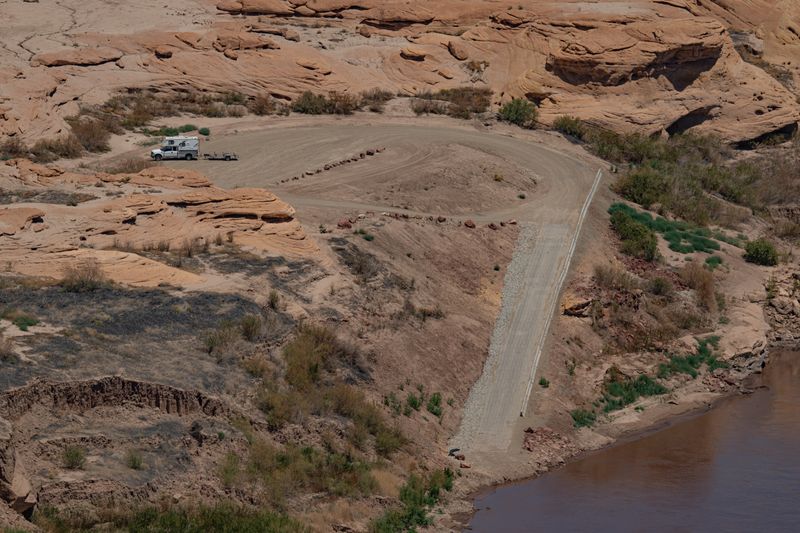
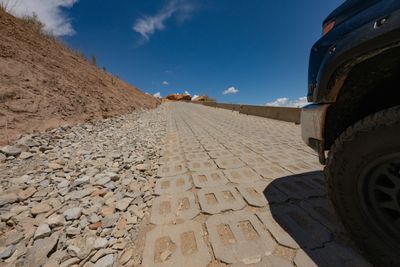
The Utah Division of Outdoor Recreation finished it on June 4, 2026: about sixteen feet wide, surfaced with interlocking concrete blocks, one vehicle and trailer at a time, four-wheel drive and high clearance to get down to the water. Utah is blunt that this is not a typical boat ramp — the surface stops short of the river at current levels, and they advise against backing a trailer in. It is built for taking boats off the river rather than putting them on. We watched it working on July 23, 2026.
For Cataract information — rapids, camps, gauges — see the Cataract Canyon section dashboard. For the trip details Cataract Canyon guide.
What it replaced
For most of the last decade the bottom of a Cataract trip was the part you couldn't plan. Lake Powell dropped, the river began cutting down through the sediment the reservoir had left behind, and the take-out became whatever the bank happened to be that season — mud, a winch, and a hauling system rigged to drag boats up it. The other option was to keep going down-lake to Bullfrog: more flatwater, an extra night, and for most crews a motor.
Sixteen feet of concrete block gave that back. It is a modest piece of infrastructure — a bench with a steep road down to it — and it is the first thing down there that was built rather than improvised.
Why it's temporary
For a generation the bottom of Cataract was flatwater into a full reservoir, and the take-out was Hite.
Then Lake Powell fell. The reservoir gave back the canyon it had drowned, and as it retreated the Colorado began cutting down through decades of trapped sediment — the process the Returning Rapids Project has documented as rapids re-emerge below the Confluence. Good news for the whitewater, and a structural problem for anyone trying to build something permanent at the bottom.
That is why the 2026 structure is explicitly interim: state and federal evaluations found the site unsuitable for a permanent facility. NPS Canyonlands calls it a temporary, high-durability ramp; the state calls it an interim solution while a long-term project is completed. The successor is in planning — the state's press release calls it North Hite — with no published completion date. Plan around the ramp that exists.
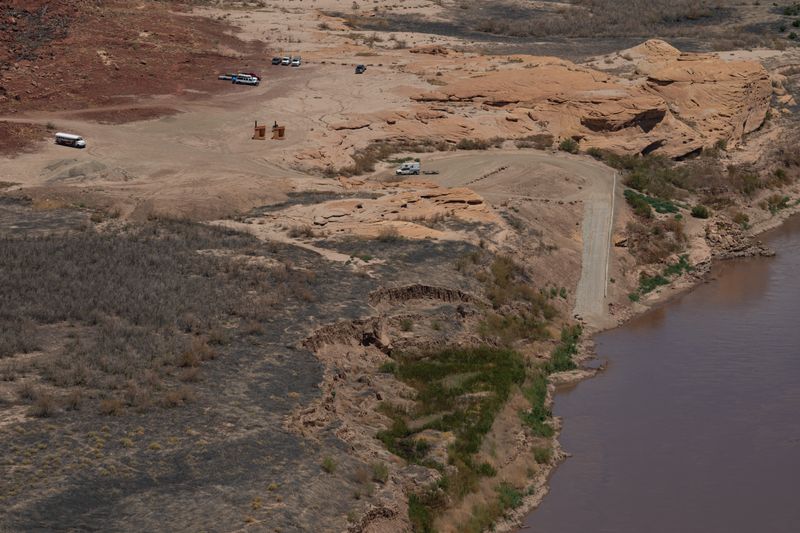
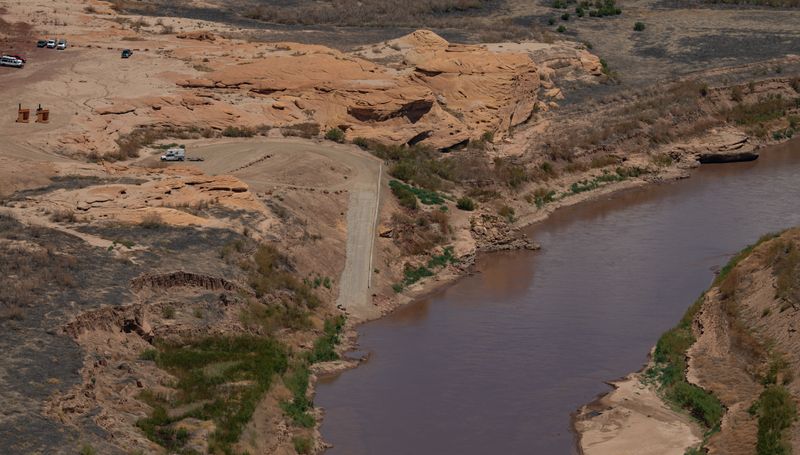
The takeout in pictures
The whole take-out from above. One lane down to the water; everything else is staging.
Where the ramp meets the water, looking upstream toward Narrow canyon.
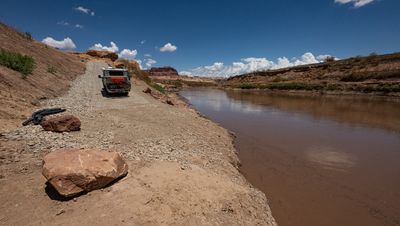
One lane, one party at a time. The turnaround above is where the queue forms.
The articulating concrete block mat — the surface that makes a ramp this steep usable at all.
Your takeout day
The ramp solved the surface. It did not solve the queue, or the grade. Sort these before you put-on.
Before launch:
- A two-wheel-drive shuttle rig. Utah DOR says 4WD is required to safely use the ramp; NPS says strongly recommended. The grade is the reason. If your shuttle driver is asking whether their vehicle will make it, you already have your answer, and the failure mode is a stuck rig blocking the only lane for everyone behind you. The ramp is very steep.
Plan around these:
- One party at a time. The turnaround above the ramp is where the queue forms.
- Stage clear of the lane. Land upstream of the ramp. Derig up top, on the flat, not on the ramp.
- The gap between water and mat. At lower stage there is a step to carry across — not as easy as dropping the trailer in and pulling the boat on.
- No services. Hite is closed. Vault toilets in the upper lot. Hanksville is the closest town.
Before you launch
North Wash sits well above Bullfrog and Halls Crossing — call it forty-odd miles of reservoir. It is an extra night and a different type of trip. Proper planning for it is required.
Decide before launch where you will take-out.